

Deployment guide
Private LLM deployment: which option keeps your data in, at what cost
Private LLM deployment means running a language model, or calling one, inside a boundary your company controls, so prompts, documents and outputs never become a vendor's training data or leave your chosen region. This guide is for IT, ops and compliance leads at US companies who have been told "we can't send that data to ChatGPT" and need a working alternative. It compares the three real options, what each costs to run, and how the model gets connected to the systems your team already uses.
Get a free build plan
Two lines is enough. A specialist replies within one business day.
Spec: quick answer
What is private LLM deployment and which option should a mid-size company choose?
Private LLM deployment runs a language model inside infrastructure you control: a managed model in your own Azure or AWS account, an open-weight model on rented GPUs in your cloud, or hardware on your premises. Most mid-size companies get the privacy they need from the first option, at a fraction of the cost and effort of self-hosting.
- Managed models in your own Azure or AWS tenant cover most privacy requirements without buying GPUs.
- Self-hosting an open-weight model starts at roughly $2,400 a month for one always-on rented H100.
- Check retention settings: on Bedrock some newer models require AWS to keep prompts up to 30 days.
- The model is the easy part; access control, retrieval and logging decide whether it is truly private.
What does private LLM deployment actually mean?
A private LLM deployment is one where you decide where prompts are processed, who can read them, how long they are kept and whether anyone may train on them. It does not have to mean a server rack in your office. In practice there are three tiers of control, and the right one depends on the data, not on how private the project sounds.
The confusion comes from vendors using "private" for very different things. A consumer chatbot account with a privacy toggle is not private in this sense. A model endpoint inside your own cloud subscription, behind your network rules and your identity provider, is. A model whose weights sit on your own GPUs with no outside connection is the strictest version, and also the most expensive to run and maintain.
- Tier 1, managed private: a vendor model (OpenAI models via Microsoft Foundry, Claude, Llama or Mistral via Amazon Bedrock, Gemini via Google Cloud) deployed in your cloud account, with your keys, region and network rules.
- Tier 2, self-hosted in your cloud: an open-weight model such as Llama, Mistral, Qwen or Gemma running on GPU instances you rent, served with vLLM or a similar inference server.
- Tier 3, on-premise or air-gapped: the same open-weight models on hardware you own, with no internet path at all.
Is a managed model in Azure or AWS private enough?
For most US mid-size companies, yes, provided you configure it correctly. Microsoft's Foundry data privacy documentation (updated May 2026) states that prompts, completions, embeddings and training data are not available to OpenAI or other model providers, are not used to improve their models, and that the models are stateless, so nothing is stored in the model itself. Prompts are processed in the geography you choose, unless you pick a Global or DataZone deployment type; a US DataZone deployment may process requests anywhere in the United States.
There is one setting buyers miss. Azure keeps flagged prompts in an abuse monitoring store for possible human review by authorized Microsoft staff. Managed customers can apply to modify abuse monitoring, and once approved the ContentLogging property shows false in the resource's JSON view, which is how you prove to an auditor that storage is off.
Amazon Bedrock works differently, and its retention controls are recent. AWS's documentation says model providers have no access to the Bedrock deployment accounts, logs, prompts or completions. Retention is now set per region with modes: none means nothing is written to durable storage, while some of the newest models only run under an aws_review mode in which AWS keeps prompts and outputs for up to 30 days for human review, without sharing them with the model provider. If your policy requires zero retention, you can enforce none across the organization with a service control policy, and those models will simply show as unavailable. That trade-off belongs in your model choice, not in a surprise during security review.
Both clouds also offer private network paths (AWS PrivateLink and VPC endpoints, Azure private endpoints), customer-managed encryption keys and audit logging through CloudTrail or Azure Monitor. Turned on together, these give you a deployment your security team can inspect line by line.
When should you self-host an open-weight LLM instead?
Self-hosting makes sense when a contract, regulator or customer forbids any third-party processing, when you need the model to run with no internet connection, or when steady high volume makes a fixed GPU bill cheaper than paying per token. It rarely makes sense for a first project.
The cost of self-hosting is not just the GPU. Someone has to patch the inference server, monitor memory and latency, test a new model release before switching, and handle the night the service stops answering. If nobody on your team owns that work today, budget for it explicitly or choose the managed tier.
- Good reasons: air-gapped sites, defense or government contracts, customer contracts that name approved subprocessors, sustained volume around the clock, a need to fine-tune on data that may not leave your network.
- Weak reasons: a general feeling that the cloud is unsafe, wanting to avoid a vendor contract, or assuming open-weight models are free to run.
- Licenses matter: open-weight does not always mean unrestricted. Read each model's license for commercial-use and attribution terms before you build on it.
How much does private LLM deployment cost to run?
Managed private deployments are billed per token, so the cost follows usage and starts near zero. Self-hosted deployments are billed per GPU hour whether anyone uses them or not, so they start with a fixed floor.
To make that floor concrete, Lambda's public price list (checked November 2026) shows an NVIDIA H100 PCIe instance at $3.29 per GPU hour on demand and an eight-GPU HGX H100 node at $3.99 per GPU hour. One always-on H100 PCIe runs about 730 hours a month, which comes to roughly $2,400 a month before storage, networking or anyone's time. The eight-GPU node at the same 730 hours is about $23,300 a month. Hyperscaler GPU instances are generally priced higher than specialist GPU clouds, so check your own provider's rate card.
Model size decides how many GPUs you need. A rough rule: at 16-bit precision each billion parameters needs about 2 GB of GPU memory for the weights alone, so a 70-billion-parameter model needs around 140 GB and will not fit on one 80 GB card. Quantizing to 4-bit cuts that to roughly a quarter, at some cost in quality that you should measure on your own test set. Smaller 7-14 billion parameter models fit comfortably on a single card and handle classification, extraction and routing well.
| Option | How you pay | Fixed monthly floor | Who runs it |
|---|---|---|---|
| Managed model in your Azure or AWS tenant | Per token (input and output) | None beyond minimal hosting | Cloud vendor runs the model; you run config, network and logging |
| Open-weight model on one rented GPU | Per GPU hour | About $2,400 for one H100 PCIe at Lambda's $3.29/hr list price | Your team or implementation partner |
| Open-weight model on an 8-GPU node | Per GPU hour | About $23,300 at Lambda's $3.99/GPU-hr list price | Your team or implementation partner |
| On-premise hardware | Capital purchase plus power, cooling, support | Depreciation plus operations staff | Your IT team |
Which private LLM option fits your situation?
Start from the data and the volume, then pick the cheapest tier that satisfies both. The table below is the shortcut we use when a client asks which way to go.
| Your situation | Recommended option | Why |
|---|---|---|
| Internal documents, contracts, financials; normal business confidentiality | Managed model in your own cloud tenant | No vendor training, your region, your keys, lowest effort |
| Protected health information | Managed model on a tier covered by a signed BAA | HIPAA needs a Business Associate Agreement; major vendors sign BAAs only on certain API or enterprise tiers |
| Policy requires zero retention anywhere | Managed with retention set to none, or self-hosted | Some newer managed models require temporary retention and will be unavailable |
| Customer contract forbids third-party processors | Self-hosted open-weight model in your cloud | Only your own infrastructure touches the data |
| No internet allowed at the site | On-premise or air-gapped open-weight model | The only option that works offline |
| Heavy, steady volume all day on a narrow task | Self-hosted small model, compared against managed cost | A fixed GPU bill can beat per-token pricing at sustained load |
How do you deploy a private LLM step by step?
The order below keeps a private deployment from stalling in security review. Each step produces something a reviewer can check.
Most of the effort goes into steps four and five. A model that answers questions about your SharePoint library has to respect the same permissions the library does, or a junior employee can ask it about the board pack. We build retrieval so each user only gets passages from documents they could already open.
- 1. Classify the data the system will see: public, internal, confidential, regulated. This decides the tier.
- 2. Choose the tier and region, and confirm retention and abuse-monitoring settings in writing.
- 3. Provision inside your account: private endpoint, customer-managed keys, identity through Entra ID or AWS IAM Identity Center.
- 4. Connect the data: retrieval over SharePoint, Google Drive or a database, with permission-aware search and citations.
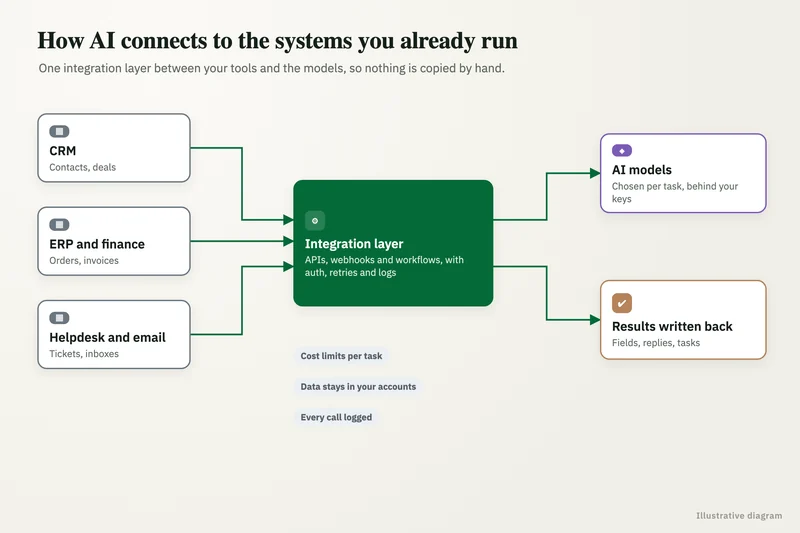
- 5. Connect the workflow: write results into HubSpot, Salesforce, NetSuite or a ticketing tool through their APIs, with validation before anything is saved.
- 6. Add evaluation and logging: a test set of real questions with known answers, prompt and output logs stored in your account, cost caps per task.
- 7. Go live with a human-review queue for low-confidence answers, then widen access once accuracy holds.
What mistakes make a private LLM deployment less private than it looks?
The model endpoint is rarely the leak. The leaks we look for are in the plumbing around it.
- Logging prompts to a third-party observability tool outside your boundary.
- Calling a public API from one workflow step "just for testing" and never removing it.
- Retrieval that ignores document permissions, so the assistant repeats content a user could not open.
- Choosing a Global deployment type for convenience when your policy says US-only processing.
- Workflow tools hosted outside your account passing full documents between steps; self-hosting n8n inside your network avoids this.
- No record of which model version answered which question, which makes audits and rollbacks painful.
When is private LLM deployment not worth it?
If the data is already public or low-sensitivity, such as marketing copy or published product specs, a standard business API account is cheaper and faster. If usage is a few hundred requests a day, self-hosting will cost far more than per-token billing. And if no one will own the system after launch, a self-hosted model will drift out of date and become a liability.
The honest answer for many companies is the managed tier, configured carefully and documented well. We tell clients that before scoping anything heavier.
How we deliver private LLM deployments
We are AI implementation consultants, so our part is the build: the deployment in your cloud account, retrieval over your documents, connections to your CRM, ERP or ticketing system, evaluation sets, logging and the review queue. We scope the work in a free review and quote a fixed price. Everything runs in accounts you own, so the code, prompts, keys, logs and data stay yours, and model bills come to you directly from the vendor. A person stays in the loop on anything that touches money, customers or regulated data.
If you are still weighing whether to build at all, our AI implementation cost guide breaks down build and running costs, and our AI integration services page shows how we connect models to the systems you already run.
FAQ
Frequently asked questions
Is Azure OpenAI private?
Microsoft's documentation states that prompts and completions sent to models sold by Azure are not available to OpenAI, are not used to train models and are processed in the geography you choose unless you pick a Global or DataZone deployment. Flagged content can be stored for abuse review, and managed customers can apply to turn that storage off.
Does Amazon Bedrock use my prompts to train models?
AWS says model providers have no access to Bedrock deployment accounts, logs, prompts or completions. Bedrock now lets you set a data retention mode per region; zero retention is available, but some of the newest models require a mode where AWS keeps prompts for up to 30 days for human review, without sharing them with the provider.
Can I run ChatGPT on my own servers?
Not the ChatGPT product itself. You can run open-weight models such as Llama, Mistral, Qwen or Gemma on your own servers, or deploy OpenAI models inside your own Azure tenant through Microsoft Foundry, which keeps processing in Microsoft's environment under your configuration.
What hardware do I need to self-host an LLM?
Plan on about 2 GB of GPU memory per billion parameters at 16-bit precision, plus headroom. A 7-14 billion parameter model fits on one modern data-center GPU, while a 70 billion parameter model needs about 140 GB at 16-bit, so several GPUs or a quantized version.
How much does it cost to self-host an LLM?
At Lambda's November 2026 list price of $3.29 per hour for an H100 PCIe, one always-on GPU costs about $2,400 a month before storage, networking and staff time. Larger models on an eight-GPU node run into five figures a month.
Is a private LLM HIPAA compliant?
The deployment option alone does not make it compliant. Any vendor that handles protected health information must sign a Business Associate Agreement, and major model vendors sign BAAs only on certain API or enterprise tiers. Access control, logging and retention also have to meet your HIPAA program; this is not legal advice.
How long does a private LLM deployment take?
A managed model in your own cloud account with retrieval over one document source can typically go live in weeks once access is granted. Self-hosted or air-gapped deployments take longer because of hardware, security review and evaluation of the open-weight model on your own test set.
Keep reading
Related pages
Get started
Tell us what you want automated
Describe the task, the systems involved and the volume. We reply within one business day with an architecture, the tools we would use, running costs and a fixed-price build plan.
- Free 30-minute build review
- Fixed quote before any work starts
- You own the accounts, code, prompts and data
Prefer email? info@aiimplementationconsultants.com
Get a free build plan
Two lines is enough to start.