

Inbound calls
An AI receptionist that answers, books and hands callers to the right person
We build an AI receptionist that picks up every inbound call to your business, answers common questions, books appointments into your real calendar and transfers the caller to a person when that is what the call needs. It is for clinics, service firms, agencies and multi-location businesses that miss calls during busy hours or after closing and want a phone line that never goes to voicemail.
Get a free build plan
Two lines is enough. A specialist replies within one business day.
Quick answer
What can an AI receptionist do?
An AI receptionist answers inbound phone calls in a natural voice, handles routine questions such as hours, pricing policy and directions, books or reschedules appointments in your calendar, takes messages, and routes or live-transfers callers to the right staff member. It runs around the clock and logs every call with a transcript and summary.
- Every inbound call is answered, including lunch hours, peaks and nights.
- Bookings go straight into your calendar or scheduling system, not a message pad.
- Callers reach a person through warm transfer whenever the AI is unsure.
- Each call lands in your CRM with a transcript, summary and outcome.
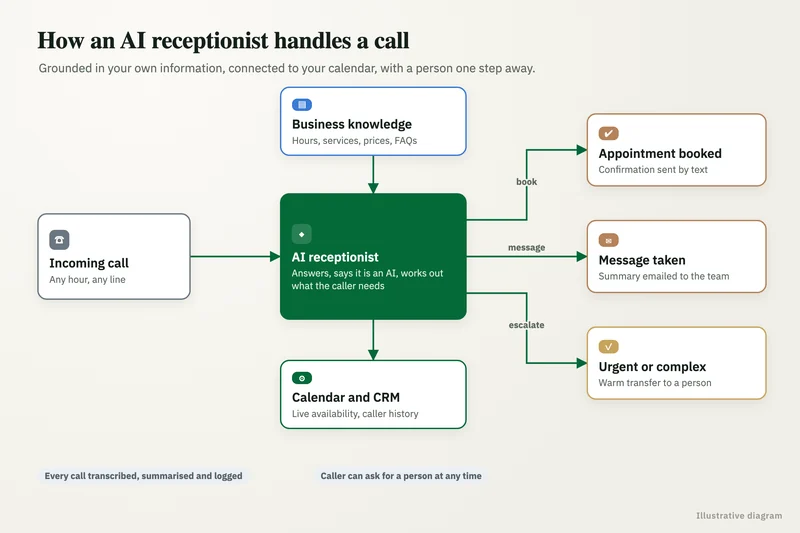
What does an AI receptionist handle on an inbound call?
It handles the calls your front desk takes dozens of times a day: are you open, where are you, do you take my insurance, can I book, can I move my appointment, can I speak to someone. Answers come from a knowledge sheet you approve, so the AI says what your staff would say.
We design the call flow around intents. For each intent we define what the AI may answer, what it must collect (name, phone number, reason for the call, preferred time) and when it should stop and hand over. Anything outside the list, an upset caller or a request the AI is unsure about goes to a person or a callback queue, never to a guess.
- Greeting with your business name and an AI disclosure where required.
- FAQs answered from an approved knowledge sheet.
- New bookings, reschedules and cancellations.
- Message taking with structured fields instead of free-text voicemail.
- Routing by department, location or caller type.
How does an AI receptionist book appointments?
It checks live availability through your calendar or booking system's API, offers open slots and writes the confirmed appointment back while the caller is still on the line. We connect to Google Calendar, Microsoft 365 calendars or the scheduling tool you already use, provided it exposes an API.
Booking rules come from your team: appointment types and lengths, buffer time, which staff can take which services, and how far ahead people can book. The caller gets a text confirmation from your Twilio number, and the booking appears in the CRM with the call summary attached, so nobody retypes it.
What you get
What we deliver
Scoped and quoted at a fixed price after a free review.
Call flow design
Intents, scripts, collected fields and handover rules for every type of inbound call.
Knowledge sheet
An approved source of answers on hours, services, policies and locations that staff can edit.
Calendar integration
Live availability checks and bookings written to your calendar or scheduling system.
Transfer and routing
Warm transfer to staff by department, hours and caller type, with callback fallback.
CRM logging
Transcript, summary and outcome for every call saved to HubSpot, Salesforce or your ticketing tool.
Compliance setup
Recording and AI disclosures in the greeting, plus a vendor stack with BAAs where needed.
How do call routing and live transfer to staff work?
The AI decides where a call should go, then either transfers it live or books a callback. A warm transfer passes a short spoken or on-screen summary to the staff member so the caller does not repeat themselves.
Routing rules follow your business hours and team structure. Billing questions can go to the office manager, urgent service calls to the on-call technician's mobile, and existing clients to their account manager. If nobody picks up, the AI returns to the caller, takes a structured message and creates a callback task in HubSpot, Salesforce or your ticketing tool. You can also give callers a phrase such as asking for a person, which triggers a transfer immediately.
Multi-location businesses get one more layer. The AI asks which branch the caller wants, or reads it from the number they dialed, then applies that location's hours, staff list and booking calendar. A weekly report shows calls answered, bookings made, transfers attempted and transfers missed per location, so you can see where staff coverage, not the AI, is the bottleneck.
Can an AI answering service cover after-hours calls?
Yes, and after-hours is often the simplest place to start. An AI answering service answers nights, weekends and holidays with the same knowledge as daytime, books into the next open slot and saves genuine emergencies for the on-call person.
We set an after-hours mode with its own rules: which requests can be booked, which go to an urgent line, and which get a promised callback time. Each morning your team gets a list of overnight calls with summaries and outcomes, instead of a voicemail inbox to work through.
Is an AI receptionist HIPAA compliant, and what about call recording?
It can be, if every vendor in the chain that touches protected health information signs a Business Associate Agreement. Major model vendors sign BAAs only on certain API or enterprise tiers, not consumer plans, and voice platforms differ: some sell HIPAA coverage as a paid add-on, while Bland AI includes a BAA on its Enterprise plan. We choose the stack so the BAA chain is complete before any patient call is taken.
Recording has its own rules. States with two-party consent requirements for call recording also apply to AI receptionists that record calls, so the greeting tells callers the call is recorded. Some states also require disclosure that the caller is speaking with an AI, under laws such as Utah's AI Policy Act and California's bot disclosure law. We build these disclosures into the script by default. This is not legal advice; your counsel should confirm the rules for your states and sector.
Which platforms do you build an AI phone answering service on?
We build on voice agent platforms such as Vapi, Retell AI, ElevenLabs Agents and Bland AI, with Twilio numbers and your choice of model behind the conversation. Platform choice depends on voice quality, latency, BAA availability, transfer features and per-minute cost at your call volume.
Your existing numbers can usually stay the same: we forward them, or port them to a Twilio account in your name. For the per-minute rates the main platforms publish and how they compare with packaged answering services, see our AI receptionist cost guide.
Case study · Logistics company, UK
Route planning automation
Dispatch typed every address into Google Maps, which optimizes only 25 stops and cannot add time at each stop. A Python tool that loads addresses automatically, adds buffer time per stop and optimizes the full route.
- Manual address entry eliminated
- Delivery estimates customers could rely on
How it works
How an engagement runs
- 01
Free review
We listen to sample calls and list the questions and requests your line handles.
- 02
Call flow and scope
We write the intents, handover rules and integrations, with a fixed price.
- 03
Build and test calls
We run scripted test calls covering normal, awkward and out-of-scope requests.
- 04
Soft launch
The AI takes overflow or after-hours calls first while staff review transcripts.
- 05
Full coverage
Once handover and booking rates look right, the AI answers all inbound calls.
FAQ
Frequently asked questions
How much does an AI receptionist cost per minute?
Voice platforms charge by the minute, and packaged services charge a monthly fee. Rates vary by platform, model and telephony, so we keep the published numbers in one place: our AI receptionist cost guide. Our own build is a fixed price quoted after a free review.
Do callers know they are talking to AI?
Modern AI voices can sound very natural, so we disclose it in the greeting. Some states require that disclosure, and it also sets expectations so callers ask for a person when they need one.
Can an AI receptionist transfer calls to a real person?
Yes. It can warm-transfer to a staff phone or mobile with a short summary, or take a structured message and create a callback task if nobody answers. Callers can also ask for a person at any point.
Can we keep our existing phone number?
Usually, yes. We either forward your current number to the AI line or port it to a Twilio account you own. Callers keep dialing the same number.
Is an AI receptionist HIPAA compliant?
Only when every vendor that handles protected health information has signed a BAA, which many offer only on higher tiers. We assemble a stack with a complete BAA chain for healthcare clients. This is not legal advice.
What is the difference between an AI receptionist and an AI voice agent?
An AI receptionist answers inbound calls: questions, bookings, routing and transfers. An AI voice agent usually places outbound or operational calls such as appointment confirmations, follow-ups and reminders, which bring extra consent rules under the TCPA.
Keep reading
Related pages
Get started
Tell us what you want automated
Describe the task, the systems involved and the volume. We reply within one business day with an architecture, the tools we would use, running costs and a fixed-price build plan.
- Free 30-minute build review
- Fixed quote before any work starts
- You own the accounts, code, prompts and data
Prefer email? info@aiimplementationconsultants.com
Get a free build plan
Two lines is enough to start.