

Sales agent
An AI sales agent that does SDR work and hands deals to your reps
We build an AI sales agent that researches accounts, writes personalized outreach, follows up on schedule, reads replies, books meetings and keeps your CRM current, then we run and tune it with you every month. It is for US sales leaders who want SDR-style capacity without adding headcount, and who want a person stepping in wherever judgment, pricing or a live conversation is needed.
Get a free build plan
Two lines is enough. A specialist replies within one business day.
Quick answer
What does an AI sales agent do?
An AI sales agent does the repetitive work of a sales development rep: researching accounts, drafting personalized outreach, sending follow-ups, sorting replies, booking meetings and updating the CRM. It works within rules you set, logs every action, and hands any conversation needing judgment, pricing or negotiation to a human rep with full context attached.
- The agent researches, drafts, follows up, triages replies and books meetings under your rules.
- Every action is written to HubSpot or Salesforce, so reps see one complete history.
- Pricing questions, objections and anything sensitive go to a human rep, not the model.
- AI voice is used only for inbound calls and callbacks people asked for, never cold calls.
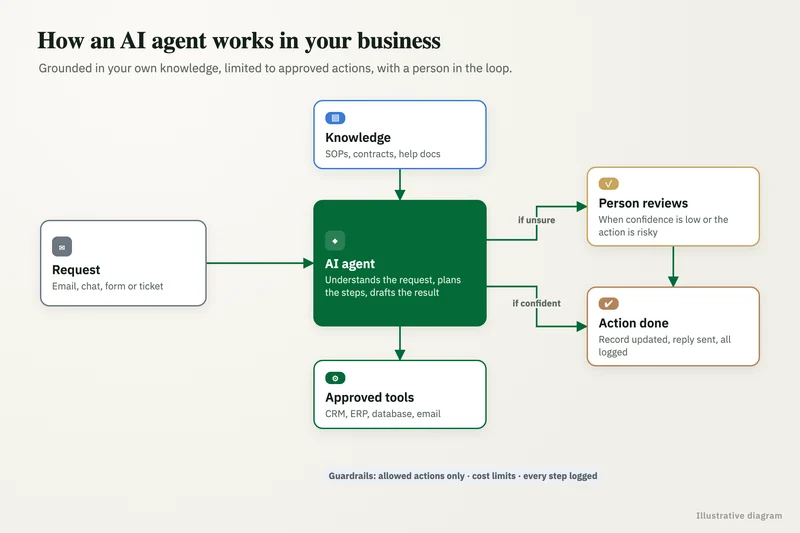
What can an AI sales agent handle, and what stays with your reps?
It handles the volume steps of prospecting and leaves the decisions to people. The agent can research a company and contact, draft an opener tied to something specific, send follow-ups on a schedule, classify replies, offer meeting times and log all of it. Reps take over once a prospect is interested, asks about price, raises an objection or needs a real conversation.
Salesforce's State of Sales 2026 report, which surveyed 4,050 sales professionals, found sellers spend only 40% of their week actually selling. Moving research, drafting and logging to an agent is how that share can grow without burning out the team.
- Account and contact research summarized into a short brief.
- Personalized first emails and follow-ups within approved templates.
- Reply classification: interested, objection, referral, not now, unsubscribe.
- Meeting booking through your scheduling link or calendar availability.
- CRM updates: activities, stages, next steps and notes.
How is the agent built and connected to your CRM?
The agent is a set of tools a language model can call, with permissions limited to what each step needs. It reads account data from HubSpot or Salesforce, pulls enrichment from Clay or Apollo, drafts through OpenAI, Claude or Gemini, sends from your sending tool and writes results back as activities and field updates.
Orchestration usually runs in n8n or in code with LangGraph, depending on complexity. Each run has a cost cap, a step limit and full prompt and output logging. If the CRM write fails or the model returns something outside the allowed format, the task moves to a human review queue rather than retrying blindly.
Access is granted through dedicated API users or connected apps with the narrowest scopes that work, never a shared rep login. The agent cannot delete records, change deal amounts or edit closed opportunities, and a daily send ceiling per inbox stops a faulty run from flooding prospects before anyone notices.
What you get
What we deliver
Scoped and quoted at a fixed price after a free review.
Sales playbook for the agent
Segments, approved claims, tone, handoff triggers and forbidden topics written as rules the agent follows.
Research and drafting tools
Account research with cited sources and drafting that only uses facts found in that research.
Follow-up and reply handling
Scheduled follow-ups and reply classification with confidence thresholds and a review queue.
Booking and CRM updates
Meeting booking plus activities, stages and notes written to HubSpot or Salesforce.
Human handoff
CRM tasks and Slack or Teams alerts that pass live conversations to reps with full context.
Logs, evals and reporting
Prompt and output logs, a test set for every change and a monthly results report.
How does the agent personalize outreach without inventing facts?
It may only use facts it retrieved and cited. The research step stores the source page for each claim, such as a press release or a careers page, and the drafting step must reference one of those sources or fall back to a segment-level message. A checker flags drafts that mention anything absent from the brief.
In the first weeks a person approves every message before it sends. Once the approval rate is consistently high for a segment, we move that segment to sampled review, where our team checks a share of each batch, and we keep full review for new segments and new offers.
How does the agent hand conversations to a human?
By rules written in advance, not by the model deciding it is confident. Any reply mentioning price, contract terms, a competitor, a complaint or legal language goes straight to the assigned rep. So does any reply the classifier scores below its confidence threshold.
The handoff arrives as a CRM task and a Slack or Teams alert with the thread, the account brief and a suggested next step. The agent pauses its own sequence for that contact the moment a handoff happens, so the prospect never gets an automated follow-up in the middle of a live conversation.
Can an AI sales agent make phone calls?
Only where consent clearly exists. The FCC ruled on February 8, 2024 that AI-generated voices are artificial voices under the TCPA, so calls using them to cell phones or residential lines need prior express consent, and telemarketing calls need prior express written consent. Cold AI-voice calling to consumers is therefore off the table.
We use voice for inbound calls from prospects, instant callbacks to people who filled in a form asking to be contacted, and meeting reminders, with consent status checked on the contact record before any dial. This is not legal advice; confirm your calling program with counsel. Our AI voice agents page covers phone builds in detail.
How do you run and measure the agent month to month?
We operate it with you on a monthly cycle. Each month we review a sample of drafts and replies, update the instructions and test cases, retire weak segments and add new ones. Changes are tested against a saved set of past prospects and replies before they go live, and can be rolled back in minutes.
Reporting covers messages sent, reply rate, positive reply rate, meetings booked and held, handoff speed, cost per meeting in model and data fees, and the share of drafts edited by a person. Build and operation are quoted at a fixed price after a free review, and the agent, prompts, logs and accounts belong to you.
How it works
How an engagement runs
- 01
Free review
We map your sales process, CRM fields, current SDR tasks and where time is lost.
- 02
Fixed quote and playbook
We agree segments, rules, handoff triggers and measures, then quote a fixed price.
- 03
Build and test
We build the agent in a test pipeline and check it against past prospects and replies.
- 04
Supervised launch
The agent goes live on one segment with every message approved by a person.
- 05
Monthly operation
We tune instructions, widen segments and report results each month.
FAQ
Frequently asked questions
Can an AI sales agent replace an SDR?
It can take over much of an SDR's research, drafting, follow-up and logging. Judgment calls, live conversations and relationship building still need a person, so most teams use the agent to give reps more selling time.
What is the difference between an AI SDR and an AI sales agent?
The terms are used almost interchangeably. Products such as 11x's Alice and Artisan's Ava are sold as AI SDRs. We build a comparable agent inside your own CRM and accounts, under rules your team sets.
Will prospects know they are talking to AI?
Emails go out under your rep's name after review, and any reply needing a real conversation goes to that rep. On voice and chat channels the agent identifies itself as an AI assistant, which some states require.
Which CRMs does the agent work with?
HubSpot and Salesforce most often, and other CRMs with a usable API. The agent reads and writes only the objects and fields it needs for its tasks.
How do sales teams use AI agents today?
Salesforce's State of Sales 2026 found that 54% of sellers have used AI agents. Common uses are prospect research, email drafting, follow-up and CRM updates.
Who owns the agent if we stop working together?
You do. The workflows, prompts, test sets, logs and tool accounts are set up in your name, and we hand over documentation so your team or another partner can run it.
Keep reading
Related pages
Get started
Tell us what you want automated
Describe the task, the systems involved and the volume. We reply within one business day with an architecture, the tools we would use, running costs and a fixed-price build plan.
- Free 30-minute build review
- Fixed quote before any work starts
- You own the accounts, code, prompts and data
Prefer email? info@aiimplementationconsultants.com
Get a free build plan
Two lines is enough to start.