

Cost guide
Cost of implementing AI in healthcare: build, HIPAA and monthly bill
The cost of implementing AI in healthcare depends far more on what the system touches than on the model behind it: a front-desk voice agent, a referral and intake pipeline and a diagnostic model are three very different budgets. This guide is for practice owners, operations leaders and IT leads at US clinics, therapy groups and specialty practices who want a realistic number before they talk to vendors. It separates the one-time build, the HIPAA layer most guides skip, and the monthly bill, using published vendor prices we checked in October 2026.
Get a free build plan
Two lines is enough. A specialist replies within one business day.
Quick answer
How much does it cost to implement AI in healthcare?
The cost of implementing AI in healthcare ranges from a monthly subscription for an off-the-shelf tool to six figures for a custom build. Cleveroad's 2026 guide puts chatbots at $10,000-$50,000 and clinical documentation or workflow automation at $50,000-$300,000+. On top of the build, budget for HIPAA-eligible vendor tiers and usage-based running costs.
- Administrative AI (calls, intake, documents) costs far less than clinical or diagnostic AI.
- HIPAA-eligible vendor tiers can cost more each month than the AI usage itself.
- EHR integration and a human-review queue drive the build price more than the model.
- Buy packaged tools for commodity tasks; build only where your workflow is unusual.
What drives the cost of implementing AI in healthcare?
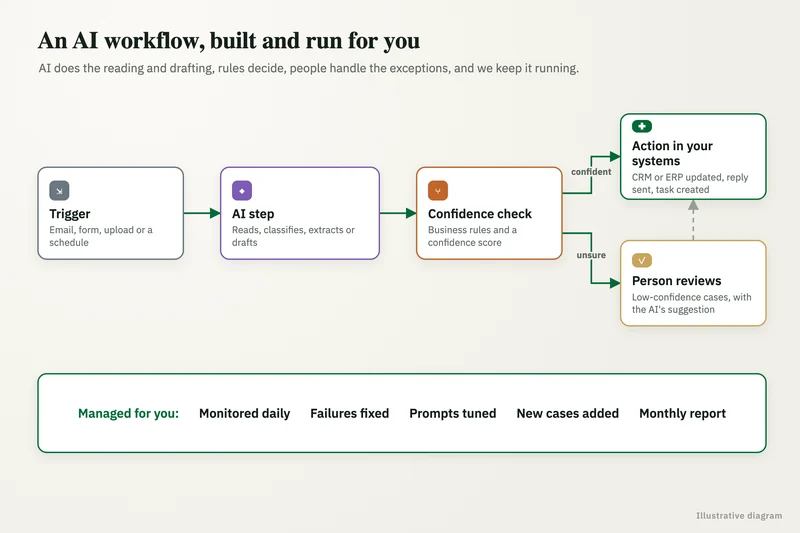
Four things set the price: whether the AI makes clinical judgments or administrative ones, how many systems it must read from and write to, whether it handles protected health information (PHI), and how much a person must check before anything is final. The model call itself is rarely the expensive part.
Most published cost figures for healthcare AI come from teams that build custom clinical models, such as diagnostic imaging, readmission prediction or treatment decision support. Those projects need labeled medical data, clinical validation and sometimes FDA review, which is why their ranges reach into the millions. A practice that wants its phones answered after hours, its referral faxes read into the EHR and its prior authorization packets assembled is buying something else entirely, built from existing models, integrations and review screens.
So before you compare any quote with a number you read online, sort your project into one of the groups below. They differ by an order of magnitude in cost and in risk.
- Administrative, patient-facing: AI receptionist, appointment booking, reminders, FAQ chat on the website.
- Administrative, back office: intake form and referral processing, insurance card and eligibility capture, prior authorization packet assembly, claim and denial triage.
- Clinical support: ambient documentation (AI scribes), chart summarization for the clinician to review.
- Clinical decision: diagnosis, risk scoring or treatment recommendations, which may count as a regulated medical device.
What do published sources say healthcare AI costs?
The ranges below come from the pages that rank for this topic and from vendor pricing pages, each named. They are market references, not our prices, and most of the build figures describe custom software firms' own project scopes.
Two warnings when reading them. First, the large ranges mostly describe clinical or hospital-wide projects; a single administrative workflow at a practice usually sits near the low end or below it. Second, ITRex's guide budgets $10,000-$150,000 for 'HIPAA certifications', but the US Department of Health and Human Services states in its HIPAA FAQ that it does not endorse or recognize private organizations' certifications and that no Security Rule standard requires one. Pay for a risk analysis, signed BAAs and proper configuration, not a certificate.
| Source | What it prices | Published figure |
|---|---|---|
| Cleveroad (2026 guide) | Healthcare chatbot or LLM fine-tuning | $10,000-$50,000 |
| Cleveroad (2026 guide) | Clinical documentation or workflow automation | $50,000-$300,000+ |
| Cleveroad (2026 guide) | Hospital-wide AI integration | $1,000,000+ |
| Cleveroad (2026 guide) | Moderate EHR or billing integration | $20,000-$50,000+ |
| ITRex (guide) | Basic AI functionality added to an existing healthcare app | About $40,000 |
| ITRex (guide) | EHR/EMR integration engineering | $7,800-$10,400 |
| Softude (Jan 2025 guide) | Custom-built healthcare AI solution | $100,000 or more |
| Freed pricing page (Oct 2026) | AI medical scribe subscription | Plans listed from $39 to $119 per month |
| Vapi pricing page (Oct 2026) | HIPAA add-on for voice agents (includes BAA) | $2,000 per month |
| Retell AI pricing page (Oct 2026) | Voice agent usage | $0.07-$0.31 per minute; HIPAA and BAA on Enterprise plan only |
How much does the HIPAA layer add to healthcare AI cost?
Any vendor that stores or processes PHI on your behalf needs a signed Business Associate Agreement, and most AI vendors only sign one on a paid business or enterprise tier. That requirement narrows your tool choice and often adds a fixed monthly fee before a single patient call is handled.
The vendor pages show how this plays out. Vapi sells HIPAA compliance as a $2,000 per month add-on that includes a BAA. Retell AI lists HIPAA and BAA support only under its Enterprise plan, priced through sales. Anthropic's commercial BAA covers its first-party Messages API and Claude Enterprise chat, but its own help page lists exclusions such as the Batch API, Files API and third-party connectors, so the architecture has to stay inside the covered features. Consumer and small-team chat plans from the major model vendors are not covered, which is why staff pasting patient notes into a personal ChatGPT or Claude account is a compliance problem, not a cost saving.
In practice, the HIPAA layer costs you in three places: higher vendor tiers, engineering time to keep PHI out of logs and tools that are not covered, and your own risk analysis and policies. Ask every vendor which of its components are covered by its BAA, in writing, before you price anything else.
- Model provider: BAA-eligible API or enterprise tier, with the covered endpoints listed.
- Voice or chat platform: BAA tier and any fixed monthly add-on.
- Telephony, transcription and storage: each one is a separate subprocessor that must be covered.
- Logging: prompts and outputs that contain PHI must be stored in a covered system with access controls and retention rules.
- Workflow tool: a self-hosted n8n server inside your own cloud account keeps PHI off a shared automation platform.
Worked example: what does an AI receptionist cost a practice each month?
Take a multi-provider outpatient practice that wants an AI receptionist to answer overflow and after-hours calls, book into the scheduling system and transfer anything clinical to staff. Assume 3,000 call minutes a month, built on Vapi because its prices are published.
Vapi's pricing page lists $0.05 per minute for its platform, plus transcription at about $0.0095 per minute, the language model at roughly $0.0077-$0.0452 per minute and voice at about $0.0146-$0.0238 per minute, depending on the providers chosen. That adds up to roughly $0.08-$0.13 per minute before telephony, or about $250-$390 for 3,000 minutes. Add the $2,000 per month HIPAA add-on and the bill is roughly $2,250-$2,400 a month before phone numbers and carrier charges.
The lesson is that at practice-level call volumes, the compliance tier, not usage, is the biggest line. That changes the decision: a single small office may be better served by a packaged medical answering product that already includes a BAA, while a group with several locations can spread the fixed HIPAA fee across many more minutes. Our AI receptionist cost guide walks through the non-healthcare version of this math.
Should a practice buy healthcare AI or build it?
Buy when the task is the same at every practice; build when the task depends on your systems, payers or rules. Ambient documentation is a good example of a buy: AI scribe products are priced per clinician per month and are already wired to common EHRs, so a custom build rarely makes sense.
Building pays off where packaged tools stop at a generic boundary. Referral intake that has to read faxed PDFs, match the patient, check the referring provider and create the right order in your EHR. Prior authorization packets that pull chart notes, prior treatments and payer-specific forms into one file for a person to submit. Phone flows that must follow your scheduling rules by provider, location and visit type. These are the places where a configured product leaves staff finishing every case by hand.
| Workflow | Usually buy or build | Main cost driver |
|---|---|---|
| Ambient clinical documentation | Buy | Per-clinician subscription |
| After-hours call answering, simple booking | Buy for one site, build for multi-site rules | HIPAA tier plus per-minute usage |
| Referral and intake document processing | Build | EHR integration and review queue |
| Prior authorization packet assembly | Build | Payer rules and chart data access |
| Patient FAQ chat on the website | Buy or light build | Keeping PHI out unless the tool has a BAA |
| Diagnostic or risk-scoring models | Specialist vendor | Clinical validation and regulatory review |
What does healthcare AI cost to run after launch?
Running costs are mostly usage-based, so they track patient volume. Budget for each of the items below as its own line, billed to your own accounts so you can see every charge.
Text workflows such as document extraction are cheap per page but add up across thousands of referrals, so we log model tokens per document during testing and set a cost cap per task. Upkeep is the line buyers forget: payers change forms, the EHR vendor changes an API, and model vendors retire older models, so prompts and test sets need periodic updates.
- Model usage on a BAA-covered tier, billed per token.
- Voice minutes, transcription and telephony for any phone agent.
- Hosting for workflow servers, databases and the review screen.
- Fixed compliance fees from vendors that charge for BAA tiers.
- Maintenance: prompt and rule changes, new form types, EHR API changes, rerunning the test set.
What hidden costs push healthcare AI projects over budget?
Most overruns come from work that was never scoped rather than from the AI. These are the ones we ask about in every healthcare review.
- EHR access: some EHRs require a vendor marketplace listing, paid API access or an interface engine before anyone can write data back.
- Messy inputs: faxed referrals, phone photos of insurance cards and handwritten forms need more testing than typed PDFs.
- Staff time: front-desk and billing staff must label test cases and review exceptions during rollout.
- Disclosure and consent: telling callers they are speaking with an AI, and following call-recording consent rules in two-party consent states.
- Outbound calls: the FCC ruled on February 8, 2024 that AI-generated voices count as artificial voices under the TCPA, so automated reminder or recall calls need prior express consent. This is not legal advice; check with counsel.
- Scope creep: adding a second location, payer or visit type halfway through the build.
How do you keep the cost of implementing AI in healthcare down?
Start with one administrative workflow that has a clear baseline, keep a person in the loop, and measure before you expand. The American Medical Association's 2026 physician survey (released March 12, 2026) found that 81% of physicians now use AI, up from 38% in 2023, mostly for research summaries and documentation. The tools are familiar; the expensive mistakes come from scaling a build before it has proved itself on real patient volume.
A therapy services provider we worked with is a useful pattern. Instead of a large AI program, we built a guided AppSheet clinician portal with validation, auto-calculated session durations, approvals and sync to billing. Daily data entry fell from 10-15 minutes per clinician to under 3, and errors were stopped at the point of entry. Details are on our case studies page. A narrow tool that fixes one daily task can pay back faster than a broad platform.
- Pick the workflow with the most hours and the clearest rules: intake, referrals or overflow calls.
- Measure today's baseline for two weeks: minutes per task, volume, error and rework rate.
- Use confidence thresholds so uncertain results go to a human-review queue instead of the EHR.
- Keep accounts, code, prompts and data in your name so you can switch vendors later.
- Set per-task cost caps and a monthly usage report from the first day.
When should a healthcare organization not implement AI yet?
Hold off if you cannot name the workflow, the person who owns it and the number you want to move. Also wait if your EHR offers no workable way to read or write the data you need, if no vendor in your stack will sign a BAA for the components that would touch PHI, or if the task is a clinical decision you are not prepared to validate and monitor.
In those cases, the cheaper first step is to fix the process, collect clean data for a few weeks, or use a packaged tool with a BAA while you learn what volume and accuracy you actually need. When you are ready to build, we scope the work in a free review and quote a fixed price, with a person staying in the loop on anything that touches patients, money or PHI.
Case study · Therapy services provider
Clinician portal on AppSheet
Clinicians logged sessions in shared spreadsheets, so billing fixed formats, durations and missing authorizations before every cycle. A guided portal with validation, auto-calculated durations, approvals and automatic sync to billing.
- Data entry down from 10-15 minutes a day to under 3
- Errors stopped at the source

FAQ
Frequently asked questions
How much does AI cost for a small medical practice?
A small practice can start with packaged tools billed monthly, such as an AI scribe priced per clinician or an answering service with a BAA. Custom builds are usually priced per workflow; Cleveroad's 2026 guide puts healthcare chatbots at $10,000-$50,000. The HIPAA tier of each vendor often matters as much as the build price.
Is there a HIPAA certification for AI tools?
No. The US Department of Health and Human Services says it does not recognize private HIPAA certifications, and no Security Rule standard requires one. What you need is a signed BAA with each vendor that handles PHI, a risk analysis and the right configuration and access controls.
Can we use ChatGPT or Claude with patient data?
Only on tiers where the vendor signs a Business Associate Agreement, and only with the features that agreement covers. Anthropic, for example, covers its first-party Messages API and Claude Enterprise chat but excludes items such as the Batch and Files APIs. Consumer and small-team plans are not covered.
What does an AI receptionist for a medical office cost per month?
On Vapi's published prices, usage runs roughly $0.08-$0.13 per minute before telephony, and its HIPAA add-on is $2,000 per month. At 3,000 minutes that totals about $2,250-$2,400 a month. Packaged medical answering products with a BAA can cost less for a single small office.
How long does it take to implement AI in a healthcare practice?
A packaged tool can be live in days once the BAA is signed. A custom administrative workflow with EHR integration and a review queue takes longer, mostly because of EHR access approvals and testing on real documents. Clinical models that need validation take the longest.
What is the biggest hidden cost in healthcare AI?
Integration with the EHR and practice management system is usually the largest and least predictable line. Read access, write-back permissions, marketplace or interface engine fees and testing against messy real inputs often cost more than the model and prompts combined.
Does AI in healthcare pay for itself?
It can, when it removes measurable staff time or errors from a high-volume task such as intake, referrals or phone overflow. Measure the current minutes per task and error rate before buying, then compare the monthly saving with the build price plus the running bill.
Keep reading
Related pages
Get started
Tell us what you want automated
Describe the task, the systems involved and the volume. We reply within one business day with an architecture, the tools we would use, running costs and a fixed-price build plan.
- Free 30-minute build review
- Fixed quote before any work starts
- You own the accounts, code, prompts and data
Prefer email? info@aiimplementationconsultants.com
Get a free build plan
Two lines is enough to start.