

Cost guide
Intelligent document processing pricing: per-page fees, build costs and review labor
Intelligent document processing pricing has three layers: an extraction fee per page or per document, a one-time build that connects extraction to your ERP or CRM, and the staff time spent reviewing the documents the system is unsure about. This guide is for finance, operations and IT leads who know which invoices, purchase orders or forms they want off their team's desks and need a budget they can defend. It sets official cloud rates, published tool prices and build costs side by side, then runs the numbers on a real-sized workload.
Get a free build plan
Two lines is enough. A specialist replies within one business day.
Quick answer
How much does intelligent document processing cost?
Intelligent document processing pricing starts at about $1.50 per 1,000 pages for plain OCR on Azure or AWS, $10 per 1,000 pages for prebuilt invoice and receipt models, and $30 per 1,000 for custom extraction on Azure. Packaged IDP tools charge more per page. A connected pipeline adds a one-time build, and human review often costs more than extraction.
- Extraction fees are usually the smallest line; review labor and integration cost more.
- Azure and AWS publish per-page rates, so cloud API costs are easy to forecast.
- Language-model extraction can cost cents per 1,000 pages but needs validation built around it.
- Compare options on cost per correctly posted document, not on headline price per page.
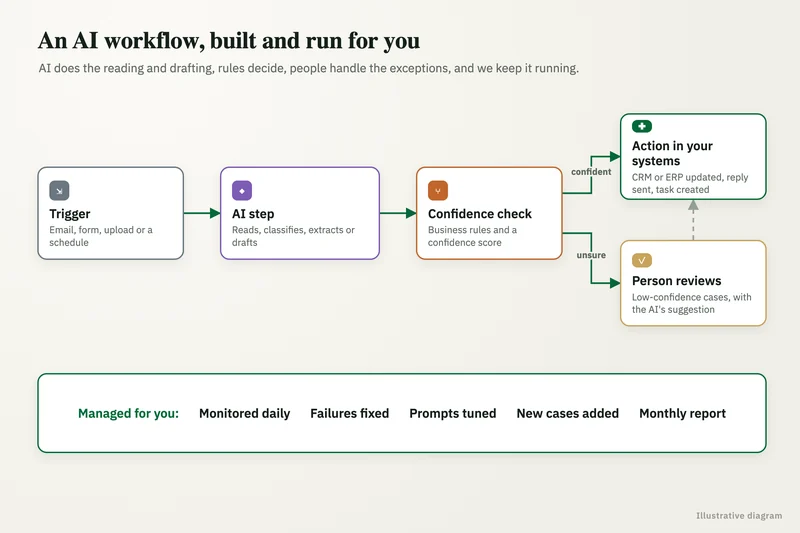
How much does intelligent document processing cost?
For most US mid-size companies, the monthly extraction bill is small and the real money sits in the build and in review time. A pipeline that handles a few thousand invoices a month can run on less than $100 of cloud extraction fees, while the engineering to connect it to NetSuite or QuickBooks and the staff minutes spent on flagged documents are what decide whether it pays back.
That is why AI document processing cost should be budgeted as three separate lines. When a quote or a pricing page shows only one of them, ask where the other two have gone.
- Extraction: the per-page, per-document or per-token charge for reading the file and returning fields.
- Build and integration: intake from inboxes or folders, classification, validation rules, a review screen and API connections to the target system.
- Operations: human review of low-confidence documents, monitoring, storage and upkeep when vendors, layouts or fields change.
What do Azure Document Intelligence and AWS Textract charge per page?
The two largest cloud document APIs publish per-page rates, and at the basic OCR level they match. The figures below come from Microsoft's Azure retail price list for the East US region and the Amazon Textract pricing page, both read in October 2026. They are pay-as-you-go list prices before any free tier or commitment discount.
Two details change the bill more than the headline rate. First, the unit is a page, so a 12-page contract costs twelve times a one-page receipt. Second, extraction type matters: plain text costs a fraction of a cent per page, while forms, custom fields and lending packets cost several cents. Azure also sells monthly commitment tiers; its price list shows 20,000 prebuilt pages for $190 a month, with overage at $9.50 per 1,000 pages.
| Service and model | Published price | Notes |
|---|---|---|
| Azure Document Intelligence, Read (OCR) | $1.50 per 1,000 pages | $0.60 per 1,000 at higher volume; free tier of 500 pages a month |
| Azure Document Intelligence, prebuilt (invoice, receipt, layout) | $10 per 1,000 pages | Add-on features $6 per 1,000 pages |
| Azure Document Intelligence, custom extraction | $30 per 1,000 pages | Custom neural training free for 10 hours, then $3 per hour |
| Azure Document Intelligence, custom classification | $3 per 1,000 pages | Sorts mixed batches before extraction |
| Amazon Textract, Detect Document Text | $0.0015 per page | $0.0006 per page over 1M pages |
| Amazon Textract, Analyze Expense (invoices, receipts) | $0.01 per page | $0.008 per page over 1M pages |
| Amazon Textract, Analyze Document (forms) | $0.05 per page | Tables $0.015, queries $0.015 per page |
| Amazon Textract, Analyze Lending | $0.07 per page | $0.055 per page over 1M pages |
What do packaged IDP tools charge?
Packaged IDP tools bundle extraction with a user interface, templates and support, and they price per page, per document or per workflow block. That makes them easier to start with and more expensive per page than a raw cloud API. Parseur, itself an IDP vendor, published a comparison in September 2026 that lists the figures below; treat them as reported third-party prices and check each vendor's page before budgeting.
The spread is large because the billing units differ. A per-document price that covers up to five pages behaves very differently from a per-page price when your files run long, and a monthly minimum can make a low per-invoice rate expensive at low volume.
| Tool | Reported price (Parseur, Sept 2026) | Billing unit |
|---|---|---|
| Parseur | $39.90 per 1,000 pages at 10,000 pages a month | Per page |
| Docparser | $159 a month for 1,000 documents | Per document (up to 5 pages) |
| Veryfi | $0.16 per invoice, $500 monthly minimum | Per document |
| Affinda | $0.20 down to $0.05 per page, tiered | Per page |
| Nanonets | Estimated $360-560 per 1,000 pages | Per workflow block |
| ABBYY Vantage, Hyperscience, Docsumo | Quote only | Annual contract or custom |
What does LLM-based document extraction cost?
Sending pages straight to a language model is often the cheapest extraction route per page, and it handles new layouts without templates. Google's Gemini API documentation states that each PDF page counts as 258 tokens, so 1,000 pages is about 258,000 input tokens before your instructions and output schema are added.
Google's Gemini pricing page lists its lowest-cost Flash-Lite tier at $0.10 per million input tokens and $0.40 per million output tokens (October 2026). On those rates, the page images for 1,000 pages cost under three cents; instructions and extracted fields add more, but the total usually stays well below a dollar per 1,000 pages. Stronger models from OpenAI, Claude or Gemini's higher tiers cost several times more per token and are worth it for messy scans, long contracts and tables that span pages.
The catch is that a raw model call returns an answer, not proof that the answer is right. There is no built-in confidence score per field in the way a cloud document API returns one, so the pipeline has to supply its own checks: a strict output schema, totals that must reconcile, lookups against your vendor master and an eval set of real documents with known answers. That validation layer is build cost, and it is the reason a cheap model call does not mean a cheap project. Many of our pipelines use both: a cloud OCR or prebuilt model where it is reliable and a language model for the fields and layouts it misses.
What does it cost to build and integrate an IDP pipeline?
The build is usually the largest single cost in intelligent document processing, because most of the work is connecting extraction to the systems around it. Softude's 2026 guide puts freelance AI projects at $10k-35k and specialist AI agency projects at $25k-150k, and Parseur's September 2026 comparison cites one Azure implementation partner listing IDP projects at $50,000 to $100,000. Softude also says one use case typically takes 3-5 months.
Those ranges are wide because scope varies. These are the drivers that move the number most when we size a document pipeline:
- Document variety: one invoice layout from three suppliers is a different job from 400 supplier layouts, handwritten delivery notes and scanned faxes.
- Target system: posting bills into QuickBooks through its API is simpler than matching lines against open purchase orders in NetSuite or an on-premise ERP.
- Validation depth: three-way matching, vendor master checks and duplicate detection take longer to build than a format check, and catch far more errors.
- Review screen: a Google Sheet or AppSheet queue is quick; a custom review app with side-by-side page view and audit trail takes longer.
- Regulated data: protected health information needs vendors on tiers that sign a Business Associate Agreement, which narrows model and hosting choices.
- Intake: Outlook or Gmail inboxes, SharePoint, Google Drive and SFTP drops each need their own connector and error handling.
Worked example: what does processing 4,000 invoices a month cost?
Here is the arithmetic for a mid-size finance team receiving 4,000 vendor invoices a month at an average of two pages each, so 8,000 pages. The extraction rates are the published figures above. The labor figures are assumptions for illustration only: four minutes to key an invoice by hand, 15% of invoices flagged for review at two minutes each, and a loaded staff cost of $35 an hour. Replace them with your own numbers.
The result is the point of the exercise. Every extraction route except the per-invoice SaaS price costs less than $100 a month, while reviewing 600 flagged invoices costs about $700 in staff time. Cutting the review rate from 15% to 8% through better validation rules saves more than switching from Azure to the cheapest language model ever could. That is why we spend build time on validation and thresholds rather than chasing a lower per-page fee.
On these assumptions, manual entry costs about 267 staff hours a month, and the automated pipeline with review needs about 20. The difference, set against a one-time build in Softude's published ranges, is the payback calculation to run before you sign. If your baseline is unclear, time the current process for two weeks first.
| Line item | Basis | Monthly cost |
|---|---|---|
| Azure prebuilt invoice model | 8,000 pages at $10 per 1,000 | About $80 |
| Amazon Textract Analyze Expense | 8,000 pages at $0.01 | About $80 |
| Language model, lowest-cost Flash-Lite tier | About 8M input and 1.6M output tokens | Under $2 |
| Packaged tool at a reported $0.16 per invoice | 4,000 invoices | About $640 |
| Human review (assumed) | 600 invoices x 2 min at $35/hr | About $700 |
| Manual entry baseline (assumed) | 4,000 invoices x 4 min at $35/hr | About $9,300 |
Which intelligent document processing pricing model fits your volume?
The right pricing model depends on volume, layout variety and who will maintain the system. Use the table as a starting point, then test the top two options on a sample of your own documents before committing.
| Situation | Usually the best fit | Why |
|---|---|---|
| Under a few hundred documents a month, standard invoices or receipts | Packaged IDP tool on a monthly plan | No build, quick start, easy to cancel |
| Thousands of standard documents, posting to one ERP or accounting system | Cloud prebuilt model plus a custom pipeline | Low per-page fee, predictable bill, full control of validation |
| Many layouts, free-form documents or contracts | Language model with schema validation, cloud OCR as fallback | Handles new layouts without templates |
| Very high volume with steady demand | Cloud API commitment tier | Azure's commitment tiers lower the per-page rate |
| Protected health information or strict data residency | BAA-eligible cloud tier or open-weight model in your own cloud | Keeps regulated data inside approved accounts |
What hidden costs do IDP pricing pages leave out?
The costs that surprise buyers after launch are almost never the per-page fee. These are the ones we see most often when we review an existing setup or a competing quote:
- Page inflation: cover sheets, terms pages and email signatures processed as billable pages; a classification step that drops them pays for itself.
- Reprocessing: the same file processed again after a retry or duplicate email; hashing each file before extraction stops it.
- Monthly minimums: a low per-document rate attached to a minimum spend that a seasonal business does not reach in quiet months.
- Template upkeep: older template-based tools need a new template whenever a supplier redesigns its invoice.
- Integration breakage: a renamed field or API change in the ERP that silently stops postings unless a daily check catches it.
- Review creep: thresholds set loosely at launch, then tightened after an error, doubling the review queue without anyone budgeting the hours.
When should you not pay for intelligent document processing?
Skip it, or wait, when the volume is too low or the process upstream is the real problem. If your team handles fewer than a hundred documents a month, a few minutes each, a packaged tool or simply better email rules may be enough. If most invoices are already arriving as structured e-invoices or EDI, you need an integration, not document AI. And if nobody can say which fields matter and what a correct record looks like, write that down before buying anything.
The opportunity is real for back-office work. MIT NANDA reported in its 2025 study that the biggest returns from generative AI came from back-office automation, even though more than half of budgets went to sales and marketing. Document processing is one of the clearest back-office cases because the baseline (minutes per document, error rate) is easy to measure.
Our case studies include an Australian insurance brokerage whose every insurer sent a differently shaped spreadsheet; an automated pipeline standardized them into one dashboard and cut report time from 4-5 hours to under 5 minutes. That is the kind of baseline worth pricing against.
How do we price an AI document processing build?
We quote a fixed price after a free review of a sample of your real documents, the fields you need and the system they must land in. The review produces a field schema, an estimate of monthly pages and extraction cost on the route that suits your documents, and a clear list of what is in and out of scope.
The cloud, model and automation accounts are opened in your name, so per-page and per-token charges go straight to you at vendor rates, and you own the code, prompts and processed data. Anything that touches payments stays behind a human approval. For the wider picture of build and running costs across AI projects, see our AI implementation cost guide.
Case study · Insurance brokerage, Australia
Automation and dashboarding
Policy data arrived as spreadsheets from several insurers, each in a different structure, and every client report took hours of manual cleanup. An automated pipeline that standardizes every insurer's file and feeds a single reporting dashboard.
- Report time cut from 4-5 hours to under 5 minutes
- Reporting accuracy up from about 75% to 99%

FAQ
Frequently asked questions
How much does intelligent document processing cost per page?
On published cloud rates, plain OCR costs about $1.50 per 1,000 pages on Azure Document Intelligence and Amazon Textract. Prebuilt invoice and receipt extraction costs about $10 per 1,000 pages on both, and Azure's custom extraction costs $30 per 1,000. Packaged IDP tools usually charge more per page in exchange for a ready-made interface.
Is Azure Document Intelligence cheaper than AWS Textract?
For basic OCR and invoice extraction they are priced almost the same: $1.50 per 1,000 pages for text and about $10 per 1,000 pages for invoices and receipts. They diverge on forms, custom models and commitment tiers, so price your actual document mix on both. Accuracy on your own files matters more than the small rate difference.
Is it cheaper to use ChatGPT, Claude or Gemini for document extraction?
Per page, a language model API is often cheaper: Google says a PDF page counts as 258 tokens, so low-cost model tiers can process 1,000 pages for well under a dollar. The saving goes into validation instead, because the model does not return reliable per-field confidence. Use the API tiers, not consumer chat apps, for business documents.
How much does it cost to implement an IDP solution?
Softude's 2026 guide puts freelance AI projects at $10k-35k and specialist agency projects at $25k-150k, and Parseur reports an Azure partner listing IDP projects at $50,000 to $100,000. The price depends on document variety, the target system and how much validation is required. One document type into one system sits at the lower end.
What is the cheapest way to automate invoice data entry?
At low volume, a packaged tool on a monthly plan is usually cheapest because there is no build. At a few thousand invoices a month, a cloud prebuilt invoice model or a language model inside a custom pipeline has lower running costs. In both cases, review time for flagged invoices is often the largest monthly cost.
Does IDP pricing include human review?
No. Per-page and per-document prices cover extraction only. Someone still has to check low-confidence documents, so budget staff minutes per flagged document and measure the flag rate during a shadow run before going live.
How long does it take to implement intelligent document processing?
Softude's 2026 guide says one AI use case typically takes 3-5 months. A single document type posting to one system with a simple review queue can move faster than that, while many layouts and multiple target systems take longer. We fix the timeline with the price after reviewing your samples.
Keep reading
Related pages
Get started
Tell us what you want automated
Describe the task, the systems involved and the volume. We reply within one business day with an architecture, the tools we would use, running costs and a fixed-price build plan.
- Free 30-minute build review
- Fixed quote before any work starts
- You own the accounts, code, prompts and data
Prefer email? info@aiimplementationconsultants.com
Get a free build plan
Two lines is enough to start.