

Buyer's guide
Claude AI implementation services: what a rollout includes and what it costs
Claude AI implementation services take a company from a few people trying Claude in a browser to a governed deployment that is wired into its own systems: SSO, permissions, connectors to tools like Google Drive, SharePoint or HubSpot, and, where needed, custom workflows built on the Claude API. This guide is for ops, IT and team leads in US companies who have already chosen Claude and need to know which deployment path fits, what it costs each month and what a good implementation partner should hand over.
Get a free build plan
Two lines is enough. A specialist replies within one business day.
Quick answer
What do Claude AI implementation services include?
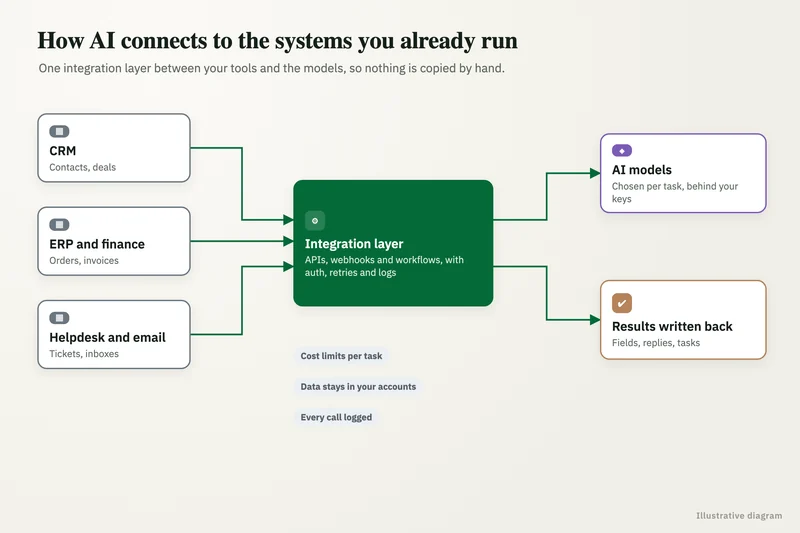
Claude AI implementation services cover choosing the right deployment path (Claude Team or Enterprise seats, the Claude API, or Claude through Amazon Bedrock, Google Cloud or Microsoft Foundry), setting up SSO, permissions and data controls, connecting company tools through connectors and MCP servers, building custom workflows, training staff and monitoring cost and usage after launch.
- Pick the deployment path first: seats for staff, the API for automated workflows, or both.
- Anthropic publishes seat and token prices, so the running bill can be estimated before you sign.
- Connectors and MCP servers decide how useful Claude is, and they need permission design.
- A Partner Network badge signals focus, not proof of delivery, so ask for working examples.
What do Claude AI implementation services include?
A Claude implementation is the work between buying access and having people or systems use Claude every day on real data. The license is the easy part. The effort sits in deciding who gets which plan, connecting Claude to the places your knowledge lives, writing the usage rules, building the automations that run without a person typing a prompt, and checking after launch that the thing is used and the bill matches the estimate.
When we scope a Claude project, the work usually falls into the components below. Most companies need some of them, not all, and a good partner prices each one separately so you can drop what you do not need.
- Path and plan selection: which teams get Claude Team or Enterprise seats, which workflows run on the API, and which cloud account (Anthropic, AWS, Google Cloud or Azure) gets the bill.
- Identity and admin: SSO, SCIM user provisioning, roles, audit logs and data retention settings on Team or Enterprise plans.
- Connectors: adding approved connectors and custom remote MCP servers so Claude can read from Google Drive, SharePoint, Jira, HubSpot, a database or an internal API under each user's own permissions.
- Skills and project setup: shared instructions, templates and reference files for repeat tasks such as proposal drafts, contract summaries or support replies.
- API workflows: code that calls Claude from your systems, for example classifying inbound email, extracting fields from PDFs or drafting CRM notes, with structured output, validation and a human-review queue.
- Training and adoption: role-based sessions built on the team's real tasks, plus a usage review after 30 to 60 days.
- Monitoring: prompt and output logging, cost per task, spend limits and a rollback path for any automated workflow.
Which Claude deployment path fits: seats, the API or a cloud marketplace?
Most buyers need one of three paths, and many end up using two. Seats (Claude Team or Claude Enterprise) suit people who work with Claude directly in chat, documents and code. The Claude API suits automated work that runs inside your own software with no one typing. Claude through Amazon Bedrock, Google Cloud or Microsoft Foundry suits companies that want model calls billed and governed inside a cloud account they already run.
The table compares the three on the points that usually decide it. The details come from Anthropic's pricing page, its support articles and its Bedrock documentation, all read in October 2026.
| Question | Claude Team or Enterprise seats | Claude API (Anthropic) | Claude via Bedrock, Google Cloud or Foundry |
|---|---|---|---|
| Who uses it | Staff, in the Claude apps | Your software, automatically | Your software, inside your cloud account |
| How it is billed | Per seat per month; Enterprise adds usage at API rates | Per million input and output tokens | Through your AWS, Google Cloud or Azure bill |
| Best for | Research, drafting, analysis, coding with Claude Code | Email triage, document extraction, agents, chat on your site | Teams with cloud commitments, existing IAM and data residency rules |
| Connects to your tools via | Connectors and custom remote MCP servers | Tool use and your own integrations | Tool use and your own integrations; some API features missing |
| Main setup work | SSO, SCIM, roles, connector approval, training | Integration code, validation, review queue, logging | IAM roles, model access, regional endpoints, logging |
How much does Claude cost to run each month?
Anthropic publishes its prices, so the running cost of a Claude deployment can be estimated before any build starts. The figures below come from Anthropic's pricing page as read on 18 October 2026. They are list prices and can change, so recheck them when you budget.
Two pricing details matter for automated workflows. Anthropic's pricing page says batch processing saves 50%, which suits overnight jobs such as tagging a document backlog, and prompt caching cuts the cost of repeated instructions or reference text that is sent with every call. On Amazon Bedrock, Anthropic's documentation says regional endpoints, which keep traffic in a chosen geography such as the US, carry a 10% price premium over global endpoints.
| Item | Published price (Anthropic, Oct 2026) | Notes |
|---|---|---|
| Claude Team, standard seat | $20 per seat per month billed annually; $25 billed monthly | For teams of 2 to 150 people |
| Claude Team, premium seat | $100 per seat per month billed annually; $125 billed monthly | Five times the usage of a standard seat |
| Claude Enterprise | $20 per seat per month billed annually, 20-seat minimum | Usage billed on top at API rates |
| API, Sonnet tier | $2 per million input tokens, $10 per million output tokens | The usual default for business workflows |
| API, Haiku tier | $0.10 to $0.50 input, $0.50 to $2.50 output per million tokens | Varies by prompt size; suits classification and routing |
| API, Opus tier | $4 input, $20 output per million tokens | For harder reasoning steps |
| API, largest model | $10 input, $50 output per million tokens | Rarely needed for routine operations work |
Worked example: a 40-person team plus one automated workflow
Here is how the numbers come together for a typical mid-size rollout. The seat prices are Anthropic's published rates; the email volume and token counts are our assumptions for illustration, so replace them with your own measurements.
Seats: 30 people on Claude Team standard seats and 10 heavier users (analysts and engineers using Claude Code) on premium seats. Billed annually, that is 30 x $20 = $600 plus 10 x $100 = $1,000, so $1,600 a month or $19,200 a year. Billed monthly, the same mix costs $750 plus $1,250, so $2,000 a month. On Enterprise, 40 seats at $20 would be $800 a month in seat fees, with usage billed on top at API rates, so Enterprise is not automatically cheaper.
API workflow: the support team receives 20,000 emails a month and wants each one classified, summarized and logged in Zendesk. Assume about 2,000 input tokens per email (instructions plus the message) and 300 output tokens. On the Sonnet tier that is 40 million input tokens x $2 = $80 plus 6 million output tokens x $10 = $60, so about $140 a month. If the job can run in batches rather than in real time, the 50% batch discount brings it to about $70. On the Haiku tier at the top of its published range, the same volume is about $20 plus $15, so roughly $35.
The lesson from the example is that model usage is rarely the big number. The build, the integration with Zendesk or HubSpot, and the minutes your staff spend reviewing flagged items usually outweigh the token bill. Our AI implementation cost guide covers those build costs in more detail.
How are connectors, MCP servers and skills set up in a Claude rollout?
Connectors are what turn Claude from a general assistant into one that can see your files, tickets and records, so they deserve the most design time. Anthropic's support documentation says custom connectors use remote MCP (Model Context Protocol) servers and are available on Free, Pro, Max, Team and Enterprise plans.
On Team plans only Owners and Primary Owners can add a custom connector; on Enterprise, Owners, Primary Owners and people with a custom role that includes managing libraries can. The admin adds the remote MCP server URL, with optional OAuth client details, and each user then connects individually. Anthropic notes that this means Claude can only reach tools and data the individual user already has access to.
That per-user model is good for security, but it moves the hard questions to your own permissions. If a shared drive is open to everyone, Claude will be able to read it for everyone. Before turning on SharePoint or Google Drive access, we review which folders are overshared, decide which connectors are approved, and for internal systems without an existing MCP server we build one that exposes only the specific read and write actions a team needs, such as looking up an order or creating a draft ticket, rather than raw database access.
- List the systems each team needs and the exact actions: read, search, create draft, update.
- Fix oversharing in SharePoint, Google Drive and Confluence before connecting them.
- Prefer narrow MCP tools with clear names over one tool that runs arbitrary queries.
- Keep write actions behind a confirmation step for anything touching money or customers.
- Log tool calls so an admin can see what Claude read and changed.
Is Claude HIPAA compliant, and what about data residency?
Claude can be used with protected health information only on specific offerings with a signed Business Associate Agreement. Anthropic's support documentation describes a HIPAA-ready Claude Enterprise offering where the Primary Owner enables HIPAA in the organization's data and privacy settings and accepts Anthropic's BAA. The same documentation lists features excluded from the BAA, including Workbench, the Claude Console, Claude Cowork and features in beta, and says not all API features are covered, so the feature list needs checking against your planned use.
Companies already running on AWS or Google Cloud can also call Claude through Amazon Bedrock or Google Cloud under that provider's own agreements. Anthropic's Bedrock documentation also lists features that are not available through the Bedrock InvokeModel integration, such as the Message Batches endpoint, the Files API and server-side tools like web search, so a design that depends on those features may need the direct API instead.
For regulated data, the implementation work includes picking the covered path, switching off features outside the agreement, setting retention, and keeping a person in the loop on anything that reaches a patient or a claim. This is not legal advice; your compliance lead or counsel should confirm the final setup.
Do you need a Claude partner? What the Partner Network badge tells you
Anthropic launched the Claude Partner Network on 12 March 2026, committing an initial $100 million to training, technical support and joint market development, and introduced its first technical certification, Claude Certified Architect, Foundations. Qualified partners are listed in a Services Partner Directory. Anthropic's announcement also says any organization bringing Claude to market is eligible and that membership is free.
That makes the badge a useful signal that a firm is focused on Claude, not proof that it has shipped working systems for a company like yours. A certification is an exam passed by an individual; ask who on the team holds it and whether that person will work on your project. Then judge the vendor the way you would judge any implementation partner: on working examples, how they test, and what you own at the end.
There is a reason to use outside help at all. MIT NANDA reported in 2025 that AI projects bought from or built with specialist partners succeeded about 67% of the time, against about 33% for internal builds. That gap is about experience with integration, testing and adoption, which is what you are paying for.
- Which deployment path do you recommend for us, and what would make you change it?
- Can you show a live connector or MCP server you built, and how its permissions work?
- How do you test accuracy before launch, and can we keep the test set?
- What will our monthly seat and token bill be, and what caps stop it running over?
- Who owns the code, prompts, skills and accounts when the engagement ends?
- What happens after launch: who fixes a broken connector or updates a workflow when Anthropic retires a model?
How long does a Claude implementation take, and what do partners charge?
A seat rollout with a handful of connectors usually takes weeks, while custom API workflows take longer because they need integration, testing and a review process. Few firms publish prices. SpotDev, a UK Claude implementation firm, lists packages on its Claude implementation page (read October 2026) from £3,500 for a four-week starter rollout for up to 15 people, £8,000 for setup and training for 45 people, from £18,000 for a rollout of up to 100 people, and £20,000 for a custom agent built over four to eight weeks.
For broader AI builds, Softude's 2026 guide puts specialist AI agency projects at $25k to $150k and says one use case typically takes 3 to 5 months. A Claude rollout that is mostly configuration sits well below that; a multi-system agent can approach it. The order of work below is the one we follow.
- Week 1: review the teams, use cases, systems and data rules; pick the path and plan mix.
- Weeks 1 to 2: set up SSO, SCIM, roles, retention and spend limits; approve the first connectors.
- Weeks 2 to 4: build skills, project templates and any custom MCP servers; train the first group on real tasks.
- Weeks 3 to 8: build API workflows with validation, a review queue and logging; test against real samples.
- Days 30 to 60 after launch: review usage, cost per task and error rates, then adjust or expand.
When do you not need Claude implementation services?
Not every company needs a partner. If fewer than 20 people will use Claude, nobody needs it connected to internal systems and no regulated data is involved, a Team plan set up by your own IT admin with a short internal guide is usually enough. Start there and come back when a specific workflow is worth automating.
You also do not need a Claude-specific partner if you have not decided on a model vendor yet. That is a strategy question, and comparing Claude with OpenAI, Gemini or Copilot should come before anyone configures connectors. Equally, if your data is scattered and your permissions are a mess, fix that first, because Claude will expose the mess faster than it hides it.
How we deliver Claude AI implementation services
We are AI implementation consultants, so our Claude work is about building and connecting rather than slideware. We set up Team or Enterprise organizations, build connectors and MCP servers for internal systems, and write API workflows for document extraction, email triage, CRM updates and agents, using Anthropic's API or Bedrock depending on where you already run.
Every engagement starts with a free review of the use cases and systems, then a fixed price for a defined scope. You own the Anthropic or cloud accounts, the code, the prompts, the skills and the data from day one, so seat and token bills go to you directly. A person stays in the loop on anything touching money, customers or regulated data. To see how this fits into a wider build, read about our AI implementation services.
FAQ
Frequently asked questions
What is a Claude implementation partner?
A Claude implementation partner is a firm that sets up and builds on Claude for a company: configuring Team or Enterprise plans, connecting company tools through connectors and MCP servers, building API workflows and training staff. Some are registered in Anthropic's Claude Partner Network, which Anthropic says is free for any organization bringing Claude to market.
Should we use Claude Team or Claude Enterprise?
Anthropic positions Team for groups of 2 to 150 people at $20 per standard seat per month billed annually, with premium seats at $100. Enterprise is $20 per seat with a 20-seat minimum plus usage at API rates, and adds options such as the HIPAA-ready offering. Heavy usage, regulated data or large headcount usually point to Enterprise.
Is Claude Code included in Claude Team seats?
Anthropic's pricing page lists Claude Code among the features included in both standard and premium Team seats, with premium seats giving five times the usage of a standard seat. Engineers who use it all day usually need premium seats, while occasional users can stay on standard.
Can Claude connect to SharePoint, Google Drive or our CRM?
Yes, through connectors and custom remote MCP servers, which Anthropic supports on Team and Enterprise plans. An admin adds the connector and each user connects with their own account, so Claude only sees what that user can already see. Internal systems without an existing connector need an MCP server built for them.
Should we call Claude through the Anthropic API or Amazon Bedrock?
Use Bedrock if your company already runs on AWS and wants model spend, IAM and logging inside that account. Use the Anthropic API if you need features that Anthropic's documentation lists as unavailable on Bedrock's InvokeModel integration, such as message batches or the Files API. Both can serve the same business workflow.
How much does it cost to hire a firm to implement Claude?
Few firms publish prices. SpotDev lists Claude packages from £3,500 for a starter rollout to £20,000 for a custom agent, and Softude's 2026 guide puts specialist AI agency projects at $25k to $150k. We quote a fixed price after a free review, and seat and token costs are billed to your own accounts.
Who owns the prompts, skills and code after a Claude implementation?
That depends on the contract, so ask before signing. In our engagements the client owns the Anthropic or cloud accounts, the code, prompts, skills and data from day one, so nothing stops working if the engagement ends.
Keep reading
Related pages
Get started
Tell us what you want automated
Describe the task, the systems involved and the volume. We reply within one business day with an architecture, the tools we would use, running costs and a fixed-price build plan.
- Free 30-minute build review
- Fixed quote before any work starts
- You own the accounts, code, prompts and data
Prefer email? info@aiimplementationconsultants.com
Get a free build plan
Two lines is enough to start.