

Healthcare build guide
HIPAA compliant AI chatbot: what has to be true before PHI touches it
A HIPAA compliant AI chatbot is one where every vendor that stores, processes or transmits protected health information has signed a Business Associate Agreement, and the build itself enforces access control, encryption, audit logging and the minimum necessary data. No model or chatbot product is compliant on its own: compliance comes from the tiers you buy, how you configure them and what the bot is allowed to see. This guide is for practice managers, operations and IT leads at US clinics, therapy providers, health plans and health tech companies who want a patient or staff chatbot built and need to know what it takes.
Get a free build plan
Two lines is enough. A specialist replies within one business day.
Spec: quick answer
How do you make an AI chatbot HIPAA compliant?
You make an AI chatbot HIPAA compliant by using only vendor tiers that sign a Business Associate Agreement for every component that sees PHI (model, vector database, hosting, workflow tool, chat or voice channel), then enforcing access control, encryption in transit and at rest, audit logs, minimum necessary data and human review for clinical or billing decisions.
- Compliance is a property of the whole data path, not of the model you pick.
- Consumer and small-team AI plans do not come with a BAA, even when you pay for them.
- A BAA often covers only listed features, so check exclusions such as connectors and file APIs.
- Start with a no-PHI scope where you can, then add PHI only where it earns its risk.
What makes an AI chatbot HIPAA compliant?
An AI chatbot is HIPAA compliant when the covered entity can show three things: a signed BAA with each vendor that handles PHI, technical safeguards that limit and record access, and policies for how staff and patients use it. HIPAA does not certify software, so any vendor that calls its chatbot "HIPAA certified" is describing its own controls, not a government approval.
PHI enters a chatbot faster than most teams expect. The moment a patient types a name together with a symptom, an appointment request or an insurance member number, the conversation is PHI, and so is everything derived from it: the embedding stored for retrieval, the log line your developer reads while debugging, and the transcript forwarded to your inbox. Each of those places needs to sit inside a BAA-covered service.
The HIPAA Security Rule is organized around administrative, physical and technical safeguards. For a chatbot, the technical ones translate into concrete build items, listed below. This is not legal advice; your privacy officer or counsel should confirm the final setup.
- Access control: unique logins for staff, role-based permissions and automatic session timeouts, so a front-desk user cannot query billing records.
- Audit controls: a log of who asked what, which records were retrieved and what the bot answered, kept inside a covered system.
- Integrity: validation so the bot cannot overwrite chart or billing data without a person approving the change.
- Transmission security: TLS on every hop, including calls from your workflow tool to the model API.
- Minimum necessary: the bot retrieves only the fields a question needs, not the whole patient record.
Which AI vendors sign a BAA for a chatbot?
The major model vendors sign BAAs, but only on specific API or enterprise tiers, and the coverage lists matter as much as the signature. A June 2026 survey of 34 AI tools published on DEV Community found that 21 would not sign a BAA at all and 9 offered one only on enterprise-gated tiers. The common mistake it describes is assuming a paid subscription brings BAA coverage; the consumer tier is the one that never can.
Anthropic's BAA page for commercial customers lists the Messages API among covered services, and Claude Enterprise chat once an organization's primary owner accepts the BAA and turns on HIPAA settings. The same page states that MCP servers and connectors, the Batch API, Files API, Skills API, code execution and web fetch are not covered. For OpenAI, IntuitionLabs' 2026 summary of OpenAI's documentation reports that the API BAA is requested by email independently of any ChatGPT plan and depends on the account being provisioned with modified retention, that ChatGPT Enterprise and Edu BAAs go through sales, and that ChatGPT Business, Plus and Pro have no BAA.
The table below covers the rest of a typical chatbot stack. Treat it as a starting point for your own vendor review, since terms change and each vendor's current BAA is the document that counts.
| Component | Example vendors | BAA position (source) | What to check |
|---|---|---|---|
| Language model | Claude API, OpenAI API, models on Amazon Bedrock, Google Vertex AI or Azure | Available on API and enterprise tiers, not consumer plans (vendor BAA pages; IntuitionLabs 2026) | Which endpoints are covered, retention settings, whether file and batch features are excluded |
| Vector database | Pinecone, pgvector on a covered cloud database | Pinecone announced HIPAA compliance on AWS, Azure and Google Cloud with a BAA on request (Pinecone blog, Oct 2023) | Plan tier that includes the BAA, region, encryption keys |
| Workflow tool | Zapier, Make, n8n | Zapier says it does not sign a BAA and should not carry PHI (Zapier blog); n8n self-hosted can sit on your covered cloud | Where execution logs are stored and who can read them |
| Voice channel | Vapi, Bland AI, Retell AI | Vapi sells HIPAA compliance as a $2,000/month add-on; Bland AI includes a BAA on its Enterprise plan (vendor pricing pages, Oct 2026) | Call recording consent rules by state, transcript storage |
| Hosting and logs | AWS, Google Cloud, Microsoft Azure | Each offers a BAA covering a list of eligible services | That every service you use is on the eligible list, including logging and backups |
What does a HIPAA compliant AI chatbot architecture look like?
A safe architecture keeps PHI inside one covered cloud account you own, calls the model through a covered API, and never lets an uncovered tool see raw conversation text. Everything else is detail on top of that rule.
In practice we build it as six layers. The chat widget or patient portal page authenticates the user. A backend service in your AWS, Google Cloud or Azure account receives each message, strips or tokenizes identifiers that the question does not need, and decides whether retrieval is required. Retrieval runs against a vector index of approved documents (policies, prep instructions, FAQs, payer rules) and, only for authenticated users, a scoped read of the record fields that question needs. The model call goes to a covered endpoint with retention settings checked. A rules layer blocks answers outside the bot's scope, such as diagnosis or dosing, and routes them to staff. Finally, every step writes to an audit log inside the same account.
- Identity: SSO for staff, verified login or one-time codes for patients, no PHI for anonymous visitors.
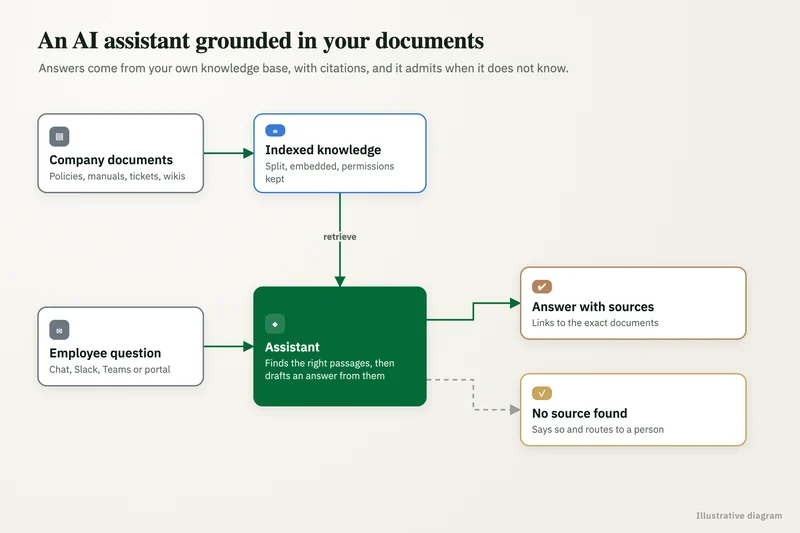
- Retrieval with citations: the bot quotes which approved document it used, so staff can check the source.
- Scope rules: a fixed list of intents the bot may answer, with everything else handed to a person.
- Human-review queue: refill requests, billing disputes and anything clinical wait for staff approval.
- Logging: prompts, retrieved chunks, outputs and costs keyed to a conversation ID, with role-limited access.
- Retention: a set period after which transcripts and embeddings are deleted, matched to your records policy.
Which use cases suit a HIPAA compliant chatbot, and which should wait?
The safest early wins are administrative: they save staff time and involve little or no clinical judgment. Scheduling questions, intake form help, insurance and billing FAQs, prep instructions and staff-facing policy search all fit. Many of these need no PHI at all, which is the cheapest compliance there is.
Use cases that interpret symptoms, suggest treatment or change medication are a different category. They carry clinical risk, may raise FDA questions about clinical decision support, and demand an evaluation program well beyond a typical build. We recommend leaving them out of a first release.
| Use case | PHI needed? | Risk level | Recommended first step |
|---|---|---|---|
| Public FAQ (hours, locations, insurance accepted, prep steps) | No | Low | Anonymous bot over approved documents, no record access |
| Staff policy and SOP search | Usually no | Low | Internal bot with SSO over SharePoint or Google Drive policies |
| Appointment booking and rescheduling | Yes (name, date of birth, appointment) | Medium | Authenticated flow writing to the scheduling system, staff see every change |
| Billing and balance questions | Yes | Medium | Read-only balance lookup, disputes routed to billing staff |
| Symptom triage or clinical advice | Yes | High | Out of scope for a first build; route to a nurse line |
How do you build a HIPAA compliant AI chatbot, step by step?
The order matters: paperwork and data mapping come before any code, because a BAA gap discovered after launch means rebuilding the stack. These are the steps we follow.
- 1. Write down the intents the bot will handle and mark which of them need PHI. Drop or defer the high-risk ones.
- 2. Draw the data flow: every system a message passes through, from the browser to the model and back, including logs and backups.
- 3. Confirm a signed BAA, and the exact covered features, for each system on that diagram. Replace any vendor that will not sign.
- 4. Build in your own covered cloud account, with encryption at rest, private networking to the database and secrets in a vault.
- 5. Assemble an evaluation set of 100 or more real questions with approved answers, including questions the bot must refuse.
- 6. Test with staff first, then a small group of patients, reviewing every transcript in the audit log for the first weeks.
- 7. Document the setup for your risk analysis: vendors, BAAs, data flows, access roles, retention and the incident process.
Worked example: a therapy practice intake and scheduling bot
Here is a worked example with round numbers for illustration, not a client result. A multi-site therapy practice gets about 1,200 website and portal messages a month. Roughly 40 percent are general questions (insurance accepted, how intake works, what to bring), 35 percent are scheduling requests, and the rest are billing questions and clinical messages for therapists.
Phase one is a no-PHI bot that answers the general questions from approved documents and hands everything else to the front desk with a one-line summary. No BAA is needed for content that holds no PHI, though we still run it on covered services so phase two does not require a migration. If staff currently spend about four minutes on each of those 480 general messages, that is around 32 hours a month to recover, minus the time spent reviewing transcripts.
Phase two adds authenticated scheduling: the patient logs in, the bot reads open slots for that patient's therapist and proposes times, and the booking is written to the practice management system with the front desk notified. Clinical messages never go to the model at all; they are routed straight to the therapist's queue. We have seen the value of stopping errors at the source in healthcare admin work: our case studies include a therapy services provider whose AppSheet clinician portal cut daily data entry from 10-15 minutes to under 3 and stopped errors at the point of entry.
Common mistakes that break HIPAA compliance in chatbot projects
Most failures are not breaches of the model vendor; they are PHI leaking into a tool nobody reviewed. These are the ones we check for first when we review an existing build.
- Pasting transcripts into a consumer ChatGPT or Claude account to "improve prompts".
- Routing chat messages through Zapier or another workflow tool that does not sign a BAA.
- Error trackers and analytics scripts capturing message text on the chat page.
- Using a covered model API but sending files through a feature the BAA excludes.
- Giving the bot a database user that can read every table instead of a scoped view.
- No refusal tests, so the bot answers dosing or diagnosis questions when asked cleverly.
- Keeping transcripts forever because nobody set a retention period.
When should you not build a custom HIPAA compliant chatbot?
Do not build custom if your EHR or practice management vendor already offers a patient messaging assistant under the BAA you have with them, and it covers the questions you get. Turning that on is usually faster and keeps PHI with a vendor you already trust.
Do not build yet if you cannot name the intents, cannot supply approved answers, or have no one to review transcripts in the first month. A chatbot without an owner drifts. And if your real problem is phone volume rather than web messages, an AI receptionist with a BAA-covered voice platform may be the better first project; our receptionist and voice pages cover that route.
How we build HIPAA compliant AI chatbots
We start with a free review of your intents, systems and a sample of real (de-identified) messages, then quote a fixed price for a defined scope. The build runs in your own cloud and model accounts under your BAAs, so you own the code, prompts, indexes and logs, and no PHI passes through our tools.
A person stays in the loop on anything touching clinical content, money or record changes. For budget context, our healthcare cost guide covers what AI builds and running costs look like in this sector, and our chatbot service page explains how we build retrieval over your documents with citations.
Case study · Therapy services provider
Clinician portal on AppSheet
Clinicians logged sessions in shared spreadsheets, so billing fixed formats, durations and missing authorizations before every cycle. A guided portal with validation, auto-calculated durations, approvals and automatic sync to billing.
- Data entry down from 10-15 minutes a day to under 3
- Errors stopped at the source

FAQ
Frequently asked questions
Is ChatGPT HIPAA compliant?
Consumer ChatGPT plans are not, because OpenAI does not sign a BAA for them. According to IntuitionLabs' 2026 summary of OpenAI's documentation, BAAs are available for the OpenAI API (on accounts with modified retention) and for ChatGPT Enterprise and Edu through sales, while ChatGPT Business, Plus and Pro have none. A chatbot built on the covered API can be part of a compliant setup.
Is Claude HIPAA compliant?
Anthropic signs BAAs for commercial customers, covering services such as the Messages API and Claude Enterprise chat once HIPAA settings are enabled. Its BAA page excludes MCP connectors, the Batch API, Files API, Skills API, code execution and web fetch. Consumer Free, Pro and Max plans are not covered.
Do I need a BAA with my chatbot developer?
You need one with any developer or agency that can access PHI, for example by reading production logs or transcripts. The cleaner approach is to run everything in your own accounts and give the builder access only to de-identified or test data. If production access is needed for support, sign a BAA first.
Can I use Zapier or n8n in a HIPAA compliant chatbot?
Zapier states that it does not sign a BAA and should not carry PHI, so keep it to workflows with no patient data. n8n does not sign BAAs either, but it can be self-hosted inside your own covered cloud account, where you control encryption, logs and access. That setup still needs to be configured and documented properly.
What is the difference between HIPAA compliant and HIPAA certified?
There is no official HIPAA certification for software. A vendor that says it is HIPAA compliant means it has safeguards and will sign a BAA; compliance for your chatbot depends on how you use and configure those vendors. Third-party audits such as SOC 2 or HITRUST can support your due diligence but do not replace a BAA.
Can a HIPAA compliant AI chatbot give medical advice?
It can be technically possible, but we advise against it for a first build. Symptom interpretation and treatment advice carry clinical risk and can raise FDA questions about clinical decision support. Most practices get faster, safer value from administrative intents and route clinical questions to staff.
How long does it take to build a HIPAA compliant chatbot?
A no-PHI FAQ bot over approved documents is the quickest, mostly content work and testing. Adding authenticated scheduling or billing lookups takes longer because of BAA reviews, integration with your practice management system and transcript review during rollout. We scope each phase separately after a free review.
Keep reading
Related pages
Get started
Tell us what you want automated
Describe the task, the systems involved and the volume. We reply within one business day with an architecture, the tools we would use, running costs and a fixed-price build plan.
- Free 30-minute build review
- Fixed quote before any work starts
- You own the accounts, code, prompts and data
Prefer email? info@aiimplementationconsultants.com
Get a free build plan
Two lines is enough to start.