

Integration guide
ServiceTitan AI integration: native Max, a certified partner or a custom build
ServiceTitan AI integration now has four routes: ServiceTitan's own Max agents and AI Voice Agent, a certified App Marketplace partner, a Zapier or Make connection, or a custom build that calls the ServiceTitan API from your own service. This guide is for owners, operations managers and IT leads at HVAC, plumbing, electrical and other trade businesses who run ServiceTitan and want AI answering calls, booking jobs or cleaning up office work. It explains which route fits which job, what ServiceTitan's 2026 API rules allow, and how to build an integration that keeps working.
Get a free build plan
Two lines is enough. A specialist replies within one business day.
Spec: quick answer
How do you integrate AI with ServiceTitan?
You integrate AI with ServiceTitan by turning on its native Max agents or AI Voice Agent, installing a certified App Marketplace partner, connecting Zapier or Make, or building a custom service on the ServiceTitan API. Custom and Zapier routes need API access, which ServiceTitan includes with The Works package, and its April 2026 API Terms require AI use to be disclosed and limited to predefined operations.
- Start with ServiceTitan's own Voice Agent and Max if they cover your calls and bookings.
- Custom builds and Zapier need API access, which comes with The Works package.
- Since April 15, 2026, AI must be disclosed and kept to fixed, predefined API operations.
- Let the model decide what the caller wants; let plain code decide which API call runs.
What are the four routes for ServiceTitan AI integration?
The right route depends on whether the job is already something ServiceTitan sells, and on how much control you need over the logic and the data. ServiceTitan has moved quickly into AI: its Pantheon 2026 press release (October 6, 2026) says Max, its agentic package, is now available to every residential in-home contractor, with a limited pilot for commercial and roofing contractors. That changes the build-or-buy question for the most common request we hear, which is an AI that answers the phone and books jobs.
Most trade businesses end up mixing routes. A typical split is ServiceTitan's Voice Agent on the main line, a certified partner for reviews or financing, and a small custom service for the work no product covers, such as reading supplier invoices into purchase orders or summarizing technician notes for the service manager each morning.
| Route | What it is | Best for | Main limit |
|---|---|---|---|
| Native: Max and AI Voice Agent | ServiceTitan's own agents for calls, booking, dispatch context and office work, plus the Atlas assistant for owners | Inbound calls, booking and follow-up inside standard ServiceTitan workflows | Behavior is what ServiceTitan ships; sold as Pro products with no public price list |
| Certified Marketplace partner | A third-party app that has passed ServiceTitan's 2026 certification | Packaged features such as payments, reviews, payroll or accounting sync | Partner pays ServiceTitan a revenue share, and its status can change |
| Zapier or Make | No-code automations calling the ServiceTitan API | Simple handoffs: a web form creates a booking, a job update posts to Slack | Needs The Works package; ServiceTitan supports Zapier only on an as-is basis |
| Custom build | Your own service using the ServiceTitan API, a model provider and your rules | Multi-system or rules-heavy work: invoices, call review, after-hours triage with your own logic | Needs API access, design, testing, monitoring and an owner |
What can ServiceTitan's native AI do already?
ServiceTitan's AI Voice Agent answers inbound calls, gathers the caller's details, books jobs straight into ServiceTitan, confirms and reschedules appointments, classifies calls and hands off to a live agent when needed. ServiceTitan's product page says it works with any phone system or as part of Contact Center Pro, and reports a 70% overall booking rate from its pilot program, with the caveat that these are early pilot results and individual results vary.
ServiceTitan's help center lists Max for residential service and replacement work in plumbing, HVAC, electrical and garage door trades. Beyond calls, the October 2026 announcements describe agents for dispatch context, invoice review and daily logs (some in pilot or marked coming soon), the Atlas mobile app that answers owners' questions about sales and revenue, and Homh, a consumer channel that makes selected contractors bookable from ChatGPT, Gemini and Claude.
The practical advice is simple: if your goal is answering and booking calls in a residential trade, get a quote for ServiceTitan's Voice Agent before paying anyone to build one. A native agent already knows your job types, campaigns, business units and capacity because it lives in the same system. A custom build earns its cost only where the native product cannot reach.
What do ServiceTitan's 2026 API rules mean for AI?
ServiceTitan's API Terms, last updated April 15, 2026, are the most important document for anyone planning a ServiceTitan AI integration, and most vendor pages do not mention them. They contain four rules that shape every design decision below. This is our reading as implementers, not legal advice; have your counsel read the terms themselves.
First, disclosure: you must tell ServiceTitan whether your application uses an AI system when you register it, and again if you add one later. Using an AI system with the APIs without disclosure and approval is defined as a material breach. Second, fixed operations: API calls made by or through an AI system must stay within predefined operations in the application's Certified Scope, and the AI must not autonomously expand or change them. The terms also bar letting an AI independently decide which endpoints to call or what actions to take. Third, caching: content from the API must not be stored or cached for longer than 24 hours unless the terms or documentation allow it. Fourth, termination: ServiceTitan can suspend access immediately for a breach, and can end the terms at its discretion on 30 days' notice.
The last rule is not theoretical. SaaStr reported in August 2026 that ServiceTitan ended its integration with Podium, a partner of nine years shared with roughly 1,000 customers, on 30 days' notice, after Podium did not meet the new certification requirements. Whatever you build, assume the API connection can change and keep a manual fallback.
- Disclose the AI when you register the app on the ServiceTitan developer portal.
- Give the model no direct API access; it returns structured output and fixed code makes each call.
- Read customer and job data live; do not copy ServiceTitan records into a long-lived vector store.
- Keep a fallback: calls forward to a person and bookings land in a queue if the API connection drops.
Do you need The Works package for a ServiceTitan AI integration?
For a custom build or Zapier, yes in practice. ServiceTitan's help article on its Zapier integration says only customers on The Works or legacy pre-packaging plans can use it, because it requires API access, which is included in those agreements. A custom service calls the same API, so check your agreement first.
Certified partners are different. ServiceTitan's App Marketplace Program Guide (revised November 2025) says certified apps get integration access to customers across all subscription tiers, and partners pay ServiceTitan a share of net revenue from the app or a minimum fee, whichever is greater. That cost is usually built into the partner's price. ServiceTitan's June 24, 2026 marketplace update says customers can build their own apps in their own ServiceTitan instance without certification, and lists five certification criteria for partners: security, performance, predictability, data transparency (apps that read data must also write data back) and revenue share.
How is a custom ServiceTitan AI integration built?
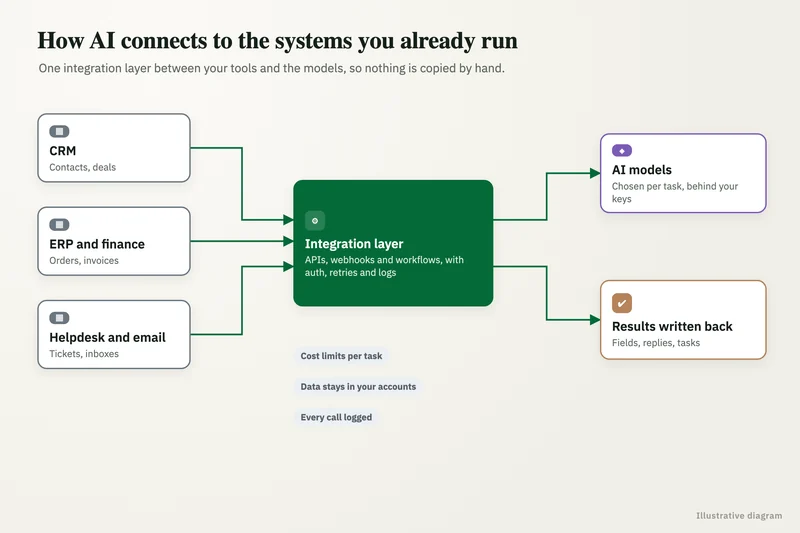
A custom ServiceTitan AI integration has five parts: a trigger, a model step, a rules step, fixed API operations and a write-back. The split between the model and the API calls is what keeps the build inside the April 2026 terms.
Access comes first. In ServiceTitan's developer portal (developer.servicetitan.io), a user whom an administrator has given the Generate API Application Key permission creates an app, adds the tenant ID and selects only the API scopes the job needs, which generates an app key. Then, in ServiceTitan under Settings, Integrations, API Application Access, the admin connects the app and generates a client ID and client secret. The service uses the OAuth client credentials grant and sends the token plus the app key with each request. ServiceTitan's documentation describes an Integration environment that is a clone of production, which is where all testing should happen.
The model never sees credentials or picks an endpoint. For a booking call, it returns a fixed schema: caller name, phone, service address, job type, urgency, preferred window, whether the caller is an existing customer, a summary and a confidence score. Plain code then runs a known sequence: search customers by phone, match or create the location, check availability, then create the booking. If any value falls outside the allowed list (an unknown job type, an address outside your service area, low confidence), nothing is written and the request goes to a CSR queue.
- Trigger: an inbound call on your voice platform, a web form, an email to the service inbox or a scheduled job.
- Model step: OpenAI, Claude, Gemini or Bedrock returns one fixed output schema, validated field by field.
- Rules step: allowed job types, business units and campaigns, service-area check, confidence threshold and a cost cap per call.
- Fixed operations: a short, named list of API calls written in code and declared when the app is registered.
- Write-back: a booking or job with a call summary and the right campaign, so revenue reporting stays correct.
- Failure handling: retries for failed requests, writes that are safe to repeat, an alert after two failures and a CSR queue as fallback.
Can Claude or ChatGPT connect to ServiceTitan through MCP?
Technically yes, since third-party MCP servers for ServiceTitan exist, but a general-purpose one is a poor fit for the 2026 terms. An MCP server works by offering a model a menu of tools and letting it decide which to call. ServiceTitan's terms bar an AI system from independently deciding which endpoints to call or what to change. A server that exposes broad read and write tools to Claude or ChatGPT appears to conflict with that rule unless ServiceTitan has approved it.
If your team wants to ask questions like "which memberships expire this month" in a chat window, a safer design is a small set of read-only, fixed reports built in code, with the model only summarizing the results. Our MCP server development guide covers how to scope tools that narrowly.
Worked example: after-hours calls for an HVAC company
Here is an illustration with round numbers, not a client result. An HVAC company on ServiceTitan gets 600 after-hours calls a month. Today they go to an answering service that takes messages, and a CSR rebooks them the next morning. Calls average about four minutes, so the AI would handle around 2,400 minutes a month.
Route one is ServiceTitan's Voice Agent. Ask ServiceTitan for a quote, since it publishes no price, and compare it with your answering service bill. Because it books directly against your capacity, it is the default choice when your call flow is standard.
Route two is a custom voice agent. Retell AI's pricing page shows about $0.11 per minute all-in in its own example, so 2,400 minutes would be roughly $264 a month in platform and call costs, plus model usage, hosting and the one-time build. This route pays off only if you need logic the native agent lacks: for example, applying your own rules on who gets an emergency dispatch at 2 a.m., checking a warranty in another system, or running the same agent for a second business on a different platform. If none of that applies, stay native.
Either way, measure the same three numbers for a month before and after: share of after-hours calls booked, share wrongly booked or needing a callback, and CSR time spent the next morning.
Checklist before you go live
The risk in a ServiceTitan AI project sits at the edges more than in the model: access, scope, fallbacks and the calls nobody planned for. Work through this list before any AI writes to your live tenant.
- Confirm your package includes API access, or that the vendor you are buying from is a certified partner.
- Register the app, disclose the AI use and keep the scope list to what the job needs.
- Build and test in the Integration environment, never against production.
- Collect 100 or more real calls or requests with known correct outcomes as a test set, and rerun it after every prompt change.
- Run in shadow mode first: the AI drafts bookings, a CSR confirms them for one to two weeks.
- Go live on one slice (after-hours, one business unit or one trade) before the main line.
- Tell callers they are speaking with an AI where state law requires it, and follow recording consent rules in two-party consent states.
- Log every call transcript, model output, cost and API write against the job or booking ID.
How do you choose a partner for ServiceTitan AI integration?
Choose a partner who will tell you when ServiceTitan's own product is the better answer. The useful questions are about the API rules, the failure cases and who owns the result, not about which model they prefer.
We scope each ServiceTitan build after a free review of your call flow, a sample of recordings and your ServiceTitan setup, then quote a fixed price. You own the code, prompts, voice platform account and model accounts. A person stays in the loop on refunds, pricing exceptions and anything that touches payment details. Ask these questions of anyone you consider, including us.
- Which route would you use for our calls (Voice Agent, certified partner, Zapier or custom), and why not the others?
- How does your design stay within ServiceTitan's April 2026 API Terms on AI systems?
- What happens to a caller and a booking if the ServiceTitan API is down or our access changes?
- Which API scopes will the app request, and what can the AI write without a person?
- How will you measure booking accuracy before launch, and on how many real calls?
- What will it cost to run each month at our call volume, and how is that capped?
Case study · Logistics company, UK
Route planning automation
Dispatch typed every address into Google Maps, which optimizes only 25 stops and cannot add time at each stop. A Python tool that loads addresses automatically, adds buffer time per stop and optimizes the full route.
- Manual address entry eliminated
- Delivery estimates customers could rely on

FAQ
Frequently asked questions
Does ServiceTitan have its own AI receptionist?
Yes. ServiceTitan's AI Voice Agent answers calls, books jobs into ServiceTitan, confirms and reschedules appointments and transfers to a live agent when needed. It is part of ServiceTitan's Pro products and Max package, and ServiceTitan does not publish its price, so ask for a quote.
Can a third-party AI receptionist book jobs in ServiceTitan?
Yes, if it connects through the ServiceTitan API, either as a certified App Marketplace partner or as a custom app in your own tenant. Since April 15, 2026, ServiceTitan's API Terms require the AI to be disclosed and limited to predefined operations. Ask any vendor how it meets those terms and whether it is certified.
What ServiceTitan package do I need for API access?
ServiceTitan's help center says API access, which Zapier and custom integrations need, is included with The Works package and legacy pre-packaging agreements. Certified Marketplace partners can connect to customers on every subscription tier, according to ServiceTitan's App Marketplace Program Guide.
Why did ServiceTitan end its Podium integration?
SaaStr reported in August 2026 that ServiceTitan ended the integration on 30 days' notice after Podium did not meet its new certification requirements. ServiceTitan said it welcomes overlapping partners as long as they do not use the partnership to gradually displace parts of ServiceTitan. The episode shows why any AI tied to ServiceTitan needs a fallback.
Can I connect ChatGPT or Claude directly to ServiceTitan?
Third-party MCP servers and connectors exist, but ServiceTitan's API Terms bar AI systems from independently choosing which endpoints to call or what to change, and require disclosure and approval. A safer design gives the model fixed, read-only reports built in code. This is our reading of the terms, not legal advice.
Is ServiceTitan Max available for every trade?
ServiceTitan's October 2026 announcement says Max is available to all residential in-home contractors, with a limited pilot for commercial and roofing contractors. Its help center lists residential service and replacement in plumbing, HVAC, electrical and garage door trades.
How long does a custom ServiceTitan AI integration take?
It depends on scope. Registering the app and getting credentials is quick, but field mapping, testing in the Integration environment against real calls, a shadow period with CSRs confirming bookings and a staged launch take most of the time. We scope each workflow after a free review and quote a fixed price.
Keep reading
Related pages
Get started
Tell us what you want automated
Describe the task, the systems involved and the volume. We reply within one business day with an architecture, the tools we would use, running costs and a fixed-price build plan.
- Free 30-minute build review
- Fixed quote before any work starts
- You own the accounts, code, prompts and data
Prefer email? info@aiimplementationconsultants.com
Get a free build plan
Two lines is enough to start.