

Integration guide
MCP server development: when to build, what it costs, how to ship it safely
MCP server development means building a small service that lets AI assistants such as Claude, ChatGPT and Microsoft Copilot read your business data and take approved actions in your systems through one standard interface, the Model Context Protocol. This guide is for ops, sales and IT leads who want an assistant or agent to work with their CRM, ERP, ticketing tool or document store and need to know whether to build a custom server, what it costs and how to keep it safe. It covers published 2026 cost figures, the security rules in the MCP specification and the delivery plan we follow when we build one.
Get a free build plan
Two lines is enough. A specialist replies within one business day.
Spec: quick answer
What is MCP server development and how much does it cost?
MCP server development is building a service that exposes your systems to AI assistants as a set of tools and data sources through the Model Context Protocol. Published 2026 figures from Groovy Web put a single server connecting one internal tool at $8K-18K over 2-4 weeks, with multi-tool servers at $15K-30K over 4-6 weeks.
- Check for a vendor-hosted MCP server first: HubSpot and Salesforce already offer one.
- Build custom when your data lives in internal databases, legacy systems or several tools at once.
- Most of the cost sits in authentication, tool design, testing and upkeep, not the protocol.
- Separate read tools from write tools and require confirmation before anything changes a record.
What does MCP server development involve?
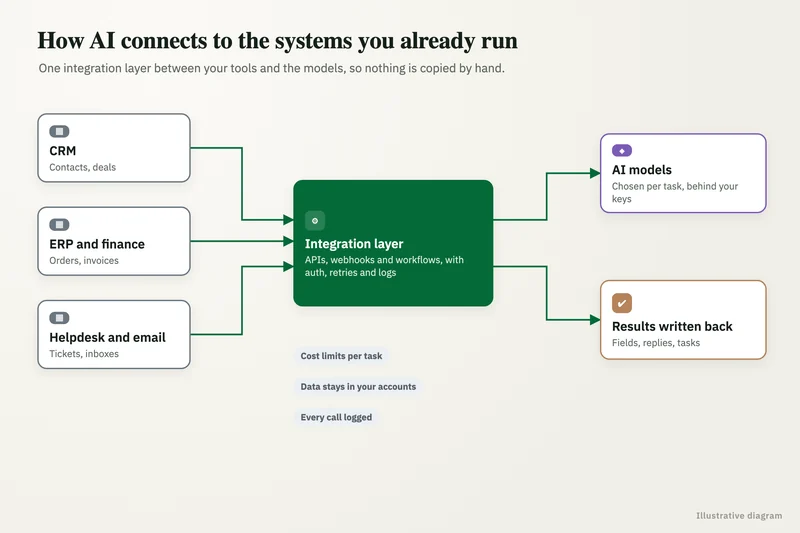
MCP server development is mostly integration engineering with a new front door. The Model Context Protocol, which Anthropic introduced and in December 2025 donated to the Agentic AI Foundation under the Linux Foundation, defines how an AI application (the host) talks to a server that offers capabilities. The official specification lists three things a server can offer: tools, which are functions the model can call; resources, which are data the user or model can read; and prompts, which are templated messages and workflows.
In practice, a server for a mid-size company might expose tools such as search_customers, get_open_invoices, create_support_ticket and draft_quote, plus resources such as a price list or a policy folder. Behind each tool sits ordinary code that calls the HubSpot, NetSuite, Zendesk or SharePoint API, checks permissions, validates inputs and returns a structured result. The protocol part is a thin layer. The work is in deciding which tools exist, what each may touch and what happens when the API behind it fails.
The payoff is reuse. Anthropic reported more than 10,000 active public MCP servers when it donated the protocol and named ChatGPT, Gemini, Microsoft Copilot, Cursor and Visual Studio Code among the products that support it. One well-built server can serve several AI clients, so you are not rebuilding the same CRM connector for each assistant your teams adopt.
Do you need a custom MCP server, or does one already exist?
Many companies do not need custom MCP server development at all. Large SaaS vendors now run their own hosted servers: our HubSpot AI integration guide covers the HubSpot MCP server that powers its connectors for Claude, ChatGPT, Copilot and Gemini, and our Salesforce AI integration guide covers the hosted MCP option there. If the data you need sits in one such product and people only want to ask questions in chat, switching on the vendor's server is cheaper than any build.
A custom server earns its cost when the data sits somewhere no vendor covers, when one assistant must combine several systems in one answer, or when you need tighter control over which fields and actions are exposed than the vendor's server allows. Use the table below to place your case.
| Your situation | Best route | Why |
|---|---|---|
| Data lives in one SaaS tool that ships a hosted MCP server | Configure the vendor server | No code to maintain; vendor handles auth and API changes |
| Unattended, high-volume processing (every new invoice, every inbound lead) | Workflow or backend build, not MCP | MCP suits a person or agent asking for things; scheduled pipelines are simpler as workflows in n8n or code |
| Internal SQL database, legacy ERP or file share with no vendor server | Build a custom server | Nothing off the shelf can reach it safely |
| One assistant must join CRM, ERP and document data in one answer | Build a custom server | You control the tools, field mapping and permissions across systems |
| Vendor server exposes too much, or too little, for your policy | Build a thin custom server in front | Expose only approved tools and fields, with your own logging |
| Several SaaS tools, standard objects, small team | Managed MCP platform or connector service | Trades a subscription for less auth and upkeep work |
What does MCP server development cost in 2026?
Published build figures for a custom server start around $8,000 and reach six figures for enterprise programs. The ranges below come from the named sources and are market references, not our prices. They are wide because each source defines a project differently, so compare the scope behind a number, not just the number.
Two points matter more than the headline ranges. First, the protocol is not where the money goes: Groovy Web's 2026 guide says most of the cost sits in everything around the protocol, and it puts the extra from authentication and authorization complexity alone at 20-40%. Second, upkeep is real. Truto's March 2026 analysis puts annual support for custom integrations at 15-30% of the initial build, which on an $18,000 server means roughly $2,700-5,400 a year for API changes, new fields, token issues and fixes.
| Source | Scope | Published figure |
|---|---|---|
| Groovy Web (updated Oct 2026) | Single server, one internal tool | $8K-18K; 2-4 weeks |
| Groovy Web (updated Oct 2026) | Multi-tool server | $15K-30K; 4-6 weeks |
| Groovy Web (updated Oct 2026) | Enterprise MCP integration | $30K-60K; 6-10 weeks |
| Groovy Web (updated Oct 2026) | MCP plus retrieval over documents (RAG) | $25K-70K; 6-12 weeks |
| RaftLabs (Aug 2026) | Basic server / production server | $8K-20K / $20K-60K; 2-4 / 4-8 weeks |
| Bacancy (2026) | Basic MVP / mid-tier / enterprise | $15K-35K / $40K-90K / $110K-250K+ |
| Truto (Mar 2026) | Ongoing support for custom integrations | 15-30% of build cost per year |
Worked example: one MCP server over HubSpot and Google Drive
Here is how a typical first server breaks down, so you can see where the hours go. The goal: account managers ask Claude or Copilot about a customer and get the deal history plus the signed contract terms in one answer, and can log a follow-up task without leaving the chat.
That is two systems and five tools, which puts it in the multi-tool band in Groovy Web's table ($15K-30K, 4-6 weeks) rather than the single-tool band. The extra cost comes from the second system's authentication, from the contract-search tool needing retrieval with citations, and from the one write tool needing confirmation and an audit trail. Dropping the write tool and launching read-only is the simplest way to cut the first phase; the task tool can follow once the read side has run cleanly for a few weeks.
- find_company (read): searches HubSpot companies by name or domain and returns ID, owner and lifecycle stage.
- get_deal_history (read): returns open and closed deals with amounts and dates for one company ID.
- search_contracts (read): retrieves passages from signed contracts in one Google Drive folder, each with a file link as citation.
- get_renewal_dates (read): reads renewal date fields so the assistant does not guess them from documents.
- create_followup_task (write): creates a HubSpot task for the requesting user only, after the user confirms the exact text and due date.
- Excluded on purpose: deleting records, editing deal amounts and reading HR or finance folders.
How should an MCP server handle security and authorization?
Treat every tool as code that an AI model can trigger, because that is what it is. The MCP specification says tools represent arbitrary code execution, that hosts must obtain explicit user consent before invoking any tool, and that descriptions of tool behavior should be treated as untrusted unless they come from a trusted server. Your server design has to assume the model may call the wrong tool, with the wrong arguments, at the wrong time.
Authorization is optional in the specification, but for any remote server reachable over HTTP it is not optional in practice. The 2025-11-25 specification says HTTP-based servers should follow its OAuth 2.1-based authorization flow, while servers running locally over stdio should take credentials from the environment instead. It also says a server must only accept access tokens issued specifically for it and must not pass the token it received from the AI client through to an upstream API. Truto's March 2026 analysis cites security research finding that most open-source MCP servers rely on long-lived static secrets rather than proper OAuth, which is the first thing to check in any server you inherit or buy.
These are the controls we build into every server by default.
- Per-user identity: the server acts as the signed-in user, so CRM and SharePoint permissions still apply.
- Narrow scopes: request read scopes first and add write scopes only for named tools.
- Read and write tools kept separate, with writes requiring an explicit user confirmation step.
- Input validation: IDs, dates and amounts checked against schemas before any API call.
- Rate limits and a cost cap per session, so a looping agent cannot flood an API or a model bill.
- Logging of every tool call (who, which tool, arguments, result, time) to your own log store.
- A person approves anything that moves money, contacts customers or touches regulated data.
How long does MCP server development take, step by step?
A first server takes two to eight weeks of calendar time in the published figures above, and most of the variation comes from access and approvals rather than coding. Waiting for an admin to create an OAuth app in Microsoft Entra ID or a service account in NetSuite can take longer than writing the tools. This is the order we work in.
- Scope (days 1-3): list the questions and actions users need, the systems behind them and the fields that may never be exposed.
- Tool design (days 3-5): name each tool, its inputs, its output schema and whether it reads or writes; agree the list with the system owner.
- Access (in parallel): OAuth apps, service accounts and least-privilege roles created in your tenant, under your accounts.
- Build: tools, validation, error handling for API timeouts and locked records, logging and rate limits.
- Evaluation: a test set of real questions with known correct answers, run against each AI client you plan to support.
- Pilot: five to ten users for two weeks, with every tool call reviewed and tool descriptions tightened where the model chose wrongly.
- Rollout and handover: deployment to your cloud, a runbook, monitoring alerts and a rollback path.
What are the most common mistakes in MCP server projects?
Most failed servers fail for reasons that have nothing to do with the protocol. These are the ones we see most often when we review an existing build.
- Wrapping the whole API: exposing 60 endpoints as 60 tools confuses the model; ten well-named tools with clear descriptions work better.
- One shared admin token: every user sees everything, and the audit log cannot say who did what.
- Write tools with no confirmation: a misread request becomes a changed deal amount or a sent email.
- Raw API output returned to the model: huge JSON responses waste tokens and bury the answer; return only the fields needed.
- No evaluation set: nobody can tell whether a change to a tool description made answers better or worse.
- No owner after launch: vendor API changes and expired credentials break tools silently until users stop trusting them.
- Building when a hosted vendor server already covered the need.
How do you choose an MCP server development company?
Pick the team that asks the most about your systems and permissions, not the one with the longest list of MCP logos. A good partner should be able to tell you in the first call whether a vendor-hosted server would do, and should talk about OAuth, scopes and audit logs before talking about models. Ask every vendor the questions below and compare the answers side by side.
When not to buy: if nobody can name the five questions or actions people need from the assistant, the project is not ready for a server. Spend two weeks collecting real requests from the team first. And if the work is a scheduled pipeline with no person in the loop, a workflow automation build will be cheaper and easier to run than an MCP server.
- Which of our systems already have a vendor-hosted MCP server, and why would we not use it?
- Which tools will read and which will write, and how is each write confirmed?
- Does the server act as each user, or as one service account? How are tokens validated and stored?
- Which AI clients will you test against before launch, and with what evaluation set?
- Who owns the code, the OAuth apps, the hosting account and the logs at handover?
- What does upkeep cost per year, and who fixes it when a vendor changes its API?
How we build MCP servers
We build MCP servers as part of our AI integration work, alongside CRM and ERP connectors, agents and chatbots over company documents. Every build starts with a free review of the systems, the questions users need answered and the actions they need to take, and ends with a fixed-price quote that lists what is in scope and what is not.
You own the code, the OAuth apps, the hosting account and the logs from day one, and the server runs in your cloud under your accounts. A person stays in the loop on anything that touches money, customers or regulated data. If a hosted vendor server or a simple workflow covers your need, we will say so in the review rather than quote a build.
Case study · Logistics company, UK
Route planning automation
Dispatch typed every address into Google Maps, which optimizes only 25 stops and cannot add time at each stop. A Python tool that loads addresses automatically, adds buffer time per stop and optimizes the full route.
- Manual address entry eliminated
- Delivery estimates customers could rely on
FAQ
Frequently asked questions
What is an MCP server in simple terms?
An MCP server is a small service that tells an AI assistant which actions it can take and which data it can read in one of your systems, using the open Model Context Protocol. The assistant sees a list of named tools, such as find_customer or create_ticket, and calls them when a user asks. The server runs the real API calls and enforces permissions.
How much does it cost to build a custom MCP server?
Published 2026 figures put a single server for one internal tool at $8K-18K (Groovy Web) and a production server at $20K-60K (RaftLabs), with enterprise programs above that. Budget for upkeep too: Truto puts annual support for custom integrations at 15-30% of the build cost. Authentication complexity and the number of connected systems move the price most.
How long does MCP server development take?
A single-system server typically takes 2-4 weeks and a multi-tool server 4-6 weeks, according to Groovy Web's 2026 figures. The calendar often depends more on how fast your admins can create OAuth apps and service accounts than on coding time. A short pilot with real users before rollout adds a couple of weeks but catches most tool-design problems.
Can Claude, ChatGPT and Microsoft Copilot all use the same MCP server?
Yes, that is the main point of the protocol. Anthropic lists ChatGPT, Gemini, Microsoft Copilot, Cursor and Visual Studio Code among the products that support MCP. Feature support differs by product and plan, so test the server against each client you plan to use before rollout.
Is an MCP server secure enough for customer data?
It can be, if it is built that way. The specification requires remote servers using its authorization flow to validate that tokens were issued for them and forbids passing the client's token through to other APIs. Add per-user identity, narrow scopes, confirmation on write tools and full call logging, and keep protected health information only on vendor tiers that sign a BAA.
Do I need an MCP server if I already use n8n or Zapier?
Not always. Workflow tools suit scheduled or event-triggered work with no person in the loop, such as processing every new invoice. An MCP server suits people or agents asking for data and actions on demand from inside an AI assistant. n8n also supports MCP, so the two can work together.
Should an MCP server run locally or on a remote server?
Local servers that run over stdio on one person's machine suit developers and single-user tools, and take credentials from the environment. For a team, a remote server over HTTP with OAuth sign-in is the better choice, because you can control access centrally, log every call and update it in one place.
Keep reading
Related pages
Get started
Tell us what you want automated
Describe the task, the systems involved and the volume. We reply within one business day with an architecture, the tools we would use, running costs and a fixed-price build plan.
- Free 30-minute build review
- Fixed quote before any work starts
- You own the accounts, code, prompts and data
Prefer email? info@aiimplementationconsultants.com
Get a free build plan
Two lines is enough to start.