

Integration guide
athenahealth AI integration: native AI, Marketplace apps or a custom build
athenahealth AI integration now has three routes for a practice: the AI built into athenaOne, an app from the athenahealth Marketplace, or a custom build on athenahealth's APIs for work neither covers, such as referral intake, phone scheduling or cross-system reporting. This guide is for practice administrators, revenue cycle leads and IT owners at US medical groups on athenaOne who want to know what each route does, what it depends on and where a build team is worth paying for.
Get a free build plan
Two lines is enough. A specialist replies within one business day.
Spec: quick answer
How do you integrate AI with athenahealth?
You integrate AI with athenahealth in three ways: use the AI built into athenaOne, such as athenaAmbient notes and revenue cycle features, enable a Marketplace partner app such as an AI scribe, or build a custom integration on athenahealth's certified FHIR APIs and athenaOne APIs, with a signed BAA from every vendor that touches patient data.
- Check athenaOne first: athenaAmbient drafts notes and athenahealth says it costs nothing extra.
- The Claude connector launched in November 2026 is for patients, not practice workflows.
- Certified FHIR APIs are free but mostly read-only; booking and documents need athenaOne APIs.
- Any AI vendor that touches PHI on your behalf needs a signed BAA.
What are the routes for athenahealth AI integration?
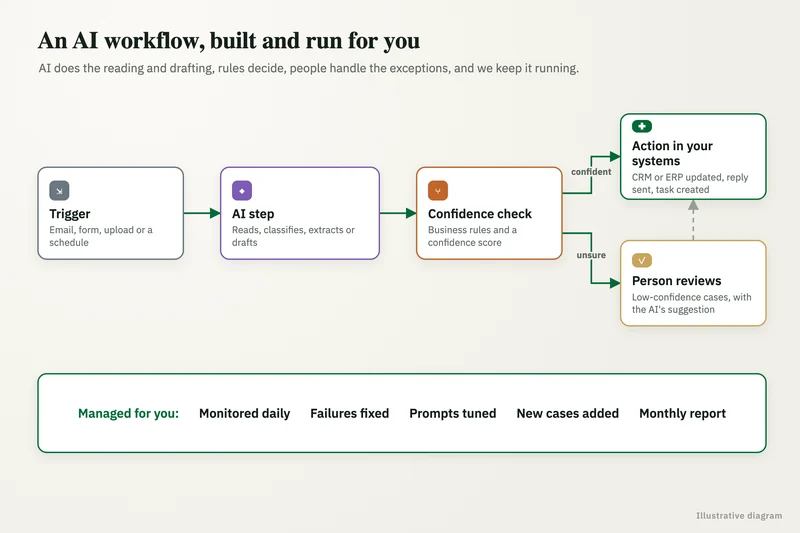
The right route depends on where the work happens and who starts it. If a clinician wants help with notes during a visit, native athenaOne features or a Marketplace scribe cover it. If faxed referrals, intake forms or after-hours calls arrive on their own and must become chart documents, appointments or tasks, you need something that runs on a trigger, writes through athenahealth's APIs and holds anything uncertain for staff.
Most practices will mix routes: native AI for documentation and billing, a Marketplace app where a specialist product already exists, and a custom build only for the workflow that is specific to them. The table sets the options side by side.
| Route | What it is | Best for | Main limit |
|---|---|---|---|
| Native athenaOne AI | AI features athenahealth builds into athenaOne, including athenaAmbient and revenue cycle tools | Clinical notes, inbox triage, insurance selection, denials and coding support | You get what athenahealth ships, on its timeline |
| Marketplace partner app | A third-party product already integrated and listed on the athenahealth Marketplace | Specialist needs such as ambient scribes, reputation management or patient messaging | Fixed product scope, separate subscription, another BAA |
| Patient Claude connector | athenaPatient MCP, which lets patients share their own records with Claude | Patients asking questions about their own health data | Patient-directed; not a tool for staff or practice workflows |
| Custom build on athenahealth APIs | Code or workflows calling FHIR and athenaOne APIs plus a model provider under a BAA | Referral and fax intake, AI phone scheduling, cross-system reporting, practice-specific rules | Needs API access approval, design, testing, monitoring and an owner |
What AI does athenaOne already include?
Quite a lot, and it is growing every release, so check it before paying anyone. In an August 2026 announcement, athenahealth said it had extended its AI-native athenaOne experience to more than 170,000 clinicians. That includes athenaAmbient, which captures the patient conversation and drafts the note, potential diagnoses and recommended order types, and which athenahealth says is built into athenaOne at no additional cost. The same announcement describes an AI-native clinical inbox that surfaces insights and suggests next steps, with problem-based summaries, a timeline view and a value-based care analytics assistant still in alpha.
On the revenue side, TechTarget reported athenahealth's release of more than 80 AI features for revenue cycle management. Examples include picking the right insurance package from a photo of the patient's card, AI voice agents that place prior authorization calls, help resolving coding-related denials, and an express coding tool in beta that athenahealth plans to sell as an add-on.
The Marketplace covers many gaps on top of that. Ambient scribe vendors such as Sunoh.ai and Abridge have announced athenahealth integrations, and athenahealth announced a partnership in April 2026 to bring rater8's reputation management into athenaOne. If a listed app does what you need, enabling it is usually faster and cheaper than a build. Ask your athenahealth customer success manager which features your contract already includes before you scope anything.
Does the athenahealth Claude integration help a practice?
Not directly. TechTarget reported on 3 November 2026 that athenahealth launched athenaPatient MCP, a Model Context Protocol server that lets patients connect their own athenahealth records to Claude. Patients sign in with their athenahealth credentials, choose which data to share, such as lab results, vitals, conditions, medications, immunizations, visit history and procedures, and can withdraw access at any time. It is open to Claude Pro and Max users in the US.
It is a patient tool, and the compliance position reflects that. GovInfoSecurity quoted athenahealth's data leader Sam Lambson: "This is patient-directed, and the AI assistant is not a covered entity or business associate." Attorneys in the same piece agreed HIPAA usually does not reach a patient-directed exchange, while warning the analysis can change when an EHR vendor and an AI provider partner directly. For your practice the lesson is the opposite case: when you send patient data to an AI vendor to run your own workflow, that vendor is acting for you, and a BAA is needed. This is not legal advice; confirm specifics with your compliance counsel.
How does athenahealth API integration work for an AI build?
A custom build reads and writes through athenahealth's APIs, which come in two families with different rules. According to Nirmitee's 2026 athenahealth developer guide, the certified FHIR R4 APIs are free to use but almost entirely read-only, while the athenaOne APIs cover scheduling, clinical documents, orders and billing, are billed by call volume and have no public rate card. In practice an AI agent can read a patient's problems and medications over FHIR, but booking an appointment or filing a referral letter into the chart goes through athenaOne APIs.
Getting access has steps that belong in the project plan. Developers can register and test against a Preview sandbox with synthetic data, but the same guide notes that production use of non-certified APIs needs a Platform Services contract or Marketplace partnership, a solution validation review and enablement for each practice. Calls to non-certified APIs without that contract are rejected. Build that approval time into the schedule rather than discovering it after the demo works.
For events, FHIR subscriptions and changed-data feeds tell a pipeline when appointments or patient records change, so it does not have to poll the whole practice. Department and practice IDs scope most calls, which matters for multi-location groups where each site books differently.
- Read over FHIR: demographics, problems, medications, allergies, recent results and visit history.
- Write with athenaOne APIs: appointments, clinical documents, tasks and orders, each under a scoped service account.
- Listen for events: subscriptions on appointment and patient changes instead of polling.
- Keep a log outside athenaOne: input, model output, confidence score, reviewer and the API response for every action.
What does an athenahealth AI integration cost, and how long does it take?
Costs split into a one-time build, athenahealth's own API charges and the running bill for models and hosting. athenahealth does not publish its API rate card, so ask for it during scoping. For the build, the most specific published ranges we found come from Arkenea, a healthcare software firm, which bases them on its own athenahealth integration engagements. They describe data integrations in general, not AI specifically, and are not our prices.
Arkenea also puts annual maintenance at 10-20 percent of the original build cost. On top of that, an AI layer adds model usage, a review screen for staff, and per-minute voice platform fees if the integration answers phones. Our AI implementation cost guide breaks down those running costs.
| Scope (Arkenea, 2026) | Published timeline | Published budget |
|---|---|---|
| Read-only integration | 6-10 weeks | $25,000-45,000 |
| Bidirectional integration with writes | 10-16 weeks | $45,000-90,000 |
| Product-grade, multi-practice integration | 16-24 weeks | $90,000-180,000 |
What does an athenahealth AI integration look like in practice?
Here is a worked example with round numbers for illustration, not a client result. A specialty group with six locations receives 1,200 faxed and emailed referrals a month. Staff open each one, find or create the patient, classify the document, file it to the right chart and department, and create a scheduling task. At about 6 minutes each, that is 120 hours a month, and misfiled referrals mean patients who are never called.
A custom pipeline watches the fax inbox and referral mailbox, extracts patient name, date of birth, referring provider, reason and insurance into a fixed schema, and matches the patient in athenaOne using several fields, never name alone. When the match and classification clear the confidence threshold, it files the document to the chart through the athenaOne API and creates a task for the scheduling team. Anything uncertain, such as two possible patient matches or an unreadable insurance ID, goes to a review screen showing the fax, the proposed match and the reason it was held.
If 75 percent of referrals file without edits and the rest take a minute of review, 120 hours of filing can drop to about 5 hours of review (300 held referrals at a minute each), with every referral logged and none filed without a trace. The real pass rate depends on fax quality and how clean patient demographics are, so we measure it on a few hundred real referrals before quoting. The same pattern feeds an AI receptionist that books into athenaOne slots, or a nightly report that joins athenaOne data with your CRM.
How do you keep an athenahealth AI integration HIPAA compliant?
Compliance comes down to contracts, minimum necessary data, permissions and logs. Every vendor in the chain that handles protected health information for you, including the model provider, voice platform and hosting, needs a signed Business Associate Agreement. Major model vendors sign BAAs only on certain API or enterprise tiers, not consumer plans, so a staff member pasting chart notes into a personal ChatGPT or Claude account is a breach risk no integration can fix. This is not legal advice.
Prompt injection is the risk most teams miss. A faxed letter can contain text that reads like an instruction. The model must treat document content as data, and actions such as changing a patient's demographics, insurance or appointment should go to a person.
- Signed BAAs with the model provider, voice platform, hosting provider and the build partner.
- Send the model only the fields the task needs; mask identifiers where the task allows it.
- One scoped service account per workflow, limited to the departments and endpoints it uses.
- Human review for anything clinical, financial or patient-facing before it is written back.
- Audit logs of every read, proposal, approval and write, kept for your retention period.
- Cost and volume alerts so a failing loop does not run up API or model charges overnight.
How do you choose a partner for athenahealth AI integration?
Choose a partner who can explain the API access path and the failure handling, not just show a demo against the Preview sandbox. The hard parts are production approval, patient matching, department rules and what happens when athenaOne rejects a write.
Do not buy a custom build if athenaOne already includes the feature, if a Marketplace app does the job, or if volume is a handful of documents a day. Where a build does make sense, we scope it after a free review of real samples, quote a fixed price, and hand over the code, prompts and accounts so you own all of it, with a person in the loop on anything touching patients or money. Ask each candidate these questions in writing.
- Which route fits this workflow (native, Marketplace or custom), and why not the others?
- Which endpoints need athenaOne APIs rather than FHIR, and what will those calls cost us?
- Who applies for production access, and how long do you plan for approval?
- How do you match patients, and what happens when two records look alike?
- Which vendors will touch PHI, and will each sign a BAA?
- Who owns the code, prompts, logs and model accounts when the project ends?
Case study · Logistics company, UK
Route planning automation
Dispatch typed every address into Google Maps, which optimizes only 25 stops and cannot add time at each stop. A Python tool that loads addresses automatically, adds buffer time per stop and optimizes the full route.
- Manual address entry eliminated
- Delivery estimates customers could rely on

FAQ
Frequently asked questions
Does athenahealth have built-in AI?
Yes. athenaOne includes athenaAmbient for drafting clinical notes, which athenahealth says comes at no additional cost, plus an AI-native clinical inbox and more than 80 revenue cycle AI features such as insurance card capture and denial support. Some features are still in alpha or sold as add-ons.
Can Claude connect to athenahealth?
Patients can connect their own records to Claude through athenaPatient MCP, launched in November 2026 for Claude Pro and Max users in the US. That connector is patient-directed and not designed for practice workflows. For staff-facing AI, you need native features, a Marketplace app or a custom integration under a BAA.
Does athenahealth have an API for AI integrations?
Yes. athenahealth offers certified FHIR R4 APIs, which are free and mostly read-only, and athenaOne APIs for scheduling, documents, orders and billing, which are billed by call volume. Production access to athenaOne APIs needs a Platform Services contract or Marketplace partnership and enablement for each practice.
How much does an athenahealth integration cost?
Arkenea publishes ranges from its own athenahealth work of $25,000-45,000 for read-only integrations and $45,000-90,000 for integrations that write back, with maintenance at 10-20 percent a year. Add athenaOne API call charges, which have no public rate card, plus model and hosting costs for the AI layer.
Is an AI integration with athenahealth HIPAA compliant?
It can be, if every vendor that handles PHI for you signs a BAA, the model only receives the fields it needs, access is scoped per workflow and every action is logged. Consumer AI accounts are not suitable for patient data. This is not legal advice.
Can an AI receptionist book appointments in athenaOne?
Yes, through the athenaOne scheduling APIs, since the FHIR appointment interface is not built for open-slot search and booking. The receptionist checks open slots for the right department and provider, books or holds the slot, and hands the call to staff when it is unsure or the caller asks for a person.
Should we use a Marketplace app or a custom build?
Use a Marketplace app when one already does the job, because it is integrated, supported and usually faster to switch on. Build custom when the workflow is specific to your practice, spans several systems or needs rules no listed product supports.
Keep reading
Related pages
Get started
Tell us what you want automated
Describe the task, the systems involved and the volume. We reply within one business day with an architecture, the tools we would use, running costs and a fixed-price build plan.
- Free 30-minute build review
- Fixed quote before any work starts
- You own the accounts, code, prompts and data
Prefer email? info@aiimplementationconsultants.com
Get a free build plan
Two lines is enough to start.