

Platform guide
Amazon Bedrock consulting: what to build, what it costs to run and who to hire
Amazon Bedrock consulting means hiring a team to design, build and run generative AI applications on Bedrock inside your own AWS account: choosing models, grounding answers in your documents, adding guardrails, deploying agents and wiring the results into the systems your staff already use. This guide is for IT, operations and product leads at US companies that already run on AWS and want a production system, not a demo. It covers when Bedrock is the right platform, what the build includes, what AWS charges to run it, and how to judge a partner.
Get a free build plan
Two lines is enough. A specialist replies within one business day.
Spec: quick answer
What does an Amazon Bedrock consultant do?
An Amazon Bedrock consultant builds production AI on AWS's managed model service: picking models from providers such as Anthropic, OpenAI, Meta, Mistral and Amazon, setting up Knowledge Bases for document search, Guardrails for content and PII filtering, AgentCore for agents, IAM and PrivateLink for security, and cost controls, then connecting it all to your business systems.
- Bedrock fits best when your data, identity and logging already live in AWS.
- Most of the build is integration, retrieval and review queues, not the model call.
- AWS publishes per-unit prices for Knowledge Bases, Guardrails and AgentCore, so estimate before building.
- Judge partners on integration depth and evaluation habits, not just their AWS tier.
What is Amazon Bedrock consulting, and when do you need it?
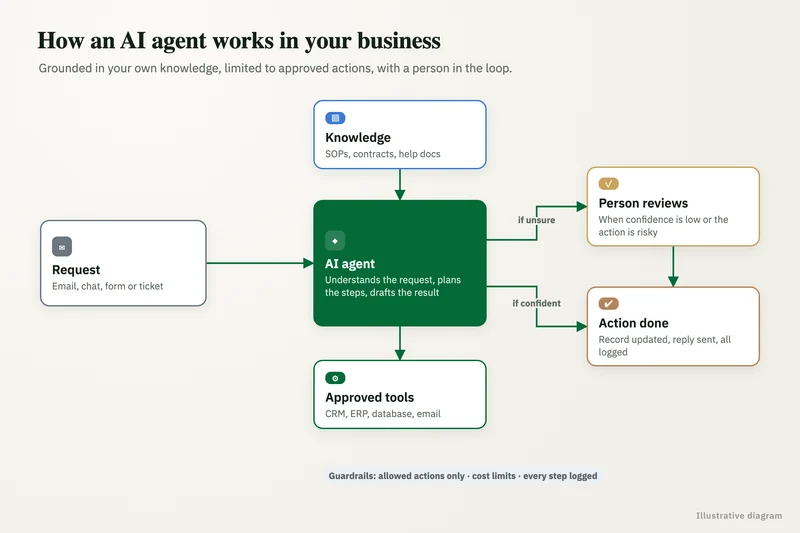
Amazon Bedrock consulting is hands-on engineering work that turns Bedrock's building blocks into a working application with owners, tests and a monthly bill you can predict. Bedrock gives you API access to foundation models plus managed services around them. It does not decide which workflow to automate, map your Salesforce fields, clean your SharePoint permissions or design the screen where a person approves a low-confidence answer. That is the part you hire for.
You usually need outside help in one of three situations. Your team knows AWS well but has not shipped a retrieval or agent system before. A pilot works in a notebook but nobody has added evaluation, logging and cost caps. Or the use case touches regulated data and security wants private networking, encryption with your own keys and an audit trail before anything goes live.
The choice of platform has become more interesting in late 2026. In its weekly roundup of October 5, 2026, AWS announced a public preview of Amazon Bedrock Managed Agents powered by OpenAI, built on a customized version of OpenAI's Agents API, alongside new OpenAI models on Bedrock. AWS's Bedrock FAQ now lists AI21 Labs, Amazon, Anthropic, Cohere, DeepSeek, Luma AI, Meta, Mistral AI, OpenAI, Stability AI, TwelveLabs and Writer as model providers. For a buyer, that means picking Bedrock no longer locks you out of any of the major model families.
Bedrock, a direct model API or another cloud: which should you build on?
Choose Bedrock when the rest of your stack is on AWS and you want model calls to stay inside your account, under your IAM roles and CloudTrail logs. Choose a direct API from OpenAI or Anthropic when you are small, not on AWS and want the newest vendor features the day they ship. Choose Microsoft Foundry or Google's Vertex AI when your identity, data and contracts already sit with those clouds.
The table below is the shortcut we use in a first call. It is not about which models are smartest, since all three clouds now carry strong models from several vendors. It is about where your data, logins and procurement already live, because that is what drives integration effort and security review time.
| Your situation | Usually best fit | Why |
|---|---|---|
| Workloads, data lake and identity already on AWS | Amazon Bedrock | IAM, PrivateLink, KMS keys, CloudTrail and S3 data are already in place, and spend lands on the AWS bill you have |
| Microsoft 365, Entra ID and Azure are the standard | Microsoft Foundry or Copilot Studio | Same identity, compliance tooling and purchasing path as the rest of your Microsoft estate |
| Google Workspace and BigQuery are the core | Gemini Enterprise or Vertex AI | Data and permissions stay in Google's stack |
| Small team, no cloud preference, one model vendor | Direct OpenAI or Anthropic API | Fewest moving parts and earliest access to vendor features |
| Need to mix models and route by cost | Amazon Bedrock (or another multi-model cloud) | Several providers behind one API, with Intelligent Prompt Routing priced at $1 per 1,000 requests |
What does an Amazon Bedrock implementation actually include?
A production Bedrock implementation is a set of AWS services wired together around one workflow. The model call is a few lines of code; the work is in feeding it the right context, checking what comes back and writing results somewhere useful. These are the components we scope for a typical build, and a good partner should be able to explain each one for your use case.
Not every project needs all of them. A document Q&A assistant for staff might use a Knowledge Base, Guardrails and a simple web front end. An agent that reads inbound purchase requests, checks NetSuite and drafts a reply needs AgentCore, tool definitions, identity handling and a human approval step.
- Model selection: a shortlist tested against your own examples, with a cheaper model for classification and a larger one only where reasoning is needed.
- Knowledge Bases: ingestion from S3, SharePoint or Confluence, chunking, embeddings, and answers that cite the source passage.
- Guardrails: content filters, denied topics, PII redaction and contextual grounding checks that flag answers not supported by the retrieved text.
- AgentCore: Runtime to host agents, Gateway to expose your APIs as tools, Memory, Identity for user-scoped access, and Observability through CloudWatch.
- Integration: reading and writing records in Salesforce, HubSpot, NetSuite, QuickBooks, Zendesk or your own databases, with retries and duplicate checks.
- Security: IAM least-privilege roles, PrivateLink endpoints, KMS encryption with your keys, and model invocation logging.
- Evaluation and review: a test set of real inputs with known answers, rerun on every change, plus a queue where low-confidence results wait for a person.
What does Amazon Bedrock cost to run each month?
Bedrock is billed by usage: tokens for model calls, plus separate charges for retrieval, guardrails and agent hosting. AWS's Bedrock pricing page (November 2026) lists the figures below. Token prices differ by model and region, so we pull the current rate for your shortlisted models during scoping rather than guessing here.
The pricing tiers matter more than most buyers expect. Batch inference runs at 50% of the on-demand price for supported models, which suits overnight jobs such as classifying a backlog of tickets or summarizing a month of call notes. Flex is priced at a 50% discount to Standard, and Priority carries a 75% premium for latency-sensitive traffic. Provisioned Throughput reserves capacity by the hour on 1-month or 6-month commitments, and AWS's own worked example shows one model unit at $21.18 an hour costing $15,757.92 for a 31-day month. For most mid-size workloads, on-demand plus batch is far cheaper than reserving capacity.
| Bedrock component | AWS published price (Nov 2026) | What drives it |
|---|---|---|
| Batch inference | 50% lower than on-demand for select models | Jobs that can wait hours for results |
| Flex / Priority tiers | 50% discount / 75% premium to Standard | How fast each request must return |
| Knowledge Bases index storage | $5.00 per GB of raw data per month | Size of the document set you index |
| Knowledge Bases retrieval | $1.00 per 1,000 standard retrieval calls; agentic retrieval $4.00 per 1,000 plus $1.00 per 1,000 underlying calls | Number of questions asked |
| Guardrails | $0.15 per 1,000 text units for content filters and denied topics; $0.10 per 1,000 for sensitive information filters | Volume of text checked on the way in and out |
| AgentCore Runtime | $0.1276 per vCPU-hour and $0.0169 per GB-hour, consumption based | How long agents actually run |
| AgentCore Gateway | $0.005 per 1,000 invocations | Tool calls from agents to your APIs |
| Provisioned Throughput | Hourly per model unit, 1- or 6-month terms | Reserved capacity whether used or not |
A worked example: the monthly bill for a staff policy assistant
Take a 400-person company that wants staff to ask questions about HR policies, IT procedures and benefits documents, with answers that cite the source. Assume 2 GB of raw documents in a Knowledge Base and 20,000 questions a month, each answer checked by a content filter and a sensitive information filter, and each exchange counted as two text units for illustration.
At AWS's published prices, index storage is 2 GB at $5.00, or $10. Retrieval is 20,000 calls at $1.00 per 1,000, or $20. Content filtering on 40,000 text units at $0.15 per 1,000 is $6, and the sensitive information filter at $0.10 per 1,000 is $4. That puts the platform layer at about $40 a month before model tokens and hosting for the chat front end.
Model tokens are the variable line. We measure average tokens per question during testing, multiply by monthly volume at the chosen model's current rate and set a cap per request, so the first real invoice lands close to the estimate. The lesson from the example is that, for internal assistants at this scale, Bedrock's running cost is rarely the budget problem. The build, the document cleanup and the permissions work are where the money goes, which is why our AI implementation cost guide treats build and running costs as separate lines.
How long does a Bedrock implementation take?
A single, well-scoped Bedrock use case typically moves from discovery to production in weeks to a few months, depending mostly on integration and data work. Partner pages vary in what they promise: FactualMinds, an AWS-focused consultancy, advertises a working proof of concept in one to two weeks and production in four to eight. Softude's 2026 guide puts one AI use case at a typical 3-5 months, and multi-department rollouts at 6-12 months or more.
The gap between those figures is mostly scope. A Knowledge Base over clean PDFs in S3 is quick. A system that reads scanned documents, respects SharePoint permissions per user, writes into NetSuite and passes a security review takes longer. We work in this order, and each step has a clear exit test before the next one starts.
- Week 1-2: process mapping, sample inputs, success metric and model shortlist tested on real examples.
- Build: retrieval or agent logic, Guardrails, integrations and the human-review screen.
- Evaluation: a labelled test set, accuracy and cost per task measured against the target.
- Pilot: a small group of real users, with prompt and output logging switched on.
- Production: alerts, cost caps, rollback path, runbook and handover to your team.
Is Amazon Bedrock secure enough for regulated data?
Bedrock is built for it, but configuration decides the outcome. AWS's Bedrock FAQ states that users' inputs and model outputs are not shared with any model providers, and that AWS and third-party providers will not use Bedrock inputs or outputs to train their models. Data is encrypted in transit and at rest, can be encrypted with your own keys, and is stored at rest in the AWS Region where you use Bedrock. AWS lists Bedrock as HIPAA eligible and supports PrivateLink so traffic between your VPC and the models does not cross the public internet.
Eligible is not the same as compliant. Any vendor handling protected health information needs a signed Business Associate Agreement, so a healthcare build needs your AWS BAA in place, and every other tool in the chain, from the front end to the logging store, has to be covered too. We also set IAM roles so each agent can reach only the tables and APIs it needs, turn on model invocation logging to an encrypted bucket you own, and keep a person in the loop for anything that touches money, patients or customer records. This is not legal advice; your compliance team should confirm the setup for your obligations.
How do you choose an Amazon Bedrock consulting partner?
Pick the partner who can show how they will test, monitor and integrate your workflow, not the one with the longest list of AWS badges. AWS partner tiers tell you about a firm's relationship with AWS. They do not tell you whether the team has written records into Salesforce without creating duplicates, or what happens when the retrieval step returns nothing useful. We are an independent implementation team and do not claim AWS partner status, so judge us on the same questions below.
Ask every shortlisted firm the same questions and compare the answers side by side. Vague answers to the evaluation and ownership questions are the clearest warning sign.
- Which of our systems will the build read from and write to, and how will you handle API errors and duplicates?
- How will you measure accuracy before launch, and on what test set?
- What happens to a low-confidence answer: who sees it, and where?
- Which model will you start with, and how will you test a cheaper one against it?
- What will the monthly AWS bill be at our volume, and what caps will you set?
- Will everything run in our AWS account, under our IAM roles and our keys?
- Who owns the code, prompts, infrastructure templates and evaluation data at the end?
- How do you handle a model being retired or a new version changing behaviour?
- What logging and alerts will exist on day one?
- What is fixed in the price, and what counts as a change?
Common mistakes, and when not to use Bedrock
The most common mistake is buying Provisioned Throughput before measuring real traffic. Reserved capacity bills every hour whether it is used or not, and AWS's own example runs to five figures a month. Start on-demand, move overnight work to batch and only reserve capacity when steady volume justifies it. The second mistake is pointing a Knowledge Base at a whole SharePoint tenant without checking permissions, so staff can retrieve documents they should never see. The third is skipping an evaluation set, which leaves nobody able to say whether a prompt change made answers better or worse.
Bedrock is also not always the right answer. If your company does not use AWS today, adopting it just to host one chatbot adds account setup, IAM design and a new bill to manage. If the job is a standard one with a good off-the-shelf product, such as an AI receptionist or a help desk bot inside Zendesk, buying that product is often faster. And if you have not picked a workflow and a success metric yet, a platform decision is premature; start with one measurable process.
How we deliver Amazon Bedrock projects
We scope each Bedrock build in a free review, then quote a fixed price for a defined result. The review covers the workflow, the systems it touches, a sample of real inputs, the accuracy you need and the security constraints your team has set. The build runs in your AWS account, so the infrastructure, code, prompts, evaluation sets and data are yours from day one, and AWS bills you directly for usage.
Our team has delivered 100+ projects for 200+ clients over 8+ years, mostly automation and data work that connects AI to the systems where work already happens. If you are comparing platforms, our Claude implementation and private LLM deployment guides cover the neighbouring options, and our AI integration services page shows how we connect models to CRMs, ERPs and document stores.
Case study · Insurance brokerage, Australia
Automation and dashboarding
Policy data arrived as spreadsheets from several insurers, each in a different structure, and every client report took hours of manual cleanup. An automated pipeline that standardizes every insurer's file and feeds a single reporting dashboard.
- Report time cut from 4-5 hours to under 5 minutes
- Reporting accuracy up from about 75% to 99%

FAQ
Frequently asked questions
How much does Amazon Bedrock cost per month?
It depends on usage. AWS charges per token for model calls at rates that vary by model and region, plus items such as $1.00 per 1,000 Knowledge Base retrieval calls, $5.00 per GB per month for index storage and $0.15 per 1,000 text units for Guardrails content filters (AWS pricing page, November 2026). An internal assistant answering 20,000 questions a month can have a platform layer of around $40 before model tokens.
Can you use OpenAI models on Amazon Bedrock?
Yes. AWS's Bedrock FAQ lists OpenAI among its model providers, and on October 5, 2026 AWS announced new OpenAI models on Bedrock and a public preview of Bedrock Managed Agents powered by OpenAI. That lets AWS customers use OpenAI models under their AWS account, IAM and billing.
Does Amazon Bedrock use my data to train models?
No, according to AWS. Its Bedrock FAQ says inputs and outputs are not shared with model providers and are not used to train Amazon or third-party models. Data is encrypted in transit and at rest and stays in the AWS Region you use.
Is Amazon Bedrock HIPAA compliant?
AWS lists Bedrock as HIPAA eligible, which is not the same as compliant. You need a Business Associate Agreement with AWS, every other tool that touches protected health information must be covered too, and the system has to be configured with proper access controls and logging. This is not legal advice.
What is Amazon Bedrock AgentCore used for?
AgentCore is AWS's set of services for running agents in production: Runtime for hosting, Gateway for exposing your APIs as tools, Memory, Identity, Observability, Policy and evaluations. It is billed per use, for example $0.005 per 1,000 Gateway invocations. It suits teams that want to build agents with their own framework while AWS handles hosting, identity and monitoring.
Should we use Bedrock or call the OpenAI or Anthropic API directly?
Use Bedrock if your data and identity already live in AWS and you want model calls inside your account, under IAM, CloudTrail and your own encryption keys. Call a vendor API directly if you are a small team without an AWS footprint and want the simplest setup. Both can produce the same application; the difference is where security, billing and logging live.
How long does it take to build on Amazon Bedrock?
A narrow use case can reach a working pilot in a few weeks, while Softude's 2026 guide puts a typical single AI use case at 3-5 months end to end. Integration with systems such as NetSuite or Salesforce, document cleanup and security review usually take longer than the model work itself.
Keep reading
Related pages
Get started
Tell us what you want automated
Describe the task, the systems involved and the volume. We reply within one business day with an architecture, the tools we would use, running costs and a fixed-price build plan.
- Free 30-minute build review
- Fixed quote before any work starts
- You own the accounts, code, prompts and data
Prefer email? info@aiimplementationconsultants.com
Get a free build plan
Two lines is enough to start.