

Multi-location
AI receptionist for multi-location businesses: routing, booking and cost
An AI receptionist for multi-location businesses is one voice agent that answers every branch's phone line, works out which location the caller needs, and applies that site's hours, services, staff and calendar before booking, answering or transferring. It is for operators of clinics, home service companies, salons, franchises and retail groups with three or more sites whose calls go to busy front desks, shared voicemail or a call center that does not know the local details. This guide covers routing, booking, per-site setup, US compliance, a worked cost example across eight locations and the rollout order that avoids wrong-branch mistakes.
Get a free build plan
Two lines is enough. A specialist replies within one business day.
Spec: quick answer
How does an AI receptionist work for a business with multiple locations?
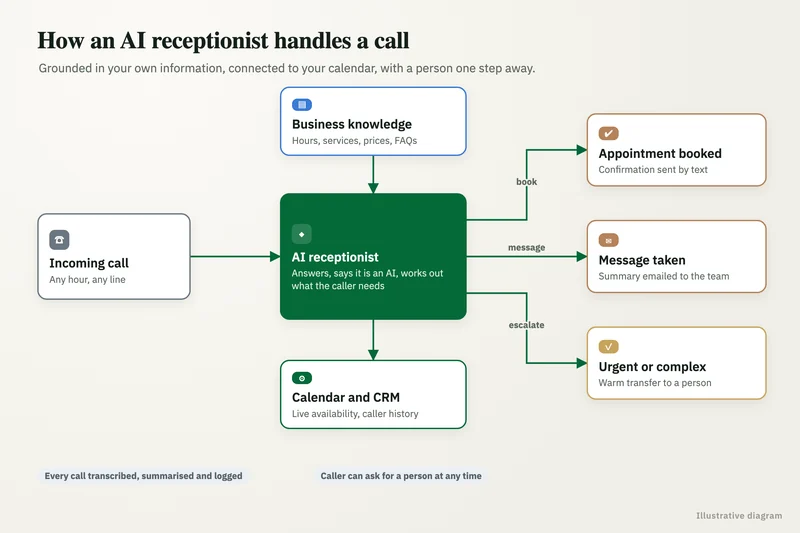
An AI receptionist for multi-location businesses identifies the location from the number dialed, the caller's record or a quick question, then answers with that branch's hours, services and policies, books into that site's calendar and transfers to that site's staff. Shared rules and brand voice are set once; local details are configured per location.
- Identify the branch from the dialed number first, and ask only when that fails.
- Set brand voice and policies once, then configure hours, staff and calendars per site.
- Per-site pricing and per-minute pricing diverge sharply as call volume grows.
- Pilot on one or two locations before switching every branch over.
What does an AI receptionist for multi-location businesses do differently?
A single-site AI receptionist knows one set of hours, one calendar and one transfer list. A multi-location setup has to decide which branch each call belongs to before it can say anything useful, then keep that context through the whole call: which hours apply, which services that site offers, which providers work there and whose phone rings on a transfer.
The rest of the job is familiar: answer routine questions, book and reschedule, take structured messages and hand over to a person when the call needs one. What changes is the data model behind it. Instead of one knowledge sheet, there is a shared layer for the brand and a location layer for each site, and every booking, transfer and report is tagged with the location it belongs to.
How does the AI route callers to the right location?
Routing works best in layers, from the most reliable signal to the least. Each branch keeps its own published number, forwarded to the AI line, so the number dialed identifies the location for most calls without asking anything. When one central number is used, the AI looks up the caller's phone number in the CRM or booking system to find their usual branch, and only then asks a short question such as which city or neighbourhood they are calling about.
Wrong-branch bookings are the most common multi-location failure, so we confirm the location out loud before any booking is written ("That's our Westfield clinic on Main Street, is that right?"). If the caller wants a service the dialed branch does not offer, the AI offers the nearest site that does, using a simple list of service-by-location rules rather than letting the model guess.
- Dialed number: each branch number maps to a location record.
- Caller lookup: phone number matched to a customer or patient record in HubSpot, Salesforce or the booking system.
- Spoken answer: city, ZIP code or landmark mapped to the nearest branch.
- Service check: the requested service is confirmed as available at that branch.
- Fallback: if location is still unclear, a person or a callback task, never a guess.
Which settings are shared and which are set per location?
Getting this split right is what keeps a 10-location rollout manageable. Anything that should sound the same everywhere sits in the shared layer and is edited once. Anything a branch manager might change on a Tuesday, such as holiday hours or who is on call, sits in the location layer, ideally in a sheet or admin screen the manager can edit without touching the AI.
| Setting | Shared across all locations | Configured per location |
|---|---|---|
| Greeting and voice | Brand name, tone, AI and recording disclosures | Optional local greeting line |
| Policies | Cancellation, payment, privacy, warranty | Local exceptions approved by head office |
| Hours | Default schedule template | Opening hours, holidays, closures |
| Services | Master service list and durations | Which services this site offers |
| Staff and calendars | Booking rules and buffer logic | Providers, rooms, calendar IDs |
| Transfers | Escalation rules and urgent keywords | Front desk, manager and on-call numbers |
| Reporting | Metrics definitions and dashboard | Recipients of the daily call digest |
How do bookings work across several location calendars?
The AI checks live availability in the calendar for the confirmed location, offers open slots and writes the appointment back while the caller is on the line. Where locations use different tools, for example Google Calendar at older sites and a practice management system at newer ones, each location record points to its own calendar connector, so the call flow does not change.
Cross-location booking is where a multi-site setup earns its keep. If the caller's usual branch has nothing this week, the AI can offer the next opening at a nearby site, provided head office has approved which sites can stand in for each other. We test double-booking explicitly: two test calls trying to book the same slot at the same time, so the second caller is offered a different time instead of creating a clash.
What does an AI receptionist cost across multiple locations?
Cost depends on whether the product charges per location or per minute, and the two models diverge quickly as volume grows. The example below is illustrative: eight locations, each with about 600 minutes of answered calls a month, so 4,800 minutes in total. Rates are the vendors' own published figures, applied by us to that volume, and exclude phone numbers, taxes and any build work.
Trillet's multi-location guide lists $49 a month per subscription with 150 included minutes and $0.20 per extra minute (as of September 2026), and we found no published volume discount or shared minute pool in it. At 600 minutes per site, each site runs 450 minutes over, so per-site pricing comes to about $1,112 a month. On a voice agent platform billed per minute, Retell AI's own all-in example of about $0.11 per minute gives roughly $528 for the same 4,800 minutes, and Bland AI's $0.14 per minute all-inclusive Start plan gives about $672. Vapi lists $0.05 per minute for the platform with model, speech and telephony billed on top, so its headline rate is not the full cost.
Per-site packages are easy to start and predictable at low volume. Per-minute platforms usually cost less at higher volume but need someone to build the routing, calendar connectors and reporting described here. Our AI receptionist cost guide covers the rates in more detail.
| Pricing model (published rate) | How it scales | 8 sites x 600 min/month |
|---|---|---|
| Trillet: $49/site/month, 150 min included, $0.20/min over (Sept 2026) | Per location, overage per site | About $1,112/month |
| Retell AI: about $0.11/min all-in in its example | Per minute across all sites | About $528/month |
| Bland AI Start plan: $0.14/min all-inclusive | Per minute across all sites | About $672/month |
| Vapi: $0.05/min platform, plus model, speech, telephony | Per minute, several bills | Platform alone about $240/month; full cost higher |
Should you buy a packaged AI receptionist or build a custom one?
Buy a packaged product when each location is simple: a few services, one calendar tool, and transfers to a front desk. Build on a voice agent platform when routing depends on your CRM, locations use different booking systems, you need network-wide reporting, or regulated data rules out consumer-grade tools.
| Situation | Packaged per-site product | Custom build on Vapi, Retell AI or similar |
|---|---|---|
| 2-3 locations, low call volume | Usually the better fit | Often more than you need |
| Mixed booking systems across sites | Limited to supported calendars | One connector per system |
| Routing from CRM records | Rarely supported | Caller lookup in HubSpot, Salesforce or your system |
| Network-wide reporting by site | Per-site summaries | One dashboard across locations |
| Protected health information | Check BAA on the plan | Stack chosen so every vendor signs a BAA |
| High call volume | Per-site overage adds up | Per-minute pricing across the network |
What compliance rules apply when locations are in different states?
Each call follows the rules of the states involved, so a network spread across states needs the strictest version built into the shared greeting. If even one branch sits in a two-party consent state, a recorded AI call there needs the caller told about recording, so the network greeting should announce it everywhere. AI disclosure works the same way: Utah's AI Policy Act and California's bot disclosure law both require telling people when they are dealing with an AI in certain situations. Putting both disclosures in every location's greeting is simpler than tracking which sites need them.
If the AI also places outbound calls, such as reminders or confirmations, the FCC ruled on February 8, 2024 that AI-generated voices count as artificial voices under the TCPA, so those calls need prior express consent. For dental groups, clinics and other healthcare networks, any vendor that handles protected health information needs a signed Business Associate Agreement; Vapi sells HIPAA compliance as a $2,000 a month add-on, while Bland AI includes a BAA on its Enterprise plan. This is not legal advice; confirm the rules for your states with counsel.
What should you report on per location?
Report by location and for the whole network, because the most useful findings are differences between sites. A branch with a low transfer success rate usually has a staffing gap at certain hours, not an AI problem. A branch with many "service not offered" calls may be losing demand to a nearby site or a competitor.
We send each location manager a daily digest of calls, bookings and callbacks owed, and head office gets a weekly view across sites. Every call is logged with a transcript, summary, location tag and outcome in the CRM, so the numbers can be checked against real calls.
- Calls answered, by hour of day and location.
- Bookings made, rescheduled and cancelled per location.
- Transfers attempted versus answered by staff.
- Calls where location was unclear or changed mid-call.
- Top unanswered questions, to update the knowledge sheet.
- Minutes used and cost per location.
How do you roll out an AI receptionist across locations?
Roll out in waves, not all at once. Start with one or two representative sites, ideally one busy and one quiet, and let the AI take after-hours and overflow calls first while staff review transcripts daily. Once wrong-branch rate, booking accuracy and transfer success look right, switch those sites to full coverage and add the next group of locations.
Each new wave mostly means filling in location records: hours, services, providers, calendar IDs and transfer numbers. If the pilot sites were set up properly, adding a location should be a data entry task plus a round of test calls, not a new build.
- Week 1: collect sample calls, location data and booking rules for pilot sites.
- Weeks 2-3: build routing, calendar connectors and the shared knowledge sheet; run scripted test calls.
- Weeks 3-4: soft launch on after-hours and overflow at pilot sites with daily transcript review.
- Next waves: add locations in groups, each with its own test calls before go-live.
What goes wrong with multi-location AI receptionists?
Most failures come from stale location data rather than the AI itself. A holiday closure that nobody entered, a provider who moved branches or a transfer number that now rings an empty desk will cause bad calls at that site only, which is why the location layer must be easy for managers to update. Other problems we design out from the start are booking at the wrong site, transferring to a branch that is closed, and treating an urgent call as routine because one site uses a different word for it.
We build our AI receptionists on voice platforms with Twilio numbers in your account, scope each project after a free review and quote a fixed price. You own the numbers, accounts, prompts and call data, and callers can always reach a person. See our AI receptionist service page for what a build includes.
Case study · Logistics company, UK
Route planning automation
Dispatch typed every address into Google Maps, which optimizes only 25 stops and cannot add time at each stop. A Python tool that loads addresses automatically, adds buffer time per stop and optimizes the full route.
- Manual address entry eliminated
- Delivery estimates customers could rely on
FAQ
Frequently asked questions
Can one AI receptionist answer calls for all of our locations?
Yes. One AI receptionist can answer every branch number, identify the location from the number dialed or the caller's record, and apply that site's hours, services, calendar and transfer list. Shared policies and brand voice are configured once for the whole network.
Can we keep each location's existing phone number?
Usually, yes. Each branch number is forwarded to the AI line, or ported to a Twilio account you own, and the number dialed tells the AI which location the caller wants. Callers keep dialing the number they already know.
How much does an AI receptionist cost for multiple locations?
Per-site products price each location separately; Trillet lists $49 a month per subscription with 150 included minutes and $0.20 per extra minute as of September 2026. Per-minute voice platforms such as Retell AI (about $0.11 per minute all-in in its example) bill total minutes across all sites, which is often cheaper at high volume.
Can an AI receptionist transfer calls to a specific branch?
Yes. Each location has its own transfer numbers for the front desk, manager and on-call staff, applied by time of day. If nobody answers, the AI takes a structured message and creates a callback task tagged to that location.
Does an AI receptionist work for franchises?
It can, with care over who controls what. Franchisors usually own the shared layer of brand voice, policies and disclosures, while each franchisee maintains hours, staff and calendars. Call data ownership and reporting access should be agreed before rollout.
Is a multi-location AI receptionist HIPAA compliant?
Only if every vendor that handles protected health information signs a Business Associate Agreement, which many offer only on higher tiers. For dental groups and clinic networks we choose a stack with a complete BAA chain before any patient call is taken. This is not legal advice.
How long does it take to roll out across all locations?
A pilot on one or two sites can usually start within a few weeks, depending on how many booking systems are involved. After the pilot, adding locations is mostly entering each site's hours, services, staff and numbers, followed by test calls for that site.
Keep reading
Related pages
Get started
Tell us what you want automated
Describe the task, the systems involved and the volume. We reply within one business day with an architecture, the tools we would use, running costs and a fixed-price build plan.
- Free 30-minute build review
- Fixed quote before any work starts
- You own the accounts, code, prompts and data
Prefer email? info@aiimplementationconsultants.com
Get a free build plan
Two lines is enough to start.