

Comparison guide
AI receptionist vs virtual receptionist: which one should answer your phones?
AI receptionist vs virtual receptionist comes down to this: a virtual receptionist is a trained person answering your calls remotely, billed by the minute or the call, while an AI receptionist is software that answers every call at once, billed at a fraction of the price but weaker on judgment. This guide is for office managers, practice owners and ops leads deciding which model to pay for, or how to combine them. It compares published vendor pricing, runs the numbers at a realistic call volume and lists the integration and compliance questions that decide the outcome.
Get a free build plan
Two lines is enough. A specialist replies within one business day.
Spec: quick answer
What is the difference between an AI receptionist and a virtual receptionist?
A virtual receptionist is a remote human who answers your calls; an AI receptionist is voice software that answers, books and routes calls automatically. Human services such as Ruby start at $250 a month for 50 minutes, while Smith.ai's AI plan starts at $150 a month. AI wins on volume and hours; people win on complaints, nuance and high-stakes calls.
- Virtual receptionists are remote people; AI receptionists are software that answers every call instantly.
- Published human plans cost several times more than AI plans at the same call volume.
- AI handles routine calls well but should transfer complaints, payments and clinical questions to people.
- A hybrid setup, AI first with a human fallback, suits most offices with mixed call types.
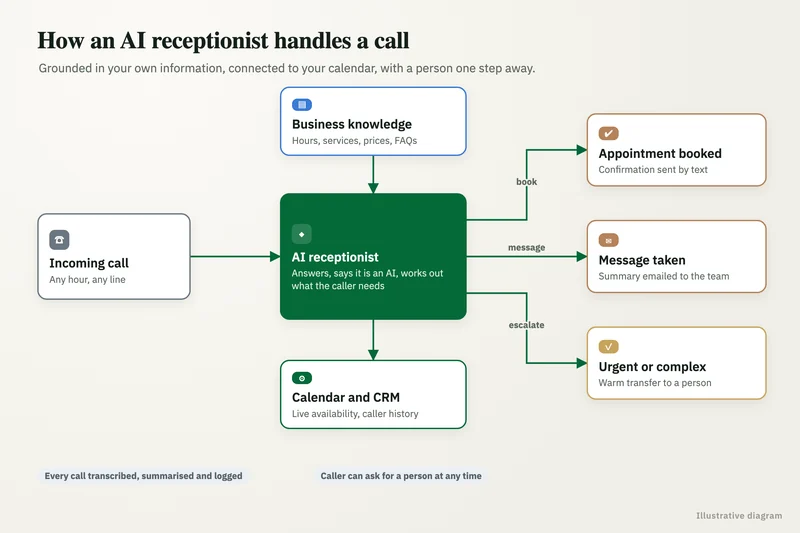
What is the difference between an AI receptionist and a virtual receptionist?
The difference is who picks up. A virtual receptionist is a real person, usually working for an answering company such as Ruby or Smith.ai, who answers calls in your business name from a remote location. An AI receptionist is a voice agent: speech recognition turns the caller's words into text, a language model decides what to do, and a synthetic voice replies, all within a second or two.
That one difference drives everything else. A person can read tone, calm an angry caller and handle a request nobody planned for. Software can answer fifty calls at the same moment, at 3 a.m. on a holiday, and write every detail straight into your calendar or CRM without retyping. Neither is a straight upgrade on the other, which is why the useful question is which calls belong with which.
Both are different from a traditional answering service, which mostly takes messages from a script. Many virtual receptionist companies now add AI features to their human plans (Ruby says AI enhancements such as transcripts and sentiment analysis are included in all its plans), and several AI vendors offer a live person as a fallback, so the line between the two is blurring.
How do AI and virtual receptionists compare side by side?
The table compares the two models on the factors that usually decide a purchase. Prices come from Ruby's and Smith.ai's pricing pages as checked in October 2026; they are third-party prices, not ours, and they change, so confirm them before you budget.
| Factor | Virtual receptionist (human) | AI receptionist |
|---|---|---|
| Who answers | A trained remote person | A voice agent built on a language model |
| Published entry price | Ruby Starter $250/month for 50 minutes; Smith.ai Starter $300/month for 30 calls | Smith.ai AI Pro $150/month (about $2 per call); free tier with 25 calls |
| How it is billed | Per minute (Ruby) or per call (Smith.ai), with overage beyond the plan | Per call on packaged plans, or per minute on voice platforms such as Retell AI and Vapi |
| Simultaneous calls | Limited by staff on shift | Many calls at once, limited only by telephony capacity |
| Hours | Depends on plan; Smith.ai lists 24/7 live staffing | Always on |
| Complaints and unusual requests | Strong | Weak; should transfer to a person |
| Writing to your calendar and CRM | Often through the vendor's own integrations, or retyped | Direct API calls to the booking system or CRM when built for it |
| Consistency | Varies by agent and shift | Same script every time, which also means the same mistakes until fixed |
| Setup effort | Scripts and instructions to the vendor | Call flows, knowledge, integrations and testing |
How much does a virtual receptionist cost compared with an AI receptionist?
A human virtual receptionist costs several times more than an AI receptionist at the same volume, because you are paying for staff minutes. Ruby's published plans run from $250 a month for 50 minutes to $1,725 for 500 minutes, with its most popular Standard plan at $720 for 200 minutes. Smith.ai's human plans are priced per call: $300 for 30 calls, $810 for 90 and $2,100 for 300, with overage between $8.50 and $11.50 per extra call depending on the plan.
AI pricing starts far lower. Smith.ai's AI receptionist has a free tier with 25 calls a month, a Pro plan from $150 a month (about $2 per call) and an Enterprise plan from $500 a month (about $1.67 per call), with live North America based receptionists available as escalation on all of them. If you build on a voice platform instead, published rates sit around $0.05 to $0.14 per minute, which our AI receptionist cost guide breaks down vendor by vendor.
Notice the billing unit, because it changes the winner. Per-minute plans punish long calls, so an office whose callers ask detailed questions pays more on Ruby than the call count suggests. Per-call plans punish many short calls, so a clinic fielding quick 'are you open today' calls pays the same for a 30-second call as for a five-minute one. Pull your phone system's call report before comparing quotes.
Worked example: 150 calls a month at three minutes each
Take an office that receives 150 calls a month with an average length of three minutes, so 450 minutes in total. These figures use the published prices above and are illustrative only; your own plan choice, overage terms and call mix will move them.
The spread is large: roughly $1,440 to $1,725 a month for an all-human service against a few hundred dollars or less for AI. The human figure buys judgment on every call. The AI figure buys coverage and speed, but only pays off if the agent actually resolves most calls instead of transferring them, so the share of calls it can finish is the number to estimate before deciding.
- Ruby (human, per minute): 450 minutes fits the Business plan at $1,725 a month for 500 minutes. The Standard plan's 200 minutes would be exceeded by a wide margin.
- Smith.ai human (per call): the Basic plan at $810 covers 90 calls; the remaining 60 at $10.50 each add $630, so about $1,440 a month.
- Smith.ai AI (per call): the Pro plan starts at $150 for its lower tier; 150 calls at its listed $2.00 to $2.50 per-call range comes to roughly $300 to $375 a month, with live escalation included.
- Custom build on a voice platform (per minute): 450 minutes at Retell AI's example all-in rate of about $0.11 per minute is roughly $50 a month in usage, plus phone number rental, a one-time build and the time someone spends reviewing calls.
Which calls should stay with a person?
Calls that involve money, emotion or risk should reach a person, whichever model answers first. Software that sounds confident is not the same as software that is right, and a wrong answer on these calls costs far more than the minutes saved.
Everything else is a candidate for AI: hours and directions, booking, rescheduling and cancelling, intake questions, order or job status, and routing by department or location. In most offices these routine calls make up the bulk of the volume, which is where the savings come from.
- Complaints, cancellations of large contracts and anything a caller is upset about.
- Payments, refunds and disputes over invoices.
- Clinical, legal or safety questions where a wrong answer carries liability.
- Callers who ask for a person, or who the agent fails to understand twice.
- High-value sales calls where tone and rapport decide the deal.
Is an AI receptionist or a virtual receptionist better for HIPAA and call compliance?
Neither model is compliant by default; the vendor terms decide it. For healthcare, any vendor handling protected health information needs a signed Business Associate Agreement. With a human service, that is one agreement with one company, so ask for it before signing. For AI the chain is longer: the voice platform, the model provider and the phone carrier may all touch the data. Major model vendors sign BAAs only on certain API or enterprise tiers, not consumer plans, Vapi sells HIPAA compliance as a $2,000 per month add-on, and Bland AI includes a BAA on its Enterprise plan.
Disclosure and recording rules apply to AI receptionists too. Some states require callers to be told they are speaking with an AI (Utah's AI Policy Act and California's bot disclosure law), and states with two-party consent rules for call recording apply when the agent records. If the AI also places outbound calls, the FCC ruled on February 8, 2024 that AI-generated voices count as artificial voices under the TCPA, so those calls need prior express consent. This is not legal advice; check your setup with counsel.
How does a hybrid AI and human receptionist setup work?
In a hybrid setup the AI answers every call, finishes the routine ones and transfers the rest to a person with context attached. The person can be your own front desk, an on-call manager or a virtual receptionist service kept as the fallback. Smith.ai builds this escalation into its AI plans, and when we build one, the transfer goes to whichever numbers you choose.
The handoff is where hybrid setups succeed or fail. A good one passes the caller's name, number, reason for calling and what the agent already tried, so the person does not start from zero. It also has a defined path when nobody answers the transfer: take a detailed message, send it by text or email to the right owner, and create a task in the CRM so the callback is tracked.
The rules for when to transfer should be explicit, not left to the model's mood. We set them as named triggers (caller asks for a person, the topic is on the human-only list, the agent's confidence in its understanding falls below a threshold, or the same question fails twice) and review transcripts of transferred calls in the first weeks to tighten them.
What integrations make an AI receptionist worth more than a human service?
Integrations are where AI pulls ahead, because a person on a remote team usually cannot write into your systems directly. A receptionist that books into the real calendar, checks the real job status and logs the call in your CRM removes the retyping that a message-taking service leaves behind.
Typical connections are Google Calendar, Microsoft 365 or Calendly for booking; a practice management system or EHR for clinics; HubSpot or Salesforce for creating contacts and logging call notes; a field service tool for job status; and a Twilio number or your existing phone system for transfer. Each connection needs failure handling: if the booking API times out, the agent should say so, take the details and alert staff, never confirm an appointment it did not create.
If you only need messages taken, these integrations matter less, and a packaged product or a human service may be the simpler buy.
When should you not switch to an AI receptionist?
Stay with people, or keep them as the main line, when most of your calls are the kind listed above for humans. A law firm whose calls are mostly distressed new clients, or a high-end service business where the first call is the sales pitch, may lose more than it saves.
Also hold off if call volume is tiny and a human plan already fits comfortably, if you cannot get BAA coverage from every vendor in the chain for health data, or if nobody on your side can review transcripts for the first month. An AI receptionist left unreviewed tends to repeat the same small mistakes, and callers notice. Our guide on why AI projects fail covers the ownership gaps that cause this.
How do you decide between an AI receptionist and a virtual receptionist?
Decide from your own call data rather than vendor claims. Export a month of calls, sort them into types, and see how many an AI could finish without a person.
If routine calls are the majority and you need after-hours coverage or bookings in your own systems, an AI-first or hybrid setup usually wins. If judgment calls are the majority, a virtual receptionist is the safer spend, perhaps with AI handling overflow and nights.
If you want help with the call analysis, we do it as part of a free review of your call reports, phone system, calendar and CRM, then quote a fixed price for the build. The voice platform, phone number and model accounts are opened in your name, you keep the prompts and call logs, and a person stays the fallback for anything touching money, complaints or regulated data.
- Count calls by type: booking, status, information, sales, complaints, other.
- Measure average call length and peak hours from the phone system report.
- Mark which call types need a person, and estimate their share.
- List the systems the receptionist must read from or write to.
- Check BAA, disclosure and recording requirements for your state and industry.
- Price both models at your volume using the billing unit each vendor uses.
- Run a pilot on after-hours or overflow calls before moving the main line.
Case study · Logistics company, UK
Route planning automation
Dispatch typed every address into Google Maps, which optimizes only 25 stops and cannot add time at each stop. A Python tool that loads addresses automatically, adds buffer time per stop and optimizes the full route.
- Manual address entry eliminated
- Delivery estimates customers could rely on
FAQ
Frequently asked questions
Is an AI receptionist cheaper than a virtual receptionist?
Usually, by a wide margin. Ruby's human plans start at $250 a month for 50 minutes and Smith.ai's at $300 for 30 calls, while Smith.ai's AI plan starts at $150 a month at about $2 per call. The saving only holds if the AI resolves most calls instead of transferring them.
Can an AI receptionist replace a human receptionist completely?
For offices whose calls are mostly booking, status and information requests, it can handle most of them. Complaints, payments, clinical or legal questions and callers who ask for a person should still reach a human. Most businesses get the best result from AI first with a human fallback.
Do callers know they are talking to an AI receptionist?
They should. Some states, including Utah under its AI Policy Act and California under its bot disclosure law, require callers to be told they are speaking with an AI. A short disclosure in the greeting is simple and avoids losing trust when callers work it out themselves.
What is the difference between a virtual receptionist and an answering service?
A virtual receptionist acts like a remote front desk: they greet callers in your name, transfer calls, book appointments and screen leads. A traditional answering service mostly takes messages from a script. Many providers now blend both and add AI features on top.
Can a virtual receptionist and an AI receptionist work together?
Yes, and it is a common setup. The AI answers every call and handles routine requests, then transfers complex or sensitive calls to a live receptionist with the caller's details attached. Smith.ai includes live escalation in its AI plans, and custom builds can transfer to any number you choose.
Is an AI receptionist HIPAA compliant?
Only if every vendor that handles protected health information signs a Business Associate Agreement, which can include the voice platform, the model provider and the phone carrier. Major model vendors sign BAAs only on certain API or enterprise tiers, and some voice platforms charge extra for HIPAA coverage.
How long does it take to switch from a virtual receptionist to AI?
A packaged AI receptionist that takes messages and books into a supported calendar can be live quickly. A custom build that books into an EHR or writes to a CRM takes longer because of integration and testing. Starting with after-hours or overflow calls lets you run both while the AI is tuned.
Keep reading
Related pages
Get started
Tell us what you want automated
Describe the task, the systems involved and the volume. We reply within one business day with an architecture, the tools we would use, running costs and a fixed-price build plan.
- Free 30-minute build review
- Fixed quote before any work starts
- You own the accounts, code, prompts and data
Prefer email? info@aiimplementationconsultants.com
Get a free build plan
Two lines is enough to start.