

Platform comparison
Vapi vs Retell: which voice AI platform fits your build, and what it really costs
Vapi vs Retell comes down to this: Retell is the faster route to a production phone agent for a business team, with more included in its per-minute price, while Vapi gives developers more control over every provider in the call and suits teams that will write and maintain code. This guide is for ops, support and IT leads choosing a platform for an AI receptionist or outbound voice agent. It compares both from their own pricing pages and documentation as of November 2026, works through a monthly bill and explains how to run a fair test before you commit.
Get a free build plan
Two lines is enough. A specialist replies within one business day.
Spec: quick answer
Is Vapi or Retell better for a business voice agent?
For most businesses, Retell is the simpler choice: a visual conversation flow builder, warm transfer, 20 concurrent calls included and SOC 2 with a custom BAA. Vapi is better when developers want to pick and swap every provider, build multi-assistant Squads in code, and are comfortable assembling transcription, model, voice and telephony costs separately.
- Retell includes 20 concurrent calls; Vapi's free tier includes 4 and charges $10 per extra line.
- Vapi's HIPAA add-on is $2,000 a month, which can outweigh every per-minute difference.
- Vapi retired Workflows on August 18, 2026, so older Vapi builds need moving to Squads.
- Test both on your own call recordings before choosing; vendor comparisons are written to win.
Vapi vs Retell: what is the short answer?
Pick Retell if you want a working phone agent quickly, a builder that non-developers can follow and fewer line items on the invoice. Pick Vapi if you have engineers who want to control the transcriber, model, voice and carrier separately, and who will maintain the agent in code after launch.
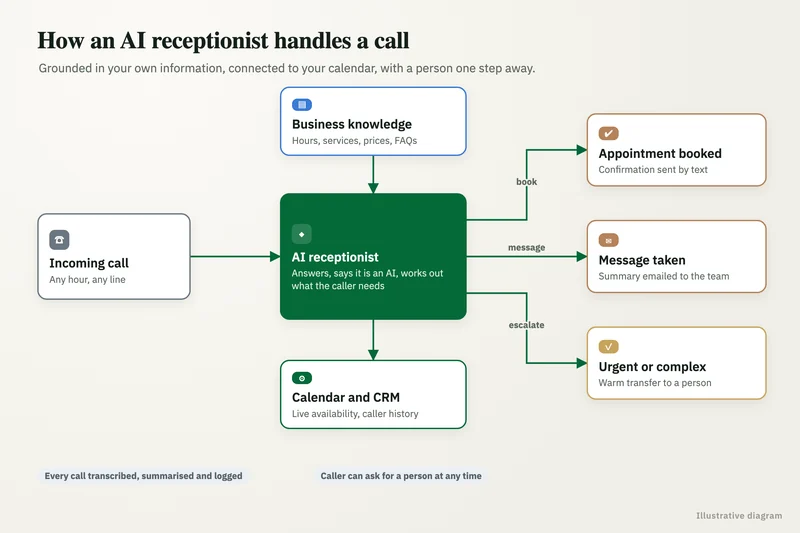
Both platforms do the same core job. They take a phone call, turn speech into text, send it to a language model with your instructions and tools, turn the reply back into speech and manage the turn-taking in between. Both connect to Twilio or Telnyx numbers, call your APIs mid-conversation and send call data to your systems afterwards. The differences sit in how you build the conversation, what the per-minute price includes, how many calls can run at once and what regulated data costs.
One warning before the details: most pages ranking for this comparison are written by Retell itself, by competitors selling an alternative, or by tools that sell testing. Treat every vendor table, including the claims below, as a starting point for your own test rather than a verdict.
How do Vapi and Retell compare side by side?
The table summarizes what each vendor publishes on its pricing page and documentation, checked in November 2026. Where a vendor does not publish a figure, the cell says so.
| Factor | Vapi | Retell AI |
|---|---|---|
| Platform fee | $0.05/min hosting fee | $0.055/min Retell Voice Infra |
| What else you pay per minute | Transcriber, model, voice and transport, each listed separately | Model and voice, plus telephony at $0.015/min (none for your own SIP trunk) |
| Published all-in range | Not published as one figure | $0.07-$0.31/min depending on model and voice |
| Concurrent calls included | 4 free, 10 on Core ($29/month), 30 on Pro | First 20 free |
| Extra concurrency | $10 per line per month | $8 per concurrent call per month |
| Phone numbers | Not itemized on the pricing page; Twilio or Telnyx numbers are billed by the carrier | $2/month per number |
| Regulated data | HIPAA add-on $2,000/month, includes BAA and DPA | SOC 2 certified, HIPAA-ready, custom BAA |
| Uptime SLA | 99% on Pro, 99.9% on Premier | Enterprise terms on request |
| How you build | Assistants and multi-assistant Squads, API-first | Single prompt agents or a node-based conversation flow |
| Free start | $5 in credits | $10 in credits |
What does each platform really cost per minute?
Headline platform fees of $0.05 and $0.055 are close to meaningless on their own, because neither is the price of a call. A real minute also pays for speech recognition, the language model, the synthetic voice and the phone line, and the two vendors bundle these differently.
Vapi's pricing page itemizes each layer. In November 2026 it listed Deepgram transcription at $0.0095-$0.0099 per minute, OpenAI models at $0.0077-$0.0452 per minute, ElevenLabs voices at $0.0146-$0.0238 per minute, and transport at $0.008 per minute for Twilio inbound or $0.0055 per minute for Telnyx, all on top of the $0.05 hosting fee.
Retell's pricing page folds transcription into its $0.055 infrastructure fee and charges the rest as add-ons: voices from $0.015 per minute for its basic options up to $0.040-$0.10 per minute for ElevenLabs voices, telephony at $0.015 per minute, and a model charge that ranges from a fraction of a cent to more than $0.30 per minute for the fastest premium models. Optional extras include knowledge base retrieval at $0.005 per minute, PII removal at $0.01 per minute and batch outbound dialing at $0.005 per dial.
The model and voice you choose move the total more than the platform does. A large, fast model with a premium voice can cost several times more per minute than a small model with a standard voice, on either platform, so decide the quality you need first and price the platform second.
Worked example: 3,000 inbound minutes a month
Take a services business whose AI receptionist handles about 3,000 minutes of inbound calls a month, with an ElevenLabs voice on both platforms so the comparison is like for like. The model charge is left out of both columns because it depends on which model you pick; add the same model line to each.
On Vapi, using the top of each published range: $0.05 hosting, $0.0099 transcription, $0.0238 voice and $0.008 Twilio inbound comes to about $0.092 per minute, or roughly $275 for 3,000 minutes. If more than four calls can arrive at once, add the $29 Core plan for 10 lines. On Retell: $0.055 infrastructure, $0.040 for the entry ElevenLabs voice and $0.015 telephony comes to $0.11 per minute, or $330 for 3,000 minutes, plus $2 for the number, with 20 concurrent calls already included. Switch Retell to one of its basic voices at $0.015 and the figure drops to $0.085 per minute, or $255.
So at this volume the two land within about $55 of each other on minutes, and the voice choice decides which is cheaper. Now make the same practice a medical office that needs a Business Associate Agreement. Vapi's HIPAA add-on adds $2,000 a month, which turns a $275 bill into $2,275 before the model. Retell lists a custom BAA but does not publish its price, so ask for it in writing before you compare. For small regulated call volumes, compliance pricing often decides the platform on its own.
These figures are built from the vendors' list prices in November 2026 and will change. For the wider picture, including other platforms and build costs, see our AI voice agent cost guide.
| 3,000 min/month, ElevenLabs voice, model excluded | Vapi | Retell AI |
|---|---|---|
| Per-minute subtotal | About $0.092 | $0.11 |
| Minutes cost | About $275 | $330 |
| Concurrency for up to 10 calls | $29 Core plan | Included (20 free) |
| Phone number | Your carrier's monthly rate | $2 |
| Subtotal before model | About $304 plus the number | About $332 |
| With a BAA for health data | Add $2,000 HIPAA add-on | Custom BAA, price on request |
Which is better for HIPAA and regulated calls?
If calls carry protected health information, the vendor must sign a Business Associate Agreement, and so must every provider in the chain that touches the audio or transcript. That rule matters more than any feature list.
Vapi sells HIPAA-eligible data handling as a $2,000 per month add-on that includes a BAA and a standard data processing agreement. Retell's pricing page describes the platform as SOC 2 certified and HIPAA-ready with a custom BAA. In both cases, confirm which plan the BAA covers, whether call recordings and transcripts are stored and for how long, and whether the model and voice providers you pick are covered too.
Recording consent applies whichever platform you choose. States with two-party consent rules for call recording apply them to AI receptionists that record calls, and the FCC ruled on February 8, 2024 that AI-generated voices count as artificial voices under the TCPA, so outbound calls need prior express consent. This is not legal advice; your counsel should confirm how these rules apply to your call types and states.
How do you build call logic on Vapi and on Retell?
Retell gives you two agent types. Its documentation recommends starting with a single prompt agent and moving to a conversation flow when you need more structure, where the call is split into nodes, each with its own instructions or actions. Warm transfer to a person, including an agentic warm transfer node, and post-call extraction of structured fields are built in. Operations staff can usually read and adjust a conversation flow after handover, which matters if you do not want to call a developer for every script change.
Vapi is API-first. You define assistants in code or the dashboard, and for multi-step calls you build a Squad: several assistants, each with its own prompt, voice, model and tools, handing the call to one another under conditions you describe. Vapi's visual Workflows product was retired on August 18, 2026, and from August 19 existing workflows stopped running. Vapi's migration guide maps conversation nodes to Squad members and edge conditions to handoff tools. If a previous vendor built your agent on Vapi Workflows, check that it was migrated.
Both platforms call your own endpoints during a call (check availability, look up an order, create a ticket) and send a webhook with the transcript, recording link and extracted fields when the call ends. That webhook is where the real integration work sits: writing the outcome into HubSpot, Salesforce, a practice management system or a field service tool, with duplicate checks and a retry when the CRM is down.
Latency, uptime and concurrency: what to check
Callers notice slow replies long before they notice a slightly better voice. Coval's February 2026 comparison put typical response latency at about 550-800 milliseconds for Vapi and 600-800 milliseconds for Retell, which is close enough that your model and voice choice, plus the distance between your servers and theirs, will matter more than the platform.
Uptime commitments differ by plan. Vapi's pricing page lists a 99% uptime SLA on Pro and 99.9% on Premier, with no SLA on the free tier. Retell offers enterprise terms on request. If the agent answers your main line, ask what happens when the platform is down: the answer should be a carrier-level fallback that forwards calls to staff or voicemail, which you configure in Twilio or Telnyx, not in the voice platform.
Concurrency is the hidden cost for busy lines. Retell's 20 included concurrent calls cover most small and mid-size businesses. On Vapi, the free tier's 4 lines fill quickly on a Monday morning or during an outbound campaign, so budget for Core, Pro or extra lines at $10 each.
How to run a fair Vapi vs Retell bake-off
A two-week test on your own calls tells you more than any comparison page, including this one. This is the method we use with clients who want evidence before they commit.
- Collect 30-50 real call recordings or transcripts covering your common requests, your hardest callers and at least five calls that should go to a person.
- Build the same agent on both platforms with the same model, the same voice provider, the same prompt and the same tools.
- Place scripted test calls from real phones, including noisy lines and callers who interrupt, and score each call on task completed, correct transfer and caller experience.
- Measure response latency from your own logs, not the vendor dashboard, at the times of day your line is busiest.
- Price a full month at your real volume from each pricing page, including concurrency, numbers, add-ons and any BAA.
- Ask each vendor for the BAA, data retention terms and uptime commitment in writing before deciding.
When should you choose neither?
Vapi and Retell are platforms for building a custom agent. If you only need calls answered, messages taken and appointments booked from a standard script, a packaged AI receptionist can be cheaper to run and quicker to launch: Smith.ai lists its AI receptionist Pro at $150 a month, and simple off-the-shelf AI receptionists are reported at roughly $49-99 a month.
Other build platforms are worth a look for specific needs. On their October 2026 pricing pages, ElevenLabs Agents listed $0.08 per minute and Bland AI listed $0.14 per minute all-inclusive on its Start plan and includes a BAA on its Enterprise plan. Our guide to AI receptionists versus virtual receptionists covers when a human answering service is still the better choice.
And if fewer than a few calls a day go unanswered, or every caller needs judgment a script cannot give, fix staffing and call routing first. A voice agent pays back on volume and repetition.
How we build on Vapi or Retell
We build AI receptionists and outbound voice agents on Vapi, Retell AI, ElevenLabs Agents or Bland AI, and we pick the platform after testing against your calls, not before. Every build includes Twilio or Telnyx numbers registered to your business, call transfer rules, consent and disclosure checks for outbound calls, structured outcomes written to your CRM, prompt and output logging and a carrier-level fallback if the platform goes down.
Every project starts with a free review of your call types, volumes, systems and compliance needs, followed by a fixed price for a defined scope. You own the platform account, numbers, prompts and call data from day one, and per-minute usage is billed by the vendors straight to your account. A person stays in the loop on anything involving money, complaints or health information.
Case study · Logistics company, UK
Route planning automation
Dispatch typed every address into Google Maps, which optimizes only 25 stops and cannot add time at each stop. A Python tool that loads addresses automatically, adds buffer time per stop and optimizes the full route.
- Manual address entry eliminated
- Delivery estimates customers could rely on
FAQ
Frequently asked questions
Is Vapi cheaper than Retell?
Not reliably. Vapi's $0.05 hosting fee is lower than Retell's $0.055, but Vapi bills transcription, voice and transport separately, while Retell includes 20 concurrent calls. At 3,000 minutes a month with an ElevenLabs voice the two land within about $55 of each other, and a HIPAA requirement can add $2,000 a month on Vapi.
Is Retell AI HIPAA compliant?
Retell's pricing page describes the platform as SOC 2 certified and HIPAA-ready, with a custom BAA available. A platform alone does not make your setup compliant: you need a signed BAA, covered model and voice providers, and retention rules for recordings and transcripts. Get the BAA terms in writing before any patient calls go live.
Which is easier for non-developers, Vapi or Retell?
Retell is usually easier. Its conversation flow builder splits a call into readable nodes that operations staff can adjust, and its docs recommend starting with a single prompt agent. Vapi is designed for developers, and since its visual Workflows product was retired in August 2026, multi-step agents are built as Squads of assistants.
Does Vapi still support Workflows?
No. Vapi retired Workflows on August 18, 2026, and existing workflows stopped running from August 19. Vapi's migration guide moves them to Squads, where each conversation node becomes an assistant and each edge condition becomes a handoff tool.
Can Vapi and Retell connect to HubSpot or Salesforce?
Yes, through tool calls during the conversation and webhooks after the call. The platform sends the transcript and extracted fields, and an integration you build or commission writes them to the right contact, deal or ticket, with duplicate checks and retries when the CRM is unavailable.
Do I need Twilio to use Vapi or Retell?
You need a phone carrier. Both platforms work with Twilio and Telnyx numbers, and Retell does not charge its telephony fee if you bring your own SIP trunk. Keep the numbers registered to your business so you can move platforms without changing them.
Can I switch from Vapi to Retell later?
Yes, if you own the phone numbers, prompts and integration code. The conversation logic must be rebuilt in the new platform's format, and the webhooks that write to your CRM need adjusting. Plan for a few weeks of parallel testing before moving live traffic.
Keep reading
Related pages
Get started
Tell us what you want automated
Describe the task, the systems involved and the volume. We reply within one business day with an architecture, the tools we would use, running costs and a fixed-price build plan.
- Free 30-minute build review
- Fixed quote before any work starts
- You own the accounts, code, prompts and data
Prefer email? info@aiimplementationconsultants.com
Get a free build plan
Two lines is enough to start.