

Buyer guide
Product data enrichment services: how to choose, what it costs and how to check the work
Product data enrichment services fill in the missing attributes, categories, identifiers and descriptions in your product catalog so shoppers, marketplaces, Google and AI shopping assistants can find and filter your products. This guide is for ecommerce, merchandising and catalog operations leads who have thousands of thin SKUs and need to decide whether to outsource the work, buy a tool or have a pipeline built. It covers the three delivery models, what each costs, how to measure accuracy and the brief to send any provider.
Get a free build plan
Two lines is enough. A specialist replies within one business day.
Spec: quick answer
What are product data enrichment services?
Product data enrichment services add and correct the facts in your product records: attributes such as size, material and compatibility, categories mapped to a standard taxonomy, GTINs and brand, and clean titles and descriptions. They are delivered by an outsourced data team, a SaaS tool or a custom AI pipeline that reads supplier files and writes approved values back to your PIM or store.
- Choose between an outsourced team, a SaaS tool or a custom AI pipeline by catalog size and change rate.
- Every enriched value should carry its source, so a reviewer can verify it in seconds.
- Measure accuracy on a hand-checked sample of SKUs before paying for the full catalog.
- Enrich the attributes your filters, feeds and channels actually read, not every possible field.
What do product data enrichment services actually do?
They turn a thin product record (a supplier SKU, a short name and a price) into a complete one that every channel can use. The work splits into five jobs, and a good provider will tell you which of them they do well and which they subcontract or skip.
The output only matters where something reads it. On a Shopify store, assigning a product to a category in Shopify's Standard Product Taxonomy opens up category metafields such as size, neckline, fabric and color for a shirt, and Shopify's help center says those metafields work as storefront filters and as dimensions in its analytics reports. In Google Merchant Center, the product data specification requires an id, title, description, link, image link, availability and price, and asks for brand on new products, a GTIN where one exists and an MPN when there is no GTIN. Enrichment that does not land in fields like these is wasted spend.
- Attribute extraction: pulling dimensions, materials, voltage, fit, compatibility and compliance marks out of supplier spec sheets, PDFs and manufacturer pages.
- Classification: mapping each SKU to your category tree and to the taxonomy each channel expects.
- Identifiers: finding and validating GTIN, brand and MPN so marketplaces and Google can match the product.
- Normalization: one unit system, one spelling per color, consistent size scales and no duplicate variants.
- Content: titles, bullet highlights and descriptions written from the verified attributes, not invented around them.
Outsourced team, SaaS tool or custom AI pipeline: which model fits?
The right model depends on catalog size, how often new SKUs arrive and how messy the source files are. Outsourced teams handle odd, low-volume work well; SaaS tools are quick for clean catalogs on supported platforms; a custom pipeline pays off when SKUs arrive every week from many suppliers in many formats.
Most mid-size catalogs end up with a mix: a pipeline does the bulk extraction and writing, and people review the low-confidence values and the products that matter most. The table compares the three on the points buyers usually ask about.
| Factor | Outsourced data team | SaaS enrichment tool | Custom AI pipeline |
|---|---|---|---|
| Best for | One-off backlogs, unusual products, manual research | Clean catalogs on a supported store or PIM | Steady SKU intake from many suppliers and file types |
| How it is priced | Per SKU or per hour, quoted by scope | Per product or credit, or a monthly plan | Fixed build price, then model and hosting usage |
| Speed on new SKUs | Batch turnaround agreed in the contract | Minutes, inside the tool | Minutes, triggered when a supplier file lands |
| Source evidence per value | Varies; ask for it in writing | Varies by tool | Designed in: each value stores its source passage or URL |
| Your own rules and taxonomy | Followed from a style guide | Limited to the tool's settings | Coded as validation rules you own |
| Lock-in | Low, files are returned | Medium, content lives in the tool until exported | Low if the code, prompts and accounts are yours |
How much do product data enrichment services cost?
Cost is driven by the number of SKUs, the number of attributes per SKU, how hard the facts are to find and how much human review you need. Few outsourced providers publish rates; on the three pages ranking for this phrase when we checked in November 2026, none listed a price, so expect a quote after you send a sample.
SaaS tools are the easiest to price because some publish rates. Describely's pricing page (November 2026) lists a pay-as-you-go plan at $0.75 per product for unlimited generations on up to 500 products, data enrichment at $0.55 per credit and custom pricing for catalogs over 500 SKUs. Treat that as one public reference point, not a market average.
A custom pipeline has a one-time build cost and then a usage bill. The usage side is mostly model calls to OpenAI, Claude, Gemini or an open-weight model, plus hosting for the workflow (n8n, Python on a cloud function, or similar). Because the bill is per call, it is set by how many pages each SKU needs read and how many fields each call fills, which we measure on a sample during testing and cap per SKU. Our AI implementation cost guide explains how build and running costs split.
A worked example: pricing a 2,000-SKU backlog
Take a distributor adding 2,000 SKUs from 15 suppliers, each needing a category, 12 filterable attributes, a GTIN check and a rewritten title. The numbers below show how to compare options on the same footing rather than how much any one vendor will quote.
At Describely's published pay-as-you-go rate of $0.75 per product, 2,000 products would come to $1,500 in generation fees, except that the plan caps at 500 products, so a catalog this size falls into its custom-priced tier. That is typical of tools: the list price fits a small store, and larger catalogs move to a quote.
For an outsourced team, ask for a per-SKU price that names the attribute count and the review rate, then multiply by 2,000. For a custom pipeline, ask for the build price plus a measured cost per SKU from a test run on 100 real products. The decision usually comes down to the next 12 months: if another 2,000 SKUs will arrive by then, the per-SKU costs repeat, while a pipeline you own mostly does not.
Whatever the quote, add the internal cost: someone on your team still approves the category map, answers style questions and spot-checks output. Budget a few hours a week during the first batches.
How do you check the accuracy of enriched product data?
Measure it, on your own products, before you pay for the whole catalog. Hand-check a sample of 100 to 200 SKUs that covers your hardest categories, record the correct value for every target field, then score the provider's output field by field: filled correctly, filled wrongly or left blank.
Wrong is worse than blank. A blank material field hides a product from one filter; a wrong voltage or size causes a return. Ask for two numbers separately, fill rate and accuracy of filled values, and agree a threshold for each critical field before work starts.
In the pipelines we build, a language model must quote the passage or table cell it took each value from, and a confidence threshold decides whether the value is written or sent to a review queue. Validation rules catch the rest: a GTIN must pass its check digit, a weight must sit in a sensible range for the category, a color must come from your allowed list. A person approves anything that changes price, safety or compliance information.
- Source per value: a URL, file name and page or row, visible to the reviewer.
- Field-level scoring: fill rate and accuracy reported per attribute, not one blended score.
- Rules before writes: format checks, allowed values and range checks block bad data.
- Protected fields: values your team edited by hand are never overwritten without approval.
- Re-test after changes: rerun the scored sample whenever prompts, sources or the taxonomy change.
Why is product data enrichment urgent for AI shopping assistants?
AI assistants recommend products from structured data they can read, so gaps in your catalog now cost visibility outside your own site. OpenAI's Product Feed Specification for selling in ChatGPT asks merchants for identifiers, descriptions, pricing, inventory, media and fulfillment options, and encourages recommended attributes such as rich media, reviews and performance signals to improve ranking and relevance.
Retail software vendors are saying the same thing. Reporting on Blue Yonder's 2026 Consumer Retail Returns Survey (iTWire, October 29, 2026), CEO Duncan Angove said that an AI assistant is only as good as the product information it can find, and that most product data was written for a search bar, not for a machine suggesting products for someone. The practical takeaway is the same as for Google Shopping: complete, consistent, sourced attributes.
This does not require a new system. The same enriched fields feed your storefront filters, your Merchant Center feed and any AI shopping feed, so do the enrichment once in the system of record (usually your PIM or store) and let each feed read from it.
How does an AI product data enrichment pipeline work?
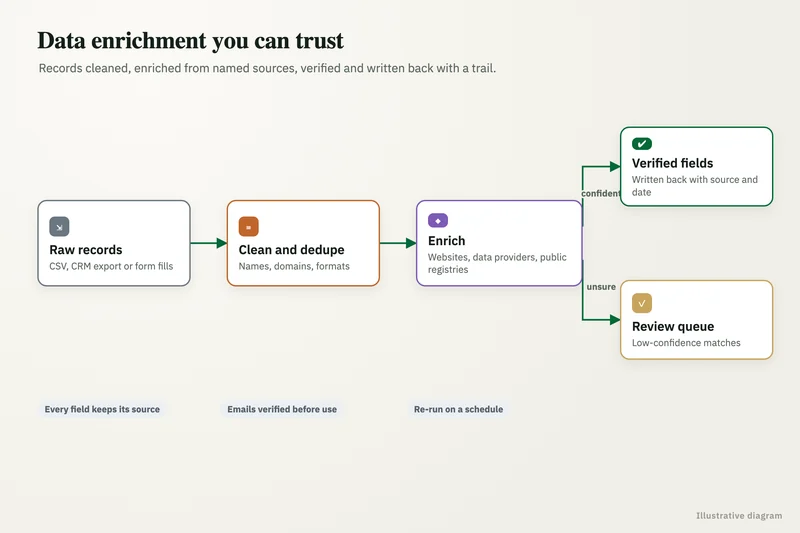
A pipeline picks up new or changed SKUs, gathers the source documents, extracts and validates the facts, and writes approved values back. This is the build we deliver as part of our data enrichment services, connected to the systems you already run.
Typical inputs are supplier price lists in Excel or CSV, spec sheets and certificates in PDF, manufacturer product pages and your existing store export. Typical destinations are Shopify, BigCommerce, Magento, a PIM such as Akeneo or Salsify, or a product table in your ERP. Supplier PDFs are often the hardest part, which is why the extraction step borrows from the same methods we use in AI document processing.
- Trigger: a supplier file lands in a shared folder, a new SKU appears in the store or PIM, or a scheduled refresh runs.
- Gather: the pipeline collects the matching supplier rows, PDFs and manufacturer pages for each SKU.
- Extract: a language model fills a fixed schema of attributes for that category and cites the source of each value.
- Validate: check digits, allowed values, units and ranges; duplicates and variant conflicts are flagged.
- Review: low-confidence or high-risk values wait in a queue (a sheet, an AppSheet app or the PIM's own workflow) for a person.
- Write back: approved values go to the store or PIM through its API, with the source and date stored beside each one.
- Report: fill rate, accuracy samples, cost per SKU and items waiting for review, updated daily.
What to send a provider before you ask for a quote
A precise brief is the fastest way to get comparable quotes and to stop scope arguments later. Send the same pack to every provider, whether it is an outsourced team, a tool vendor or an implementation partner.
When a provider cannot answer how they source, check and return values, that tells you more than their price. Our case studies include a sourcing and supplier quality consultancy where automated research plus the client's own screening rules cut supplier scouting time by 85%; the same pattern of sourced research and coded rules is what makes catalog enrichment checkable.
- A sample export of 100 to 200 SKUs across your hardest categories, plus the matching supplier files.
- The target field list per category, marked required or nice to have, and the channel each field feeds.
- Your category tree and any channel taxonomies you must map to (Shopify, Google, Amazon).
- Style rules: title pattern, units, allowed color names, banned claims.
- Accuracy thresholds per critical field and the review step you expect.
- Volume: backlog size and expected new SKUs per month.
- Where values must end up and who owns the accounts, prompts and code.
When should you not buy product data enrichment services?
Skip it, or wait, if the problem is upstream. If suppliers will send complete data in a template you define, fixing the supplier onboarding form is cheaper than enriching bad files forever. If your category tree is about to change, settle it first, or you will pay to classify everything twice.
A small, stable catalog of a few hundred SKUs that rarely changes is often best done once by your own team or a short outsourced job, with no tool or pipeline at all. And if no filter, feed or report reads a field, do not pay to fill it.
Common mistakes when outsourcing product data enrichment
Enrichment projects usually go wrong on scope and checking, not on technology. Each of the mistakes below can be prevented in the brief or the contract.
- Paying per SKU without defining which attributes count as done.
- Accepting generated descriptions that state facts not present in any source.
- Scoring a blended accuracy figure that hides one badly wrong critical field.
- Overwriting values the merchandising team corrected by hand.
- Enriching in a spreadsheet that never syncs back to the store or PIM.
- Ignoring new SKUs, so the catalog decays again within months.
Case study · Sourcing and supplier quality consultancy
Supplier scouting automation
Analysts found and filtered suppliers by hand on Google for every client brief. Two tools that find candidate suppliers and apply the client's screening rules automatically.
- 85% time saving
- 91% cost saving

FAQ
Frequently asked questions
What is the difference between product data enrichment and product data cleansing?
Cleansing fixes what is already in the record: duplicates, wrong units, inconsistent color names and broken variants. Enrichment adds facts that were never there, such as material, compatibility or a GTIN. Most catalogs need cleansing first, otherwise enrichment multiplies the inconsistencies.
Can AI enrich product data accurately?
Yes, when it extracts facts from real sources and cites them, rather than writing from the product name alone. Accuracy should be measured on a hand-checked sample of your own SKUs, field by field. Low-confidence values and anything touching safety or compliance should go to a person for approval.
How long does it take to enrich a product catalog?
It depends on SKU count, attributes per SKU and how hard the facts are to find. A custom pipeline usually spends most of its timeline on the field plan, the scored test sample and the write-back integration, after which batches run in hours. Ask every provider for the time to finish a scored 200-SKU sample before committing to the full catalog.
Should I outsource product data enrichment or do it in-house?
Outsource a one-off backlog or unusual products that need manual research. Keep it in-house, with a tool or a pipeline you own, when new SKUs arrive every week, because per-SKU outsourcing fees repeat while an owned pipeline mostly does not. Many teams combine both: automation for the bulk and people for review.
Which product attributes should I enrich first?
Start with the fields that something reads: storefront filters, required channel fields and the attributes shoppers use to rule products in or out. In Google Merchant Center that includes brand and GTIN or MPN; on Shopify it is the category metafields for each product category. Leave fields nothing uses for later.
Can product data enrichment write directly into Shopify or our PIM?
Yes. Approved values can be written through the Shopify Admin API, a PIM's API such as Akeneo or Salsify, or into an ERP product table. We store the source and date beside each value and protect fields your team edited by hand.
Do I need a PIM before enriching product data?
No. Smaller catalogs can be enriched straight into the store, with a spreadsheet or review app as the approval step. A PIM becomes worth it when several channels, languages or suppliers need one governed source of product truth.
Keep reading
Related pages
Get started
Tell us what you want automated
Describe the task, the systems involved and the volume. We reply within one business day with an architecture, the tools we would use, running costs and a fixed-price build plan.
- Free 30-minute build review
- Fixed quote before any work starts
- You own the accounts, code, prompts and data
Prefer email? info@aiimplementationconsultants.com
Get a free build plan
Two lines is enough to start.