

Buyer's guide
ChatGPT integration services: what to buy and how to judge a build
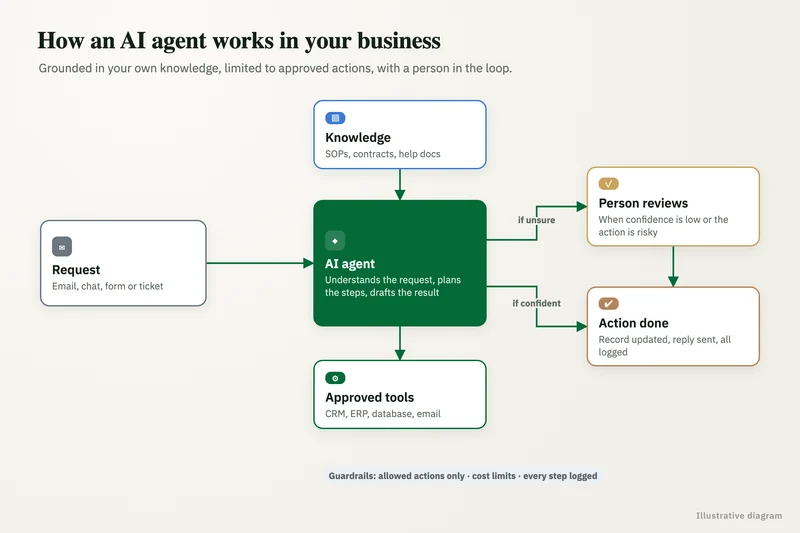
ChatGPT integration services connect OpenAI's models to the systems your business already runs, such as a CRM, help desk, ERP, inbox or document store, so the model reads real data, does a defined task and writes the result back with checks in place. This guide is for ops, sales, support and IT leads who know which job they want automated and are comparing vendors. It covers what a proper build includes, how to estimate the monthly API bill, which OpenAI data controls to switch on and the questions that separate a demo from a system that survives production.
Get a free build plan
Two lines is enough. A specialist replies within one business day.
Spec: quick answer
What do ChatGPT integration services include?
ChatGPT integration services include mapping the workflow, connecting OpenAI's API to your systems (CRM, ERP, help desk, documents), designing prompts and structured outputs, adding retrieval over your files, building a human-review step for uncertain results, testing on real examples, and setting up logging, cost caps and model-retirement plans. Good providers hand over code, prompts and accounts to you.
- Decide first whether you need ChatGPT seats, an API integration, or both.
- Most of the build effort sits in connecting systems and handling bad inputs, not the model call.
- OpenAI's API does not train on your data by default; confirm retention and residency settings anyway.
- Plan for model retirements: OpenAI shut down the Assistants API on August 26, 2026.
What are ChatGPT integration services, and how do they differ from buying ChatGPT?
Buying ChatGPT gives people a chat window; ChatGPT integration services build software that calls OpenAI's models without anyone typing a prompt. The ChatGPT app (Business or Enterprise) suits staff who draft, research and analyze. An API integration suits work that arrives on its own: a support ticket that needs classifying, a purchase order PDF that needs keying into an ERP, a lead that needs researching and scoring before it reaches a rep.
Many companies need both, and confusing the two is the most common scoping mistake we see. If your goal is staff productivity, read our ChatGPT Enterprise implementation guide. If your goal is a process that runs by itself and updates your systems, you are buying an integration, and the rest of this page applies.
| Option | What you get | Best for | What it will not do |
|---|---|---|---|
| ChatGPT Business or Enterprise seats | The ChatGPT app for staff, with admin controls and connectors to company files | Drafting, research, analysis and ad hoc questions by people | Run unattended on a trigger, enforce your business rules, or write reliably into a CRM or ERP |
| No-code integration (Zapier, Make, n8n) | An OpenAI step inside a workflow tool, wired to your apps' triggers and actions | Simple, low-volume flows: summarize a form, tag an email, draft a reply | Complex validation, large documents, strict audit needs or heavy volume without careful design |
| Custom API integration | Code or a self-hosted workflow calling OpenAI's Responses API, with retrieval, validation, review queues and logging | High-volume, repeatable work that touches money, customers or regulated data | Look after itself; it needs an owner, tests and monitoring |
What should a ChatGPT integration service include?
A complete engagement covers the work around the model as carefully as the model call itself. When we compare our own scope with vendor pages that rank for this phrase, the pieces most often missing are evaluation, review queues and a plan for when OpenAI retires a model. Use this list as a checklist when you read proposals.
- Workflow map: the trigger, the inputs, the fields that must be filled, and what counts as done.
- System access: API credentials or service accounts for HubSpot, Salesforce, Zendesk, NetSuite, QuickBooks, SharePoint or Google Drive, with least-privilege permissions.
- Prompt and schema design: instructions plus structured outputs, so the model returns fields your code can validate.
- Retrieval: searching your own documents (with citations) when answers must come from your policies, price lists or manuals.
- Evaluation set: 50 or more real past cases with known correct answers, rerun after every prompt or model change.
- Human review: a queue where low-confidence or high-impact results wait for a person.
- Operations: prompt and output logging, a cost cap per task, alerts, retries, a rollback path and a kill switch.
- Handover: code, prompts, evaluation set and runbook in your repositories, with model and hosting bills in your own accounts.
Which OpenAI API should a new integration use?
New builds should use OpenAI's Responses API. OpenAI's deprecations page records that the Assistants API was deprecated on August 26, 2025 and shut down on August 26, 2026, with the Responses API and Conversations API named as the replacements. If a vendor built your existing assistant on the Assistants API and has not migrated it, that work is now overdue.
Model retirements are a recurring maintenance task, not a one-off. On October 14, 2026, OpenAI announced that an older family of models will shut down on January 14, 2027. Any integration pinned to those models needs a new model selected, the evaluation set rerun and the prompts adjusted before that date. A good provider budgets for this in the support plan and tells you which models each workflow depends on.
How much do ChatGPT integration services cost to run each month?
The running cost of a ChatGPT integration is mostly per-token model usage, so you can estimate it from your own volumes before you sign anything. The build is a separate one-time cost that depends on how many systems are connected and how strict the accuracy bar is; our AI implementation cost guide collects published third-party ranges for that.
Here is how to estimate the monthly API bill, using illustrative volumes rather than a client result. Say a support team wants every incoming ticket classified, tagged and given a draft reply, at 6,000 tickets a month. During testing you log the tokens each ticket actually uses: the instructions, the ticket text, any retrieved help articles and the output. Multiply average input tokens and output tokens by OpenAI's current published per-token rates for the model you choose, then by 6,000. Add a margin for retries and for the longer tickets that pull more context.
Two levers change the result a lot. Model routing sends easy classification to a smaller, cheaper model and reserves a larger one for drafting. Batching helps work that does not need an instant answer: OpenAI's Batch API documentation states a 50% cost discount compared with synchronous calls, with results returned within 24 hours. Nightly jobs such as enriching CRM records or summarizing yesterday's calls are good candidates.
- Model usage: input and output tokens per task, times monthly volume.
- Retrieval: vector database storage and queries if the integration searches your documents.
- Workflow and hosting: a self-hosted n8n server, a Make or Zapier plan, or cloud functions.
- Upkeep: prompt changes, new fields and model migrations when OpenAI retires a model.
Is our data safe in a ChatGPT API integration?
OpenAI's API has stricter defaults than many buyers assume, but you still need to choose settings deliberately. OpenAI's data controls documentation states that data sent to the API is not used to train or improve its models unless you explicitly opt in. It also says abuse monitoring logs are kept for up to 30 days, and that eligible endpoints, including the Responses and Chat Completions endpoints, can run under zero data retention for approved customers.
Data residency is available in several regions, which OpenAI lists as including the United States, Europe, Canada, the United Kingdom, Japan and Australia. For protected health information, OpenAI's documentation describes a Business Associate and Healthcare Addendum, after which BAA-eligible endpoints can process PHI on an appropriately provisioned organization. Consumer ChatGPT plans are not the place for PHI. This is not legal advice; confirm the terms on your own contract.
- Use an API organization and project you own, not the vendor's, so keys, logs and invoices belong to you.
- Redact or tokenize fields the model does not need, such as full card numbers or Social Security numbers.
- Treat text inside emails, tickets and PDFs as data, never as instructions, to blunt prompt injection.
- Keep a person in the loop on anything touching money, customers or regulated data.
How long does a ChatGPT integration take?
A single, well-defined workflow is usually weeks, while a multi-system program is months. ClickIT's guide to ChatGPT integration estimates 1-2 weeks for a basic API integration, 2-4 weeks for middleware work and 4-8 weeks for a full-stack build. Softude's 2026 guide is more conservative about full projects, putting one AI use case at 3-5 months once discovery, rollout and adoption are included.
The gap between those figures is mostly testing and change management. Wiring the API takes days; proving the output is right on several hundred real inputs, building the review screen and getting a team to trust it takes longer. We prefer to ship one workflow, compare it with the old process for a few weeks, then decide on the next with real numbers.
Should you hire a ChatGPT integration company or build in-house?
Build in-house if you have engineers with spare time who will own the system for years; hire if you need it live and stable sooner. Outside help has a measurable track record here: MIT NANDA reported in July 2025 that generative AI projects bought from or built with specialist partners succeeded about 67% of the time, against about 33% for internal builds.
A hybrid often works best. A partner designs and ships the first workflow with your engineers alongside, then hands over the code, evaluation set and runbook. Your team runs it and the partner stays on call for model migrations and new workflows.
How do you choose among ChatGPT integration services providers?
Judge providers on how they handle failure, cost and ownership, because demos all look alike. Ask each one the questions below and compare written answers.
We scope every integration after a free review of a real sample, quote a fixed price, and leave you owning the code, prompts, data and OpenAI account. Our AI integration services page shows how we deliver, and our AI chatbot for business page covers assistants grounded in your documents.
- Which OpenAI API and models will you use, and what is the plan when one is retired?
- What is the estimated cost per task, and is there a hard cap per task and per month?
- How many of our real examples will you test on, and what accuracy will you report?
- What happens to an input the model is unsure about, and who sees it?
- Whose OpenAI organization, cloud account and repositories will this live in?
- Which data leaves our systems, and which retention and residency settings will you enable?
- When would you advise us not to build this?
When should you not buy ChatGPT integration services?
Skip a custom integration when an existing feature already does the job. HubSpot, Salesforce, Zendesk and QuickBooks all ship their own AI features, and a native option that covers 80 percent of the need is often better value than a build that covers all of it. Our platform guides, such as the HubSpot and Salesforce AI integration guides, compare native features with custom work.
Also hold off when you cannot measure the current process. If nobody knows how long a task takes today or how often it goes wrong, measure it for two weeks first. And if the work is rare, a few times a month, a person using ChatGPT seats will usually beat an integration on cost.
FAQ
Frequently asked questions
How much does ChatGPT integration cost?
There are two parts: a one-time build and a monthly running cost. Running cost is mostly OpenAI's per-token charges multiplied by your volume, plus hosting and any workflow tool plan. Build cost depends on the number of systems connected and the accuracy required, so scope one workflow before comparing quotes.
Does OpenAI train on data sent through the API?
Not by default. OpenAI's data controls documentation says data sent to the API is not used to train or improve its models unless you opt in. Abuse monitoring logs are kept for up to 30 days, and eligible customers can apply for zero data retention on supported endpoints.
Can ChatGPT integrate with our CRM or ERP?
Yes. An integration calls OpenAI's API from code or a workflow tool, reads records from systems such as Salesforce, HubSpot, NetSuite or QuickBooks, and writes results back through their APIs. Validation rules and a review step keep uncertain or high-impact changes from posting automatically.
Is ChatGPT HIPAA compliant for business use?
Only under the right agreement and setup. OpenAI's documentation describes a Business Associate and Healthcare Addendum, after which BAA-eligible API endpoints can process PHI on a provisioned organization. Consumer ChatGPT plans should not be used for PHI. This is not legal advice.
What happened to the OpenAI Assistants API?
OpenAI deprecated the Assistants API on August 26, 2025 and shut it down on August 26, 2026. Its deprecations page names the Responses API and Conversations API as replacements, so new integrations should use those and older ones need migrating.
Is Zapier or Make enough for a ChatGPT integration?
For simple, low-volume flows such as summarizing form submissions or tagging emails, often yes. Once you need large documents, strict validation, review queues, detailed logs or high volume, a self-hosted n8n workflow or custom code is usually easier to control and cheaper to run.
Who owns the code and prompts after a ChatGPT integration project?
That depends on the contract, so ask before you sign. We put the code, prompts, evaluation set and OpenAI account in your name from the start, so you can change providers or bring the work in-house without rebuilding.
Keep reading
Related pages
Get started
Tell us what you want automated
Describe the task, the systems involved and the volume. We reply within one business day with an architecture, the tools we would use, running costs and a fixed-price build plan.
- Free 30-minute build review
- Fixed quote before any work starts
- You own the accounts, code, prompts and data
Prefer email? info@aiimplementationconsultants.com
Get a free build plan
Two lines is enough to start.