

Buyer guide
How to choose an AI implementation partner that ships to production
An AI implementation partner is the outside team that builds an AI workflow, connects it to your systems and keeps it running after launch, so choosing one comes down to proof of production work, a fixed and specific scope, and a contract that leaves you owning everything. This guide is for ops, sales, support and IT leads who already know which workflow they want automated and now have to pick who builds it. It covers partner types and published rates, the questions that separate builders from demo shops, a scoring sheet, and the contract terms worth insisting on.
Get a free build plan
Two lines is enough. A specialist replies within one business day.
Spec: quick answer
How do you choose an AI implementation partner?
Choose an AI implementation partner by asking for evidence of systems running in production, a written scope with test cases and a definition of done, a named plan for integration with your CRM or ERP, and a contract where you own the code, prompts, accounts and data. Then compare quotes on the same scope, not on hourly rates.
- Judge partners on live systems they run today, not on demos or slide decks.
- Give every vendor the same scope and sample inputs so quotes are comparable.
- Insist on owning the code, prompts, model accounts and data from day one.
- A partner that never says no to scope is a risk, not a convenience.
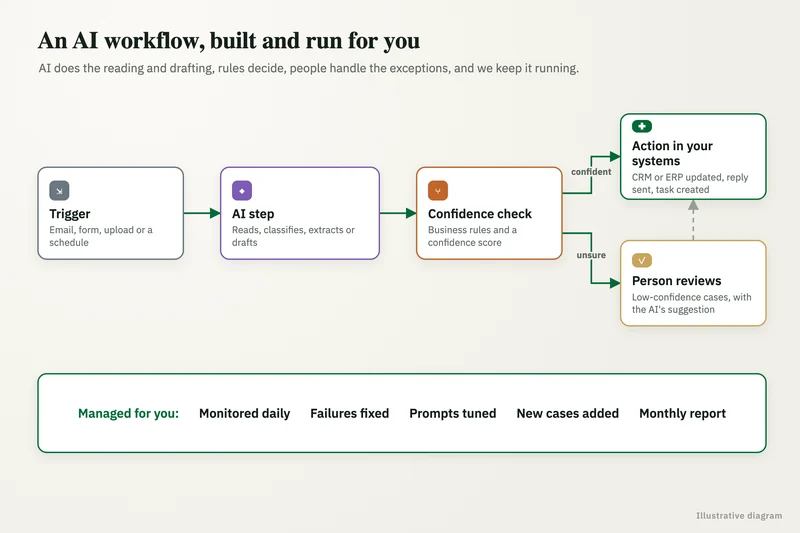
What does an AI implementation partner do?
An AI implementation partner turns a defined use case into a working system inside your business. That means data access, prompts and retrieval, structured outputs, integration with tools such as HubSpot, Salesforce, NetSuite or SharePoint, a human-review queue for uncertain cases, monitoring, and support once real users depend on it.
This is different from an advisor who helps you decide what to do with AI. An implementation partner starts once the workflow is known and is judged on one thing: whether the system works on your real inputs, every day, at a cost you expected. The choice matters. MIT NANDA reported in its 2025 study that projects bought from or built with specialist partners succeeded about 67% of the time, against about 33% for internal builds. A partner is not a guarantee, but the gap shows how much delivery experience counts.
- Discovery: mapping the current process, systems, fields and exceptions.
- Build: prompts, retrieval over your documents, validation rules and output schemas.
- Integration: authenticated read and write access to the systems the workflow touches.
- Evaluation: a test set of real inputs with known answers, rerun after every change.
- Run: logging, alerts, cost caps per task and a rollback path.
Which type of AI implementation partner fits your project?
Partner types differ more in how they work than in which models they use. Freelancers are cheapest for one narrow build but carry key-person risk. Specialist agencies cover build and integration with a small senior team. Mid-market and Big Four firms bring program management and compliance depth at a much higher rate. Offshore development shops on directories can be inexpensive per hour but often need tighter scoping from you.
The figures below are published third-party market references, not our prices. Use them to sanity-check quotes, and remember that Clutch's average describes broad development projects, while a single, tightly scoped workflow usually costs well below it.
| Partner type | Best fit | Watch out for | Published figure |
|---|---|---|---|
| Freelance AI developer | One narrow workflow, one system | Key-person risk, thin testing, no support cover | Softude (2026): $150-300/hr, projects $10k-35k |
| Specialist AI agency | One to three workflows with CRM or ERP integration | Agencies that resell one platform for every problem | Softude (2026): $150-350/hr, projects $25k-150k |
| Mid-market consulting firm | Multi-department programs, formal change management | Long discovery phases before anything ships | Softude (2026): $250-500/hr, projects $50k-250k+ |
| Big Four or top strategy firm | Enterprise-wide programs, board-level governance | Junior staff doing the build after senior staff sell it | Softude (2026): $500-1,000+/hr, projects $200k-1M+ |
| Directory-listed dev shop | Clear specs, internal product owner available | Time-zone gaps, scope drift, weak integration testing | Clutch (Sept 2026): mostly $24-49/hr; average project about $120,000 over about 10 months |
What questions should you ask an AI implementation partner?
Good questions force a partner to describe how they work, not what they believe. Ask every candidate the same ten, in writing, and compare the answers side by side. Vague answers to questions three, five and nine are the clearest warning you will get before signing.
- 1. Which systems like ours have you connected, and is any of that work running in production today?
- 2. What will you need from us in week one: credentials, sample files, a process owner, test users?
- 3. How will you measure accuracy before launch, and what accuracy are you committing to?
- 4. What happens when the model is unsure? Show us the human-review step.
- 5. Who owns the code, prompts, workflows, model accounts and data when the project ends?
- 6. Which model and platform do you propose, and why that one for this workflow?
- 7. How do you cap and report running costs per task or per minute?
- 8. Who exactly will build it, and will those people still be on it after launch?
- 9. What is out of scope, and how are change requests priced?
- 10. What does support cost after go-live, and what happens if a vendor retires the model we use?
How do you score and compare AI implementation partners?
A weighted scorecard stops the most polished pitch from winning by default. Score each partner from 1 to 5 on the criteria below, multiply by the weight and add up. We weight production evidence and ownership terms highest, because those are the two things that are hardest to fix after you sign.
Run the scorecard after each partner has seen the same sample inputs. A partner who asks for your messiest files, scanned PDFs, duplicate CRM records or calls with background noise, is usually the one who has shipped before.
| Criterion | Weight | What a 5 looks like |
|---|---|---|
| Production evidence | 25% | Shows a live system or detailed results with similar inputs and integrations |
| Scope and test plan | 20% | Written definition of done, a test set and an accuracy target per field or intent |
| Integration depth | 15% | Names the APIs, auth method, field mapping and error handling for your systems |
| Ownership and exit terms | 15% | You own code, prompts, workflows, accounts and data; documented handover |
| Running cost control | 10% | Cost per task estimate, caps, usage logs and monthly reporting |
| Team and support | 10% | Named builders, response times after launch, model-change plan |
| Price clarity | 5% | Fixed price for a defined scope, with change requests priced up front |
Worked example: comparing two AI implementation quotes
Here is an illustrative comparison, with made-up vendors and round numbers, of the kind we help buyers untangle. The workflow: read supplier invoices from a shared inbox, extract header and line items, match them to purchase orders in NetSuite and queue exceptions for an AP clerk.
Partner A quotes $18,000 at $90 per hour for 200 hours. The proposal says "invoice automation with AI", lists no accuracy target, and the build runs inside the partner's own automation account. Partner B quotes $32,000 fixed. The proposal lists the fields to extract, a 300-invoice test set, a target of 95% field accuracy on typed PDFs with everything else routed to review, two-way NetSuite integration with duplicate checks, and handover of the workflows and model account to the client.
Partner A looks 44% cheaper. But Partner A's scope leaves out the NetSuite write-back, testing and exception handling, which is where most of the effort in an AP build sits. If those land as change requests at the same hourly rate, Partner A can end up costing more, and the client still does not own the account the system runs in. The lesson: normalise scope first, then compare price.
What should an AI implementation partner's proposal include?
A good proposal reads like a build plan, not a brochure. If any of the items below is missing, ask for it in writing before you compare prices, because each one is a place where cost or risk can hide.
- The trigger, inputs, decisions and outputs of the workflow, in plain language.
- Every system touched, with read or write access and the fields involved.
- A test set built from your real data and the accuracy or resolution target it must meet.
- The human-review rule: which confidence threshold or condition sends work to a person.
- Estimated running cost per task or per minute and how it is capped.
- Milestones with acceptance criteria and the payment attached to each.
- What is out of scope, and the price of change requests.
- Handover: documentation, credentials, recorded walkthroughs and the support term.
What are the red flags when hiring an AI implementation company?
Most bad engagements announce themselves early. Gartner predicted in June 2025 that over 40% of agentic AI projects will be canceled by the end of 2027 because of cost, unclear value or weak risk controls, and it warned buyers about "agent washing". The warning signs below map closely to those causes.
- A demo on clean sample data, with no request to see your real inputs.
- No accuracy target, or a promise of 100% accuracy.
- The system will run in the partner's accounts, with your access by request only.
- Every problem gets the same platform, whatever the workflow.
- No mention of what happens when the model is wrong or unsure.
- Hourly billing with no cap and no defined deliverable.
- The people on the sales call are not the people who will build it.
- An "agent" that turns out to be a fixed script with a chat window.
Which contract terms protect you with an AI implementation partner?
Ownership and exit terms matter more in AI work than in ordinary software, because prompts, evaluation sets and workflow logic are the product. If they sit in a vendor's account, you cannot fix, move or audit the system without that vendor.
Ask for these terms in the statement of work: you own all code, prompts, workflows and evaluation sets; model, telephony and hosting accounts are opened in your name and billed to you; credentials are handed over at each milestone; payments are tied to acceptance tests, not dates; and the support term states response times and what happens when a model provider retires a model. Where regulated data is involved, the contract should name every subprocessor and confirm a Business Associate Agreement where protected health information is handled. This is not legal advice; have counsel review the final terms.
When should you not hire an AI implementation partner?
Skip the partner when an off-the-shelf product already does the job. If a packaged tool covers the workflow inside the systems you use, with acceptable accuracy and pricing, buy it and spend your effort on adoption.
Also wait if you cannot yet describe the workflow, the baseline or who owns the result. A partner can build almost anything, but without a measured starting point, minutes per task, volume per month and error rate, nobody can show that the build paid back. Measure for two weeks first. And if you have an internal engineering team with spare capacity and AI experience, a short review from an outside builder may be all you need.
How we work as an AI implementation partner
We are an AI implementation partner for US companies, delivering remotely in US time zones. We start with a free review of the workflow, the systems it touches and a sample of real inputs, then quote a fixed price for a defined scope with test cases and acceptance criteria.
You own the accounts, code, prompts and data from day one, and a person stays in the loop on anything that touches money, customers or regulated data. Our case studies include a sourcing and supplier quality consultancy where two tools that find candidate suppliers and apply the client's screening rules delivered an 85% time saving and a 91% cost saving on supplier scouting. If you want to see how we scope, budget and phase a build, read our cost and roadmap guides, or book a free review.
Case study · Sourcing and supplier quality consultancy
Supplier scouting automation
Analysts found and filtered suppliers by hand on Google for every client brief. Two tools that find candidate suppliers and apply the client's screening rules automatically.
- 85% time saving
- 91% cost saving

FAQ
Frequently asked questions
What is the difference between an AI consultant and an AI implementation partner?
An AI consultant mainly advises on strategy, use cases and governance. An AI implementation partner builds the system, connects it to your CRM, ERP or document stores, tests it on real data and supports it after launch. Many buyers need a little of both, but the contract should be clear about which one they are paying for.
How much does an AI implementation partner cost?
Published ranges are wide. Softude's 2026 guide puts specialist AI agency projects at $25k-150k and freelance projects at $10k-35k, while Clutch reports an average AI development project of about $120,000. A single, tightly scoped workflow usually sits toward the lower end, plus monthly running costs.
How long does it take an AI implementation partner to deliver?
Softude's 2026 guide says one use case typically takes 3-5 months and multi-department rollouts 6-12+ months. Narrow scope shortens this: one trigger, one or two connected systems and a clear definition of done move far faster than a multi-team program.
Should we build AI in-house or use a partner?
Use a partner when you lack engineers with production AI and integration experience, or need the system live soon. MIT NANDA reported in 2025 that partner-built projects succeeded about twice as often as internal builds. Build in-house when AI is core to your product and you can staff and maintain it long term.
Who should own the code and prompts after an AI project?
You should. Ask for code, prompts, workflows, evaluation sets and every vendor account to be in your name and handed over at each milestone. Without that, you cannot change, audit or move the system without the original partner.
Can an AI implementation partner guarantee results?
No honest partner guarantees outcomes, because results depend on your data, volumes and adoption. What a partner can commit to is a measurable accuracy target on an agreed test set, a human-review path for uncertain cases and acceptance tests tied to payment.
What should we prepare before talking to AI implementation partners?
Write a one-page description of the workflow, list the systems involved, gather 50 to 300 real sample inputs including messy ones, and measure the current baseline: minutes per task, monthly volume and error rate. This lets every partner quote the same scope.
Keep reading
Related pages
Get started
Tell us what you want automated
Describe the task, the systems involved and the volume. We reply within one business day with an architecture, the tools we would use, running costs and a fixed-price build plan.
- Free 30-minute build review
- Fixed quote before any work starts
- You own the accounts, code, prompts and data
Prefer email? info@aiimplementationconsultants.com
Get a free build plan
Two lines is enough to start.